


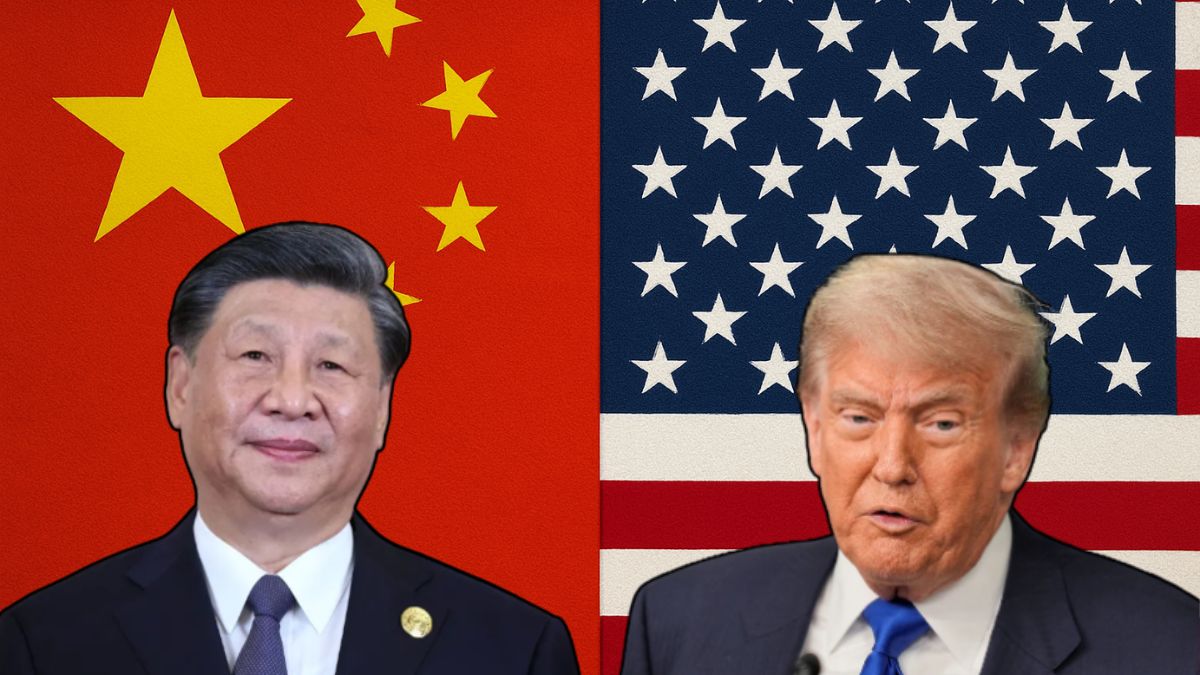
A classified US defence assessment has issued one of the starkest warnings yet about Washington’s military vulnerability in a potential conflict with China over Taiwan.
The document, known as the “Overmatch Brief” and prepared by the Pentagon’s influential Office of Net Assessment, concludes that China could destroy key American assets, including fighter jets, carriers, and satellites, and ultimately defeat US forces in a Taiwan showdown, American media platforms reported.
What does the Pentagon assessment say about the Taiwan war?
The assessment highlights a widening strategic gap: while the United States remains dependent on “expensive, vulnerable” platforms such as next-generation aircraft and Ford-class carriers, China is fielding cheaper, resilient, and technologically sophisticated systems designed to overwhelm those assets.
One senior national security official who reviewed the document in 2021 reportedly turned “pale,” realising that “every trick we had up our sleeve, the Chinese had redundancy after redundancy.”
The report also details critical US supply-chain vulnerabilities and warns that Volt Typhoon, a China-backed cyber group, has infiltrated American infrastructure networks powering military bases—potentially crippling US mobilisation during a Pacific crisis.
Why is the assessment a worry for the US?
The revelations come amid a sharp escalation of military activity in East Asia. Beijing recently warned it would “crush” all foreign interference in the Taiwan issue, reiterating its claim that the island is an inseparable part of China.
Taiwan, for its part, insists only its 23 million people can decide their future, with Premier Cho Jung-tai stating that a “return” to China is not an option.
What is the current regional stand-off between China and the US?
Against this tense backdrop, the United States and Japan launched major joint air exercises this week, hours after Chinese and Russian bombers conducted coordinated patrols circling Japan.
Tokyo scrambled fighter jets as two Russian Tu-95s linked up with two Chinese H-6 bombers in a show of strategic alignment between Moscow and Beijing.
Japan said the bilateral drill with the US Air Force was held to reaffirm readiness amid “an increasingly severe security environment.” The exercise featured US B-52 bombers flying alongside Japanese F-35s and F-15s, signaling deepening cooperation between the two allies.
How is the present trouble testing regional peace?
The US-Japan partnership is also being tested by a provocative incident over the weekend, when Chinese J-15 fighters from the carrier Liaoning twice locked fire-control radar onto Japanese jets near Okinawa, an action Washington condemned as “not conducive to regional peace.”
Tokyo summoned China’s ambassador as Beijing counter-accused Japan of “intruding” into a Chinese training zone.
Japanese Prime Minister Sanae Takaichi’s recent comments suggesting Japan could intervene militarily in a Taiwan conflict have further angered Beijing, which views any foreign involvement as a direct challenge to its sovereignty claim.
What was NATO’s response to the latest flashpoint?
NATO Secretary-General Mark Rutte, in a call with Japan’s Defence Minister Shinjiro Koizumi, described the Chinese-Russian patrols and radar incident as “regrettable,” underscoring growing global concern that Indo-Pacific and Euro-Atlantic security are now “inseparable.”
With South Korea also scrambling jets in response to Chinese-Russian flights through its air defence zone, the region’s security environment is fast approaching a boiling point, just as the Pentagon’s own confidential assessment warns that the US may not be ready for what comes next.