


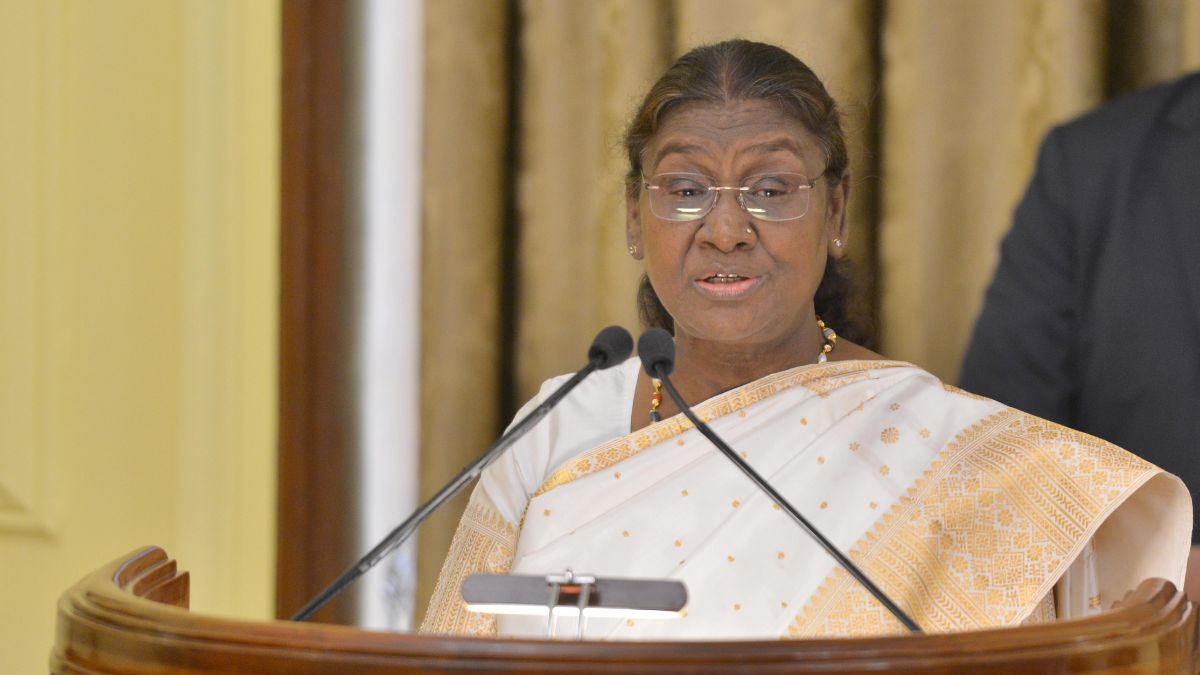
President Droupadi Murmu will embark on a 6-day state visit to Angola and Botswana from Saturday, November 8 to 13, marking the first-ever visit by an Indian head of state to both nations. The Ministry of External Affairs (MEA) said the visit reflects India’s growing engagement with the Global South, especially Africa, across political, economic, developmental, defence, and cultural dimensions.
MEA Secretary (Economic Relations) Sudhakar Dalela emphasised that the visit underscores New Delhi’s priority to strengthen partnerships in the African continent, with a focus on energy, defence, trade, and sustainability.
President Murmu’s Africa visit: What’s on the agenda?
President Murmu will begin her visit in Angola from November 8–11, at the invitation of President João Lourenço. She will hold bilateral talks, attend the 50th anniversary celebrations of Angola’s independence on November 11, address the Angolan Parliament, and interact with the Indian community.
During the visit, both sides are expected to expand cooperation in defence and energy, two critical areas that have become central to India–Angola relations. India already maintains a $ 5 billion trade volume with Angola, with nearly 80% tied to the energy sector.
How is India Strengthening its defence and energy ties with Angola?
India is preparing to extend a $200 million Line of Credit (LoC) to Angola to help modernise its defence forces. Discussions are in the final stages, according to Dalela, who noted that the initiative aligns with Angola’s requirements and India’s commitment to defence cooperation with the Global South.
In May 2025, Prime Minister Narendra Modi had announced the approval of this credit line during Angolan President Lourenço’s visit to India. The partnership aims to boost industrial cooperation, defence training, and security capacity building.
On energy, Dalela highlighted that Angola is already a key partner in India’s energy security, and the upcoming visit would “add momentum and depth” to this cooperation, particularly in renewable and sustainable sectors.
What are India’s broader goals in Botswana?
In the second leg of the trip, from November 11 to 13, President Murmu will visit Botswana at the invitation of President Duma Gideon Boko. The focus will be on expanding cooperation in trade, investment, technology, agriculture, health, pharmaceuticals, and defence.
Murmu will also address the National Assembly of Botswana, visit cultural and historical sites, and review ongoing collaboration under Project Cheetah, which involves the translocation of cheetahs from Botswana to India as part of a larger wildlife restoration effort.
How is defence cooperation evolving with Botswana?
India shares a longstanding defence partnership with Botswana, even one of the oldest in Africa. For nearly three decades, an Indian training team has worked closely with the Botswana Defence Forces, reflecting deep trust and collaboration. Dalela highlighted that India also supports defence training under the Indian Technical and Economic Cooperation (ITEC) Programme, which has trained over 750 professionals and officers from Botswana in the past decade.
Beyond defence and energy, India is exploring collaboration in critical minerals, a sector vital for India’s National Critical Minerals Mission and energy transition. “We would like to work with our African partners through joint ventures, especially for minerals linked to sustainability and electric vehicles,” Dalela said.
India is also open to future partnerships in cybersecurity, with discussions expected to evolve as ties deepen.
How does President Murmu’s visit fit into India’s Africa strategy?
The MEA said President Murmu’s visit should be seen as part of the broader Indian vision to deepen engagement with Africa, particularly through the Global South framework. India’s growing presence in Africa now spans capacity building, digital public infrastructure, renewable energy, and mineral cooperation.
By strengthening ties with Angola and Botswana, India aims to advance its strategic, economic, and environmental diplomacy, while also reinforcing people-to-people connections, a key pillar of India’s outreach to the African continent.