


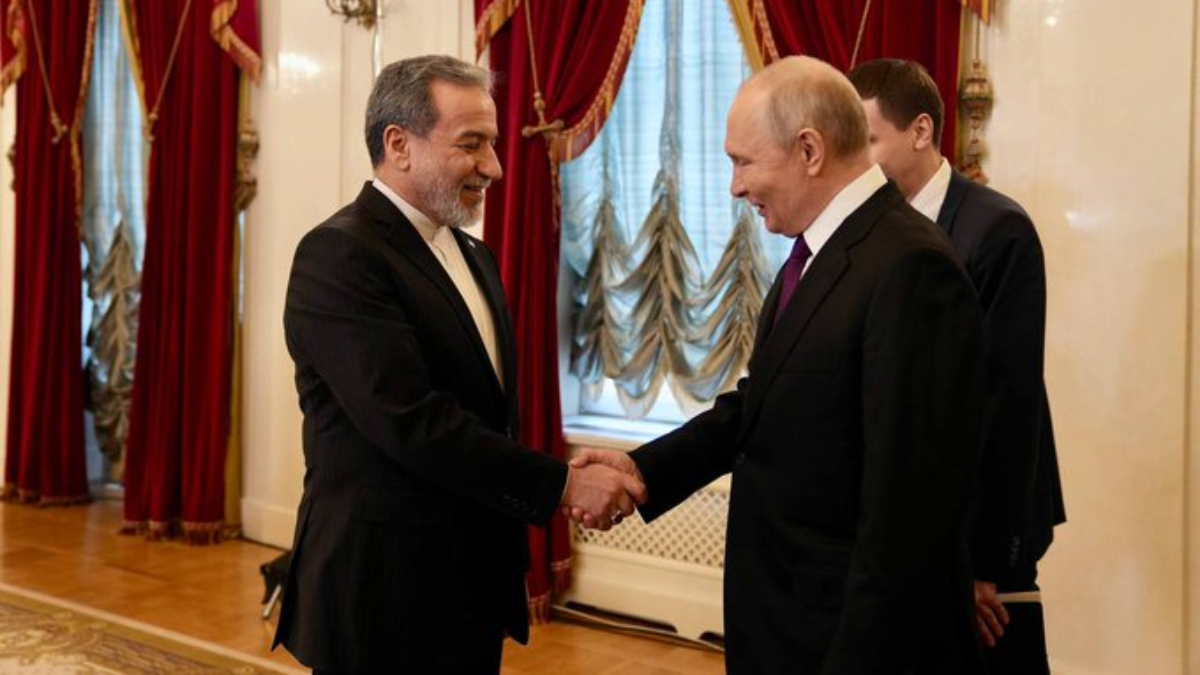
Russian President Vladimir Putin on Monday (April 27, 2026) met Iranian Foreign Minister Abbas Araghchi in St. Petersburg when the former offered support to Tehran, saying he was hoping for peace in West Asia soon and that Iran would navigate the “difficult period of war.”
Araghchi responded by hailing the “strategic partnership between Iran and Russia but blaming the US for the failure of the first round of peace talks mediated by Pakistan in Islamabad two weeks ago.
Araghchi landed in Moscow after talks with leaders of Pakistan and Oman, during visits to those nations as part of a diplomatic outreach to convey Iran’s position on the West Asian war and peace talks.
“For our part, we will do everything that serves your interests, the interests of all the people of the region, so that peace can be achieved as soon as possible,” Putin told Araghchi during their meeting.
Moscow, an ally of Tehran, had so far distanced itself from the West Asian conflict, as it continues to focus on the full-scale war against Ukraine, and this was the first direct expression of support to Iran in its conflict with the US and Israel that began on February 28.
Meanwhile, US media houses reported that Iran had offered a deal to the US to reopen the blockaded Strait of Hormuz over the weekend, while Tehran wanted nuclear negotiations to be postponed to a later date.
US President Donald Trump seemed to acknowledge the Iranian proposal when a White House spokesperson told another US publication on Saturday (April 25) that the “US holds the cards” in the negotiations with Iran.
Iranian media platforms claimed the efforts were still progressing for scheduling the second round of peace talks with the US, to be mediated again by Pakistan, and the venue of the negotiations could be Islamabad. Iran is believed to have sent such messages to the US through Pakistan, which was visited by Araghchi last week.
The White House said the US national security leadership had discussed the Iranian talks proposal on Monday (April 27). “I don’t want to get ahead of the president or his national security team,” said White House spokeswoman Karoline Leavitt.
“What I will reiterate is that the president’s red lines with respect to Iran have been made very, very clear, not just to the American public, but also to them as well.”
In Moscow, Araghchi said, “The US approaches caused the previous round of negotiations, despite progress, to fail to reach its goals because of the excessive demands.” He also said that “safe passage through the Strait of Hormuz is an important global issue.”
Last week, Trump had cancelled his envoys’ trip to Islamabad for a meeting with the Araghchi-led Iranian team after the latter left Pakistan for Oman without waiting for the American delegation to arrive for the talks.
Meanwhile, the US forces in the Gulf region intensified their naval blockade of Iranian ports, claiming to have turned back 38 vessels that were either entering or exiting Iran.