


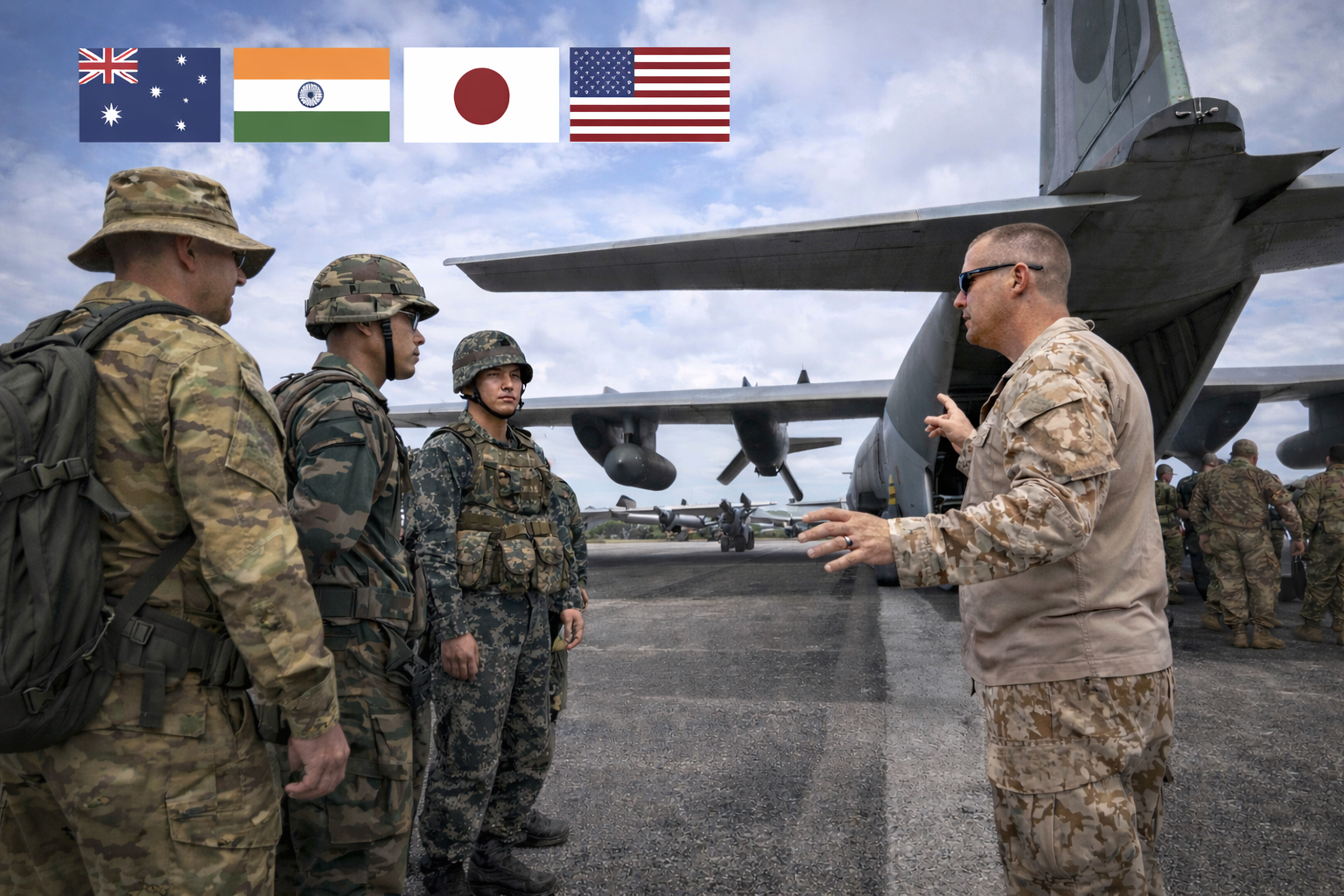
Quad partners Australia, India, Japan and the United States (US) have concluded their first Field Training Exercise (FTX) under the Quad Indo-Pacific Logistics Network (IPLN), aimed at strengthening coordinated disaster response capabilities across the Indo-Pacific region.
The exercise was conducted from December 8 to December 12 at Andersen Air Force Base in Guam, on the sidelines of Operation Christmas Drop, marking a shift from planning-level coordination to practical, on-ground cooperation.
What is the Quad Indo-Pacific Logistics Network?
The Indo-Pacific Logistics Network is a Quad initiative designed to enable the four partner countries to leverage shared logistics capabilities to support civilian response to large-scale natural disasters across the Indo-Pacific.
The framework focuses on faster and more efficient delivery of humanitarian assistance, helping save lives, accelerate recovery efforts, and provide timely support to regional partners affected by natural calamities.
What did the Field Training Exercise involve?
The FTX focused on improving interoperability and coordination among Quad partners through practical training activities. As part of the exercise, personnel conducted joint logistics and airlift-related drills, including boarding a Japan Air Self-Defense Force (JASDF) C-130H transport aircraft.
According to the Quad partners, the training enhanced shared understanding of procedures, coordination mechanisms, and operational integration required for effective disaster response.
Why is this exercise significant?
This was the first field-level exercise conducted under the IPLN framework, moving beyond conceptual planning to hands-on training. The FTX built on the IPLN Tabletop Exercise (TTX) conducted in April, which focused on scenario-based coordination and planning.
Together, the tabletop and field exercises demonstrate the Quad’s emphasis on practical cooperation and readiness to address regional challenges, particularly in the humanitarian assistance and disaster relief domain.
How does this align with the Quad’s broader objectives?
The Quad partners said the exercise reflects their shared commitment to strengthening cooperation in support of a free, open and inclusive Indo-Pacific region. Enhancing coordinated disaster response is viewed as a key component of supporting regional stability and resilience.
While the IPLN is focused on civilian humanitarian assistance, the emphasis on logistics coordination and interoperability aligns with the Quad’s broader goal of building capacity to respond collectively in moments of regional need.
What are the next steps for the IPLN?
The Quad partners indicated that they plan to explore regular IPLN activities in the future. These may include additional tabletop and field training exercises, confidence-building measures, and subject matter expert exchanges.
Such activities are intended to institutionalise logistics cooperation and ensure that the IPLN remains effective and responsive to emerging humanitarian challenges across the Indo-Pacific.