


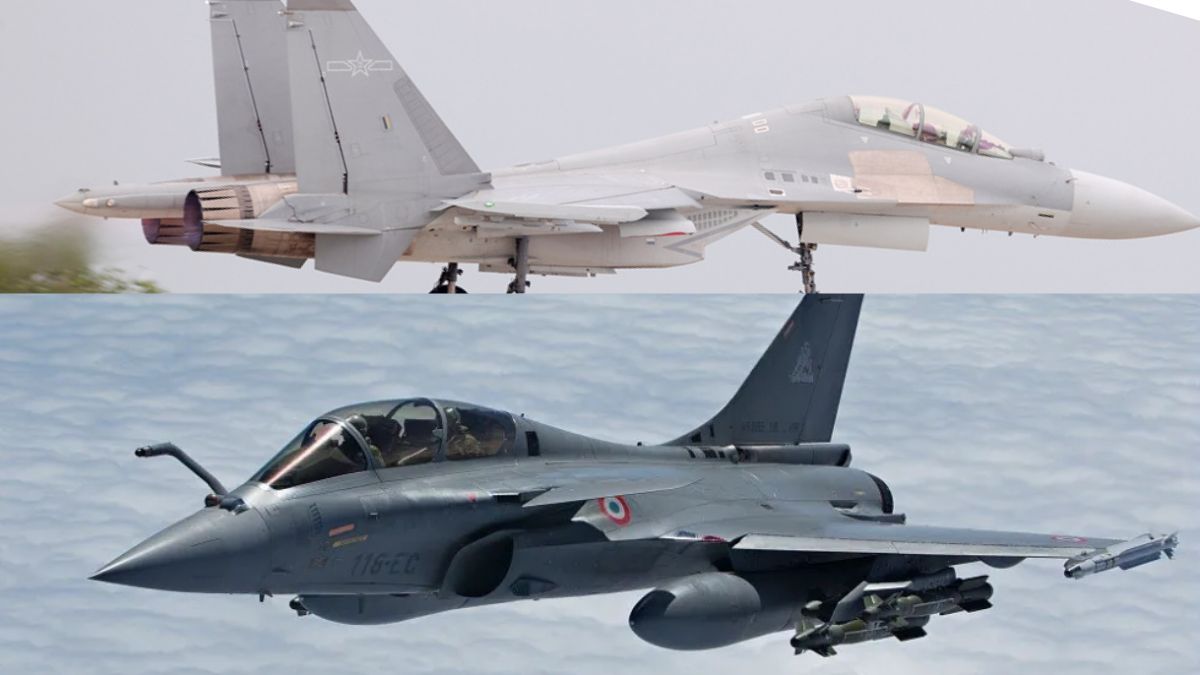
China’s state broadcaster CCTV has offered an unusually detailed glimpse into People’s Liberation Army (PLA) air combat war gaming, showcasing a simulated encounter between Chinese J-16 fighters and French-made Rafales, aircraft that recently featured during India’s Operation Sindoor, against terrorist targest in Pakistan and PoK.
The tabletop exercise, revealed on Friday (December 9, 2025), comes around seven months after Operation Sindoor, during which India deployed French-origin Rafale fighters while Pakistan relied heavily on Chinese-made jets, notably the J-10C.
Chinese J-16 vs Rafale face off: What happened?
The footage, as reported by South China Morning Post, showed PLA Air Force officers analysing a hypothetical air battle scenario. On one side of the board were eight J-16 multirole fighters, China’s 4.5-generation aircraft built by Shenyang Aircraft Corporation. Opposing them were six Rafale fighters, a platform operated by France, India, Egypt etc.
The scenario also included references to additional “threats”, suggesting a complex, multi-layered simulation rather than a simple one-on-one engagement. CCTV did not disclose the assumptions, outcomes or tactical conclusions drawn from the exercise.
PLA war games are typically classified, but this simulation was part of a broader push to institutionalise war gaming across the Chinese military, the report said.
Why Rafales matter after Operation Sindoor
The simulated clash has taken on added significance following Operation Sindoor, India’s military response to the April 22 Pahalgam terror attack. During the brief but intense crisis in early May, the Indian Air Force flew Rafales as part of its strike and air dominance posture, while Pakistan deployed Chinese aircraft, including the J-10C “Vigorous Dragon”.
Pakistan later claimed its J-10C fighters shot down multiple Indian aircraft, including Rafales, during aerial engagements on May 7. India has not officially confirmed any Rafale losses. However, US officials told Reuters in May that at least two Indian jets were downed, including one Rafale, potentially marking the aircraft’s first combat loss.
For China, whose defence industry has been aggressively marketing its fighter jets overseas, the episode was widely seen as a test case for Chinese aircraft against NATO-standard platforms.
PLA war gaming goes mainstream
CCTV said 2025 marks the first year that war gaming is being promoted at scale across the PLA and the People’s Armed Police Force. The Rafale–J-16 simulation was conducted in Xuchang, Henan province, at an event attended by 20 military units and academies. Similar exercises were reportedly carried out by army and submarine forces.
According to PLA officer Wu Keyu from the National University of Defence Technology, China began developing professional war-gaming systems in the 1990s, but is now accelerating their integration across services. “There is an urgent need to develop a war-gaming system with Chinese characteristics,” Wu told SCMP.
He added that while artificial intelligence is becoming central, human decision-makers must remain in the loop.
From South Asia to the Taiwan strait
The J-16 featured in the simulation plays a key role in China’s regional air power. It regularly patrols China’s coastline and, when paired with J-20 stealth fighters, is described by PLA analysts as part of the country’s strongest air-combat combination, particularly relevant in Taiwan Strait contingency planning.
The aircraft has previously drawn attention for intercepting foreign military aircraft near China’s east coast, including an incident last year in which a J-16 reportedly performed a barrel roll over an unidentified warplane.
CCTV said China has independently developed multiple war-gaming systems incorporating AI-driven combat models, big data analytics and real-time simulation engines. These tools are designed to support joint operations across land, sea, air, missile, space and electromagnetic domains.
PLA war games a strategic signal beyond the simulation?
By publicly showcasing a Rafale-focused simulation, Beijing appears to be sending a message to multiple audiences: to regional rivals, to arms buyers weighing Western versus Chinese platforms, and to military planners assessing air power trends after recent conflicts.
China certainly is pushing for its defence industry to expand its reach, aiming to attract to more buyers for J-10 and J-16s alike.