


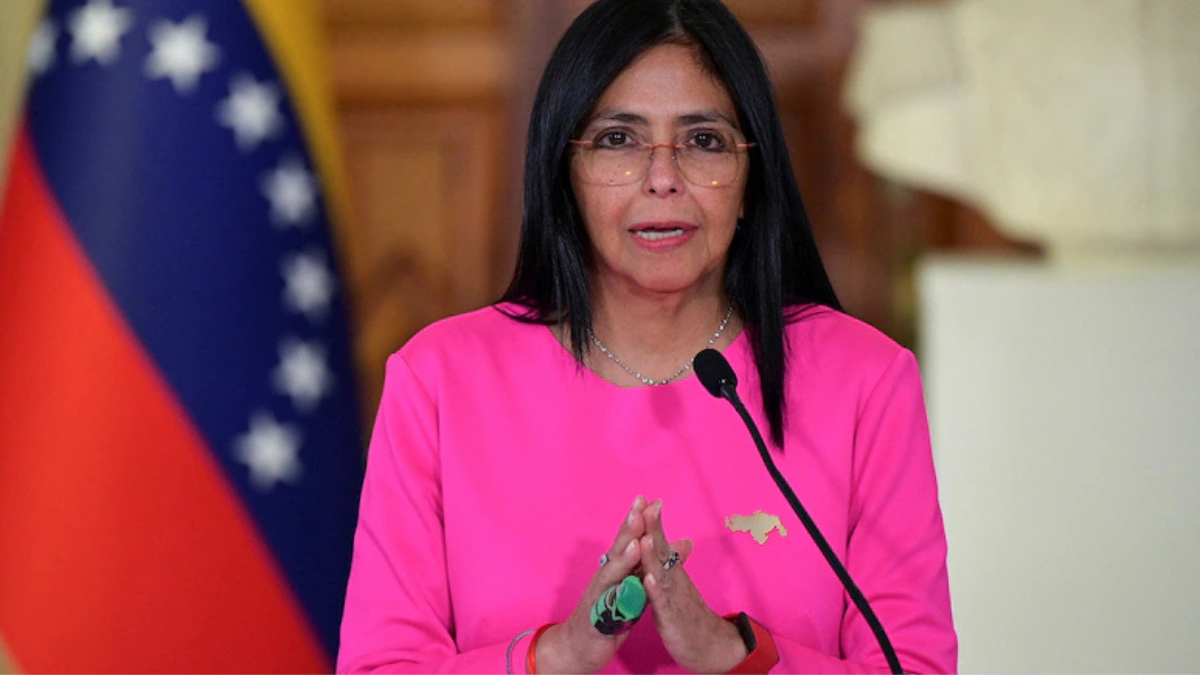
Venezuela entered a volatile new chapter on Monday (January 5, 2026) as Vice President and Oil Minister Delcy Rodríguez was sworn in as interim president following the dramatic US-led military operation that ousted President Nicolás Maduro, killed dozens of troops and security personnel, and triggered fresh security scares in Caracas, including gunfire near the presidential palace.
How did the power transition unfold in Venezuela?
Rodríguez’s swearing-in came just hours after Maduro appeared in a New York court on drug trafficking charges, marking the first time a sitting Venezuelan leader has been forcibly removed and extradited by the United States.
The transition unfolded amid lingering violence and uncertainty, underscoring Washington’s gamble that Rodríguez—rather than the long-marginalized opposition—could stabilise the oil-rich nation after the weekend’s bloodshed.
The 56-year-old labour lawyer was sworn in by her brother, Jorge Rodríguez, the powerful head of Venezuela’s National Assembly, alongside 283 lawmakers elected in May 2025.
Most opposition parties boycotted those elections, leaving the legislature overwhelmingly dominated by Maduro loyalists. First Lady Cilia Flores, also detained in the US, was the only lawmaker absent.
Why did US think Rodríguez was the most viable option?
According to US intelligence assessments cited by the Wall Street Journal, Rodríguez was deemed the most viable figure to lead a temporary government, capable of maintaining order with the backing of the security apparatus.
The assessment concluded that opposition figures such as Nobel Peace Prize laureate Maria Corina Machado or former presidential candidate Edmundo González would struggle to command legitimacy or control state institutions in Maduro’s sudden absence.
That calculation appears to have shaped President Donald Trump’s approach. While many anti-Maduro activists expected Washington to usher in the opposition, the Trump administration instead sidelined them, signalling a willingness to work with Rodríguez if she cooperates on political and economic reforms.
Secretary of State Marco Rubio reportedly told US lawmakers that Washington believes it has leverage, assessing Venezuela could run out of money within weeks without US engagement.
How have security incidents marred the power transition?
Yet the transition was immediately overshadowed by renewed security incidents. Late Monday (January 5), unidentified drones were spotted over Caracas’s Miraflores presidential palace, prompting security forces to open fire.
Witnesses reported bursts of gunfire lasting about a minute, with tracer rounds visible in the night sky. Authorities said the situation was under control, but the episode highlighted how fragile security remains after the weekend’s operation.
That operation—dubbed Operation Absolute Resolve—was led by elite US Army Delta Force units alongside the 75th Ranger Regiment and the 160th Special Operations Aviation Regiment.
Helicopters launched from US warships off the Venezuelan coast, flying low to avoid detection before descending on Maduro’s compound in Caracas.
What is the US estimate of people killed during the raid?
US officials estimate that between 67 and 80 people were killed during the raid, including Venezuelan and Cuban security personnel and civilians caught in the fighting.
Venezuela’s armed forces have confirmed that 23 of their service members died, while Cuba said 32 of its troops and interior ministry personnel deployed in Caracas were killed, including senior officers. Defence Minister Vladimir Padrino López said much of Maduro’s close protection unit was “largely wiped out”.
About half a dozen US troops were injured, some by gunfire, though none were killed. Pentagon officials described the mission as “extremely complex and grueling” but said the low number of US casualties was a testament to the operation’s planning and execution.
Maduro and Flores were flown to the United States following their capture and pleaded not guilty in a New York court to charges stemming from a 2020 indictment accusing Maduro of leading a narco-terrorism and cocaine trafficking conspiracy. The US had doubled the reward for his arrest to $50 million shortly before the raid.
What is in store for Venezuela as Rodríguez takes charge?
As Rodríguez assumes power, Venezuela’s future remains uncertain. Trump has said elections will not be held until the country is “fixed,” offering no timeline for a democratic transition.
International reaction has been cautious, with Mexico urging Washington to guarantee Maduro a fair trial as regional governments weigh the implications of the unprecedented US intervention.
For now, Rodríguez faces the immediate challenge of asserting control, preventing further violence, and navigating a narrow path between cooperation with Washington and pressure from hardline loyalists who still vow to bring Maduro back, while a nervous nation watches to see whether this interim chapter brings stability or deeper turmoil.