


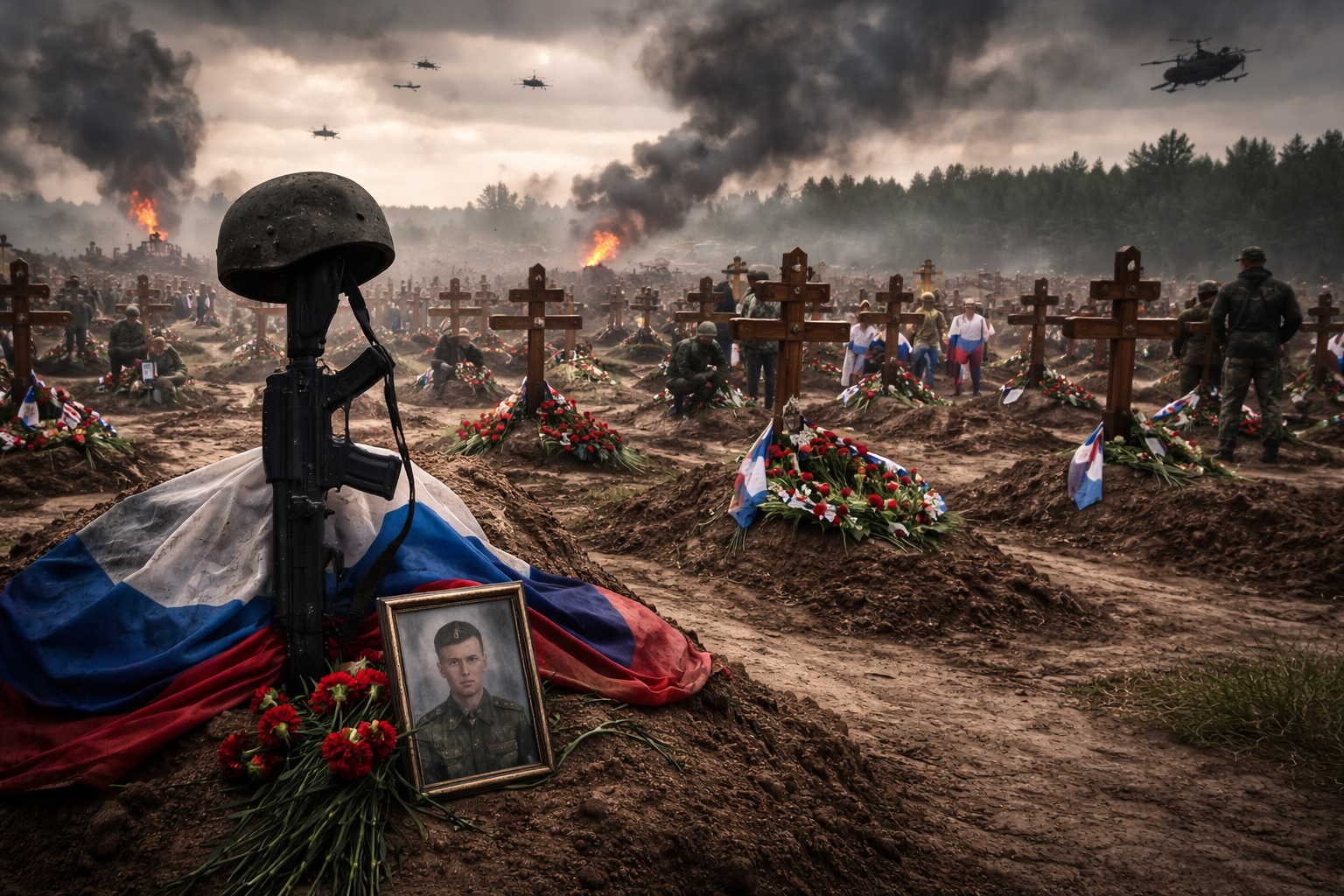
Russian military losses in Ukraine have increased at their fastest pace since the start of the full-scale invasion in 2022, according to a detailed analysis, even as diplomatic pressure from the United States intensifies to push Moscow towards a negotiated settlement.
Over the past ten months, confirmed Russian fatalities have risen sharply, coinciding with renewed battlefield offensives and stalled peace efforts during 2025.
What does the analysis show?
BBC News Russian, working with independent outlet Mediazona and a network of volunteers, has confirmed the names of nearly 160,000 Russian soldiers killed while fighting in Ukraine.
The analysis is based on official statements, regional newspapers, social media posts, war memorials, and newly identified graves. According to military experts consulted by the BBC, the confirmed names likely represent 45% to 65% of the actual death toll, suggesting total Russian fatalities may range between 243,000 and 352,000.
The analysis noted that obituary counts, while preliminary, provide a reliable indicator of how the intensity of fighting changes over time.
Why have losses risen so sharply in 2025?
Data shows a clear acceleration in losses during key diplomatic moments. After relatively low obituary numbers in January, the figures rose in February following the first direct talks between United States President Donald Trump and Russian President Vladimir Putin to end the war.
Further spikes were recorded in August, when Trump and Putin met in Alaska, and again in October and November after a planned second summit was shelved and Washington presented a 28-point peace proposal.
In November, an average of 322 obituaries per day were published in Russian sources—double the daily average recorded in 2024.
The Kremlin appears to view territorial gains as leverage in negotiations. Putin aide Yuri Ushakov recently said that Russia’s “recent successes” had positively influenced talks with the United States.
Who is bearing the brunt of the losses?
The profile of Russian casualties has shifted. According to figures, a growing proportion of those killed in 2025 were volunteers—people with no prior military background who signed contracts after the invasion began. In 2024, volunteers accounted for about 15% of Russian deaths. In 2025, the figure rose to one in three.
Local authorities, under pressure to maintain recruitment levels, have offered large financial incentives, targeted people with debt, and conducted recruitment campaigns in universities and colleges.
This approach has allowed the Kremlin to offset battlefield losses while avoiding a politically risky nationwide mobilisation.
Recruitment versus casualties
By October, 336,000 people had signed contracts with the Russian military in 2025, according to National Security Council deputy chief Dmitry Medvedev—more than 30,000 recruits per month.
NATO Secretary-General Mark Rutte has said that approximately 25,000 Russian soldiers are being killed every month. If both figures are accurate, Russia continues to recruit more personnel than it is losing, despite heavy casualties.
However, reports persist of coercion, particularly involving prisoners and individuals facing criminal charges. A law passed in 2024 allows defendants to avoid conviction by joining the military, a powerful incentive in a system with an acquittal rate of less than 1%.
What do broader estimates suggest?
NATO has estimated that Russia’s total dead and wounded now stand at around 1.1 million, including approximately 250,000 fatalities—a figure broadly consistent with the calculations.
The BBC estimates do not include fighters from militias in two Russian-occupied regions of eastern Ukraine, where an additional 21,000 to 23,500 deaths are believed to have occurred.
How do Ukrainian losses compare?
Ukraine has also suffered heavy casualties. In February, President Volodymyr Zelensky said 46,000 Ukrainian soldiers had been killed and 380,000 wounded, with tens of thousands missing or captured.
Based on cross-referenced data and external estimates, analysts believe the number of Ukrainian fatalities may now be as high as 140,000.
What does this mean going forward?
The data suggests that battlefield dynamics in 2025 have been shaped as much by diplomacy as by military strategy. Rather than easing fighting, peace talks appear to have coincided with intensified offensives, as Moscow seeks to strengthen its negotiating position through territorial pressure.
For Russia, rising losses have not yet translated into reduced military capacity. For the broader conflict, the figures underline the growing human cost of a war entering its fourth year, with no clear pathway to de-escalation.