


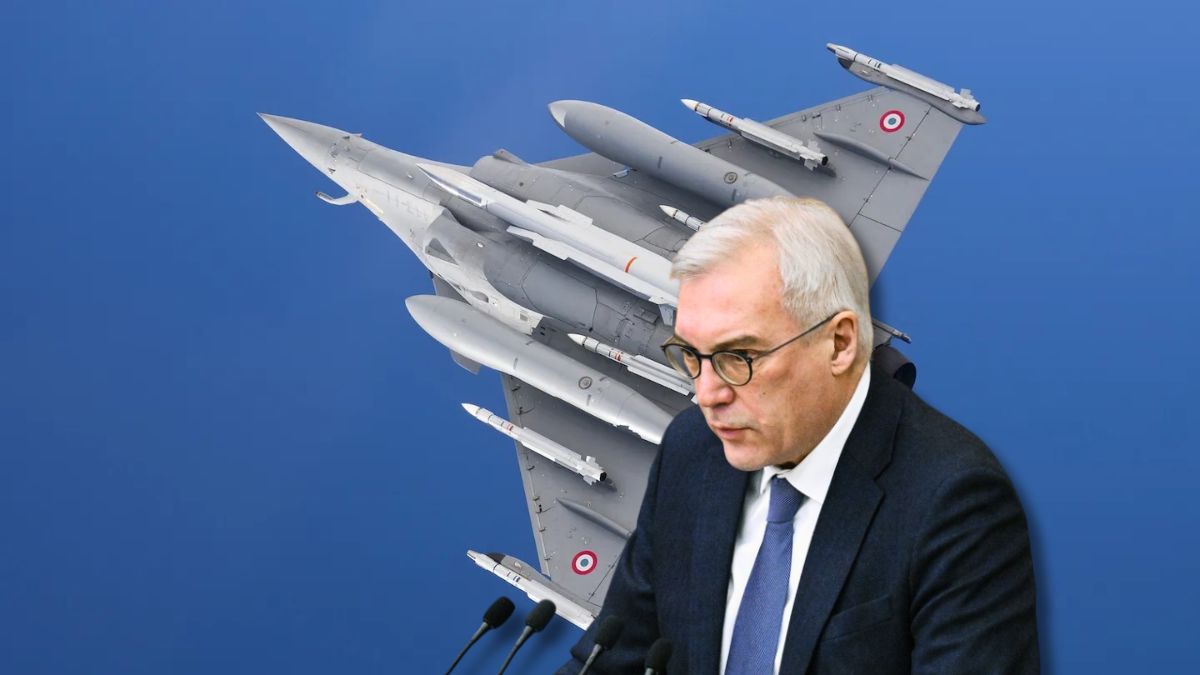
Last month, French President Emmanuel Macron had shared his plans to expand the country’s nuclear arsenal and signalled that Paris may allow European partners to host its nuclear-capable aircraft on temporary deployments. However, Russia has now issued a rather strict warning on this.
Moscow has warned that any European country hosting French nuclear-capable strategic bombers could become a target for Moscow’s forces in the event of a conflict, sharply escalating rhetoric around nuclear deterrence in Europe. Such deployments would be viewed as part of an “uncontrolled build-up” of NATO’s nuclear potential, Russian Deputy Foreign Minister Alexander Grushko said, describing it as a strategic threat to Russia.
“Clearly, our military will be forced to pay close attention to this issue in the context of updating the list of priority targets in the event of a major conflict,” Grushko told state media group Russia Today.
France’s proposal on nuclear deployments
French President Macron had in March said they are in discussions with several countries, including Britain, Germany, Poland, the Netherlands, Belgium, Greece, Sweden and Denmark, on potential arrangements. The proposal is part of a broader effort by European NATO members to take greater responsibility for their own defence architecture.
Moscow argues that extending French nuclear capabilities across Europe would destabilise the regional security balance rather than strengthen it.
Grushko noted that instead of reinforcing allied security, such moves could have the opposite effect. “As a result, instead of the declared French strengthening of the defence of their allies… the security of these countries is in fact being weakened,” he stated.
The Russian Deputy Foreign Minister also stressed that any future dialogue on nuclear weapons would need to account for the combined capabilities of NATO, including not just the United States but also the nuclear arsenals of France and Britain.
How does this fit into the broader NATO strategy?
Macron’s initiative reflects growing calls within Europe to reduce reliance on the United States for security, particularly after repeated criticism of NATO by US President Donald Trump and his push for allies to increase defence spending. It also comes amid geopolitical uncertainties, including tensions within the alliance and concerns over US strategic priorities, like Trump’s remarks about taking control of Greenland from NATO member Denmark.
European efforts to strengthen independent deterrence capabilities are increasingly seen as part of a shifting security landscape within NATO.
What is the global nuclear context right now?
The warning also comes at a time when global arms control frameworks are under strain. The expiry in February 2026 of the last remaining treaty limiting the size of Russian and US strategic nuclear arsenals has created a vacuum in nuclear governance.
This has coincided with heightened international tensions driven by ongoing conflicts, including the Ukraine war and the broader West Asia crisis involving Iran, where a fragile ceasefire and continued military posturing have kept global security on edge.
These overlapping crises have intensified concerns about escalation risks and the potential role of nuclear deterrence in future conflicts.
What has NATO said on nuclear policy?
Meanwhile, NATO recently criticised both Russia and China over their nuclear arms policies, urging greater transparency and stability. At a conference set to open at the United Nations in New York next week to review the nuclear non-proliferation treaty, the alliance is expected to push for renewed dialogue.