


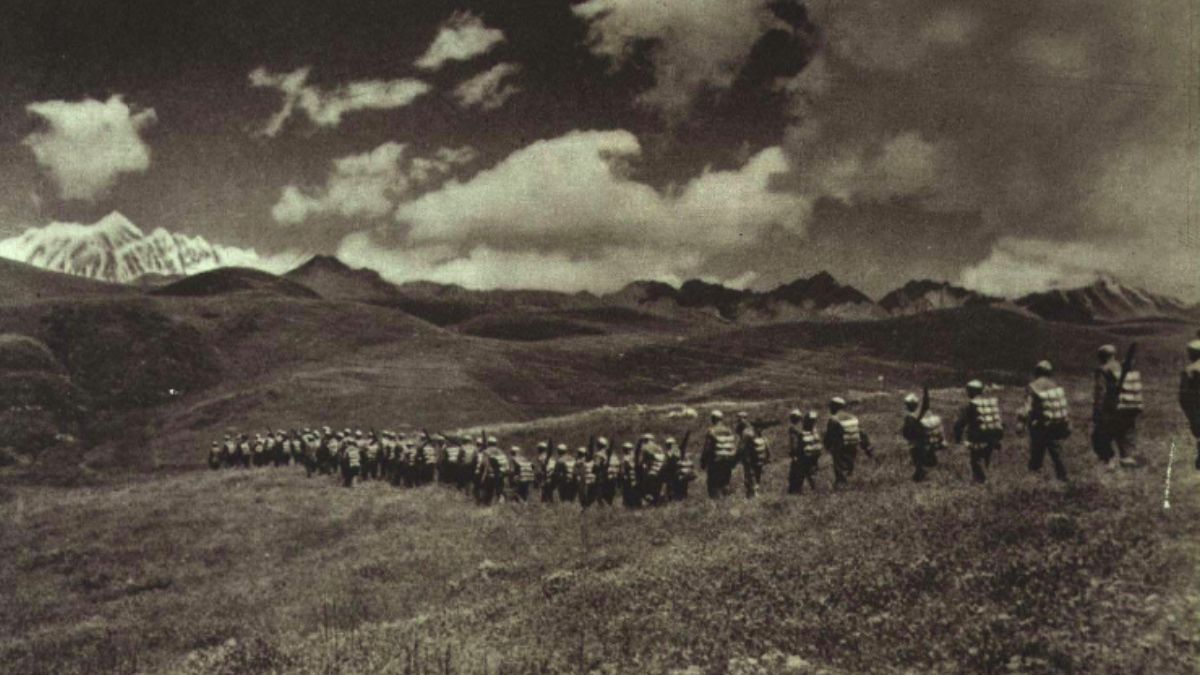
When the People’s Liberation Army (PLA) crossed into eastern Tibet on 7 October 1950, it was not just the beginning of a military campaign—it was the start of a transformation that would alter the Himalayan plateau forever. For Beijing, it marked the consolidation of its territorial ambitions. For Tibetans, it heralded an era of loss: of autonomy, faith, and identity. Seventy-five years later, the consequences of that invasion continue to reverberate across generations, both inside Tibet and among the diaspora.
The Chinese Communist Party (CCP) framed the invasion as a “peaceful liberation.” But for Tibetans, the entry of Chinese troops into Kham province was an occupation in all but name. The ensuing decades saw the systematic dismantling of Tibet’s political and religious institutions, reshaping one of Asia’s oldest civilisations under the banner of Chinese sovereignty.
What was Tibet before the invasion?
Before 1950, Tibet functioned with de facto independence. Following the collapse of the Qing dynasty in 1912, the region governed itself under the spiritual and temporal authority of the Dalai Lama. Its borders were guarded by a modest army, its currency and stamps bore Tibetan insignia, and its Buddhist monasteries were the heartbeat of its cultural life. Yet, lacking international recognition, Tibet’s sovereignty remained vulnerable to the ambitions of its powerful neighbour.
That vulnerability was exploited in the autumn of 1950. The PLA advanced across the eastern frontier, overwhelming poorly equipped Tibetan forces. Within months, Chinese troops had secured key towns, forcing Lhasa’s hand in negotiations. By May 1951, Tibetan delegates—operating under duress—signed the Seventeen-Point Agreement, which promised autonomy but effectively transferred control to Beijing. The pledge of non-interference in Tibet’s religion and administration was soon broken.
How did China consolidate control?
Beijing’s consolidation of Tibet was gradual but relentless. Land reforms stripped the monasteries and aristocracy of influence. Collectivisation campaigns uprooted centuries-old social structures. The CCP’s ideology replaced Buddhist teachings in schools, and religious leaders were purged or imprisoned. The once-powerful monasteries—centres of learning and community life—were reduced to rubble during successive political campaigns.
By 1959, Tibetan patience had run out. Fearing for the Dalai Lama’s life, tens of thousands of Tibetans rose in revolt in Lhasa. Chinese forces crushed the uprising, killing thousands. The Dalai Lama fled to India, where he established the Tibetan government-in-exile. What followed was a campaign of retribution: mass arrests, executions, and the destruction of religious institutions on a scale Tibet had never seen.
Over the following decades, Beijing’s efforts shifted from conquest to control. Infrastructure projects—roads, railways, and airfields—tightened China’s grip on the region, allowing military movement and surveillance deep into the plateau. Simultaneously, waves of Han Chinese migration altered Tibet’s demographics, turning Lhasa into a city where Tibetans are now a minority.
What remains of Tibetan identity today?
Modern Tibet bears the outward signs of development—high-speed rail, urban skylines, and state investment—but its soul remains under siege. The CCP’s policies have eroded the Tibetan language, religion, and traditions in the name of “integration.” Reports from human rights groups document the forced assimilation of Tibetan children through state-run boarding schools where Mandarin is compulsory and Buddhist teachings are banned. Monks and nuns are subjected to “patriotic re-education,” while surveillance technology tracks every movement and conversation.
Beijing presents these efforts as modernisation. Yet, for Tibetans, they represent the slow extinction of a distinct civilisation. The once-vibrant culture of monastic debate and artistic expression now survives largely in exile communities across India and Nepal.
The international response remains muted. Successive governments have shied away from confronting China over Tibet, preferring economic diplomacy to moral pressure. The Dalai Lama’s appeals for genuine autonomy within China have been repeatedly dismissed by Beijing, which insists Tibet has been part of its territory “since ancient times.”
Why does the 1950 invasion still matter?
The events of October 1950 remain a touchstone in Asia’s political memory—a reminder of how power, once consolidated, resists reversal. Tibet’s story is not merely about occupation but about the endurance of a people denied their voice. The continuing restrictions on religion, movement, and speech expose the deep contradictions in China’s claims of “liberation.”
For Tibetans, the past is not history—it is lived experience. The invasion may have redrawn borders, but it failed to extinguish belief. Seventy-five years on, the struggle for cultural and spiritual survival endures—an unbroken testament to a nation that remembers, even when the world prefers to forget.