


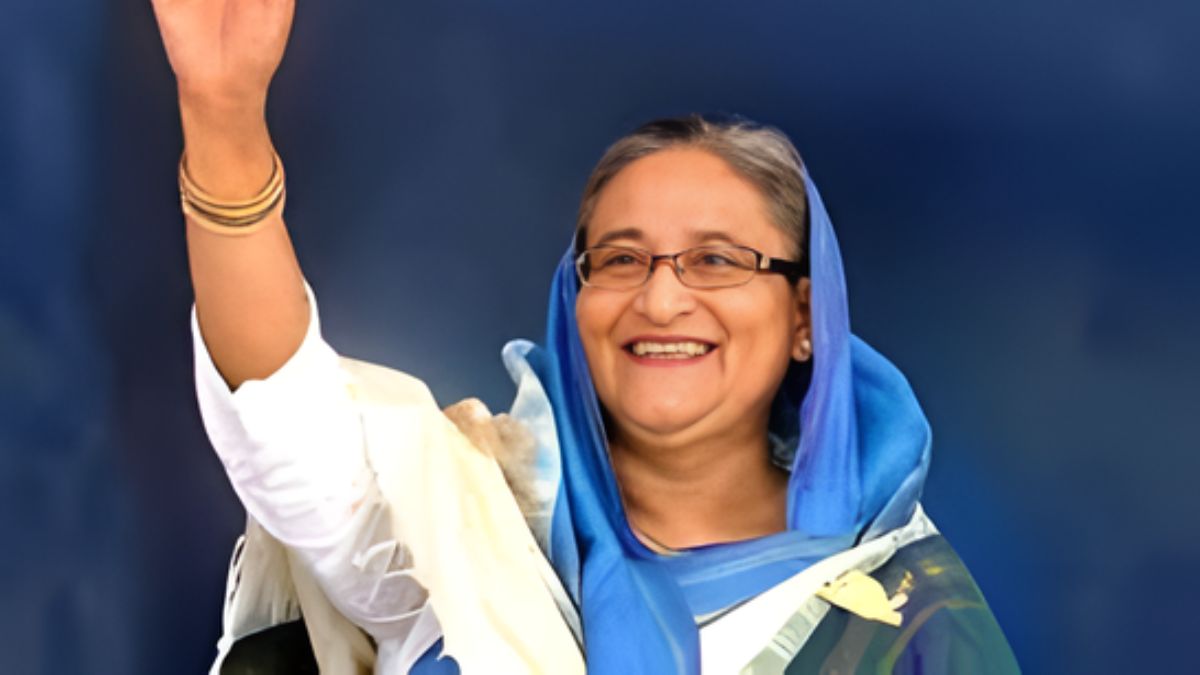
Around a year after violent student protests Bangladesh, leading to the ouster of Prime Minister Sheikh Hasina, International Crimes Tribunal-1 (ICR-1) has found her guilty on multiple counts and sentenced her to death after being tried in absentia. The former Bangladesh PM is currently in India.
Hasina was sentenced to death on Monday (November 17, 2025) by the International Crimes Tribunal (ICT-BD) for alleged crimes against humanity linked to last year’s massive student-led uprising that toppled her Awami League government. The tribunal ruled against the 78-year-old leader despite her refusal to appoint legal counsel and her repeated insistence that the charges were fabricated and politically motivated.
Hasina has been in India since August 2024, after fleeing Bangladesh in the wake of the violent protests that collapsed her government.
Sheikh Hasina death sentence: What is she guilty of?
The former Bangladesh PM has been found guilty on three counts – preventing justice, ordering killings, and failing to take measures to stop punitive killings. “All the… elements constituting crimes against humanity have been fulfilled,” judge Golam Mortuza Mozumder read to the packed court in Dhaka.
The chief judge of the ICT ruled that former Bangladesh PM Hasina ordered the use of helicopters and lethal weapons in the killing of protesters. This was revealed by her in a conversation with South Dhaka Municipal Corporation Mayor.
Along with Hasina, former Bangladesh Home Minister Asaduzzaman Khan Kamal has also been given death sentence while Al-Mamun was given just 5 years in jail because he cooperated with the prosecution. According to a February 2025 UN rights report, around 1,400 people were killed on Hasina’s orders between July 15 and August 15, 2025.
How Hasina reacted to her death sentence?
Saying that the verdict was made by a “rigged” tribunal established and presided over by an “unelected government with no democratic mandate”, former Bangladesh PM Hasina said, “They are biased and politically motivated.”
“In their distasteful call for the death penalty, they reveal the brazen and murderous intent of extremist figures within the interim government to remove Bangladesh’s last elected prime minister, and to nullify the Awami League as a political force,” she said in a statement.
Earlier on Sunday, Hasina urged her supporters not to back down, dismissing the tribunal as illegitimate and accusing interim leader Muhammad Yunus of orchestrating her removal. In an emotional audio message released by the Awami League, Hasina said, “There is nothing to be afraid of. I am alive… I will support the people of the country.”
What did the Bangladesh ICT say about Hasina?
She has been convicted as the ‘mastermind and principal architect’ of the July–August 2024 crackdown in Bangladesh. As per the tribunal, Hasina exercised “command and control” over state security forces and Awami League cadres.
The verdict refers to five formal counts against Hasina – incitement, conspiracy, ordering killings, facilitation, and failure to prevent atrocities. The tribunal further ruled that Hasina incited violence through her speeches and inflammatory remarks.
Hasina has also been found guilty of directing aerial assets to be used against students. Additionally, the court has linked her orders to the Chankharpul killings and to the Ashulia incident, where bodies were burnt after death.
UN calls verdict “important for victims” but condemns death penalty
The United Nations described the verdict against Bangladesh’s ousted PM Hasina as a significant step for victims seeking justice, while clearly distancing itself from the decision to impose the death penalty.
UN Secretary-General António Guterres’ spokesperson Stéphane Dujarric said the UN chief “fully agrees” with the position of UN High Commissioner for Human Rights Volker Türk — that the organisation opposes the death penalty in all circumstances, including in this case.
Dujarric reiterated Türk’s stance that accountability for serious rights violations, including those committed by individuals “in positions of command and leadership,” is essential. He added that UN human rights bodies have consistently urged Bangladesh to ensure justice for victims of last year’s violent unrest.
At the same time, the spokesperson underscored the UN’s concern over capital punishment being applied to Hasina. Calling for restraint, Dujarric urged Bangladeshis to “remain calm” and avoid escalation in the wake of the verdict.