


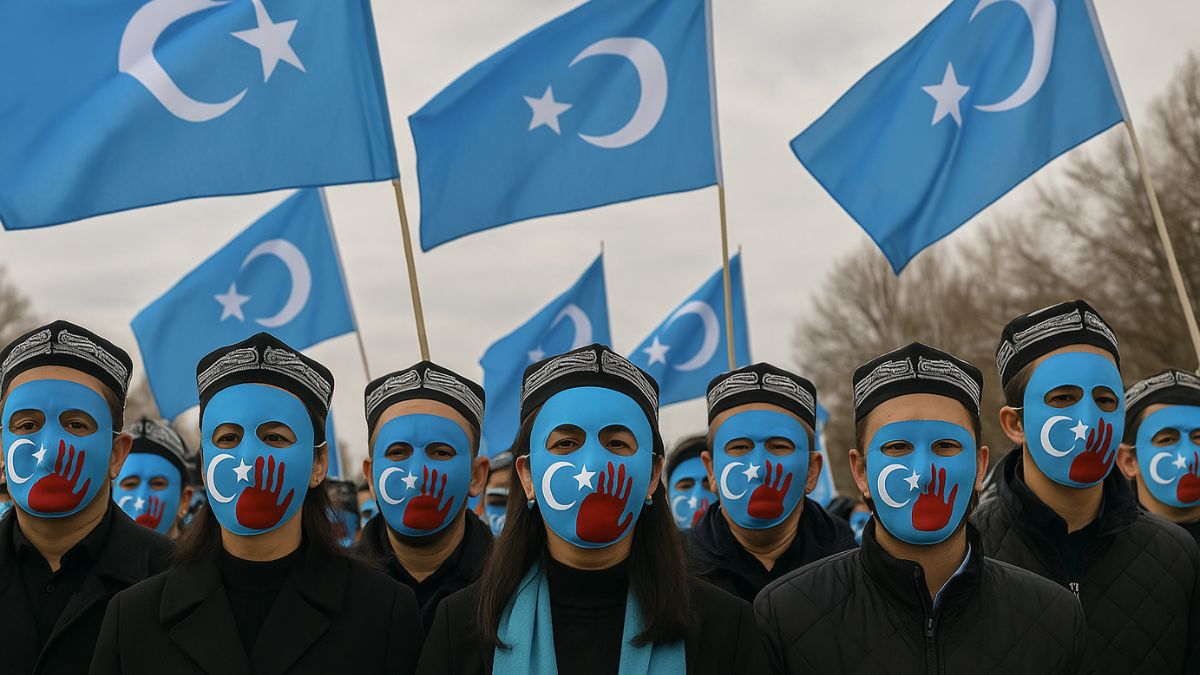
As Uyghur communities across the world prepare to mark East Turkestan Independence Day on Wednesday (November 12, 2025), the celebrations are laced with defiance and grief. The anniversary commemorates the proclamation of the first East Turkestan Republic in 1933 — a fleeting moment of self-rule that Beijing has spent the decades since trying to erase.
For many Uyghurs in exile, the date symbolises both resistance and remembrance. Inside China’s Xinjiang region— or East Turkestan, as Uyghurs call it— expressions of faith, language, and culture are criminalised. The Chinese Communist Party (CCP) has built a vast system of surveillance and mass detention: more than a million Uyghurs have been held in so-called “re-education camps,” where torture, sexual violence, forced labour, and indoctrination are common. Women have reported forced sterilisation; men have vanished into prisons without trial; and children have been taken from their families to state-run facilities guarded by armed police.
Yet, even as Beijing tries to suffocate Uyghur identity, the diaspora continues to breathe life into it — through words, art, protest, and symbols that carry the memory of a nation denied.
How have symbols become acts of defiance?
The language of Uyghur resistance today is written not only in slogans or speeches, but in symbols — vivid emblems of identity that defy erasure. These symbols have travelled far beyond Xinjiang, appearing in marches, classrooms, and social media feeds from Istanbul to Washington.
One of the most recognisable is the Doppa hat, the four-pointed embroidered cap that has become a global marker of Uyghur pride. Once a common sight in Kashgar’s markets, the Doppa is now banned in many public settings inside China. But every May 5, Uyghurs around the world mark Doppa Day, first initiated in 2009 by activist Tahir Imin. From London to Toronto, families wear the cap in defiance — its intricate motifs quietly proclaiming, “We are still here.” With more than 250 regional variations, each Doppa carries geography and lineage stitched into its fabric, serving as both heritage and protest.
Another potent emblem is the Kök Bayraq, or “blue flag” — the banner of the short-lived East Turkestan Republics of 1933 and 1944. Its turquoise field represents the sky of Turkic heritage; its white crescent and star, the Islamic faith. The flag is banned in China but waves proudly across the diaspora — at protests outside Chinese consulates, at human rights conferences, and in university vigils. It is a call for self-determination, one that has outlasted two republics and a century of repression.
More recently, a third image has come to embody modern resistance: the blue Uyghur resistance mask. Painted with the crescent and star of East Turkestan and overlaid with a red hand-shaped imprint symbolising China’s censorship, it captures both suffocation and defiance. The mask went viral during the global protests of 2018–2021 and remains a powerful visual shorthand for a people silenced but not subdued.
Why do these symbols matter?
For a community under siege, symbols have become a language of survival. Each gesture — a Doppa worn in exile, a blue flag raised in protest, a masked face at a rally — carries the collective will to exist despite state repression.
They also serve to educate and connect: young Uyghurs born abroad learn through these icons what their parents risked to preserve. The symbols link generations separated by geography and fear, turning memory into movement. In a world that often looks away from Xinjiang, they make the invisible visible.
As Uyghur diaspora communities gather this week to mark East Turkestan Independence Day, their message echoes through these symbols: that China’s campaign of assimilation has failed to erase them. The prisons and propaganda may silence voices, but not meaning. The flag, the hat, and the mask together tell a story — of a people’s unbroken thread of dignity, stitched in blue and bound by remembrance.