


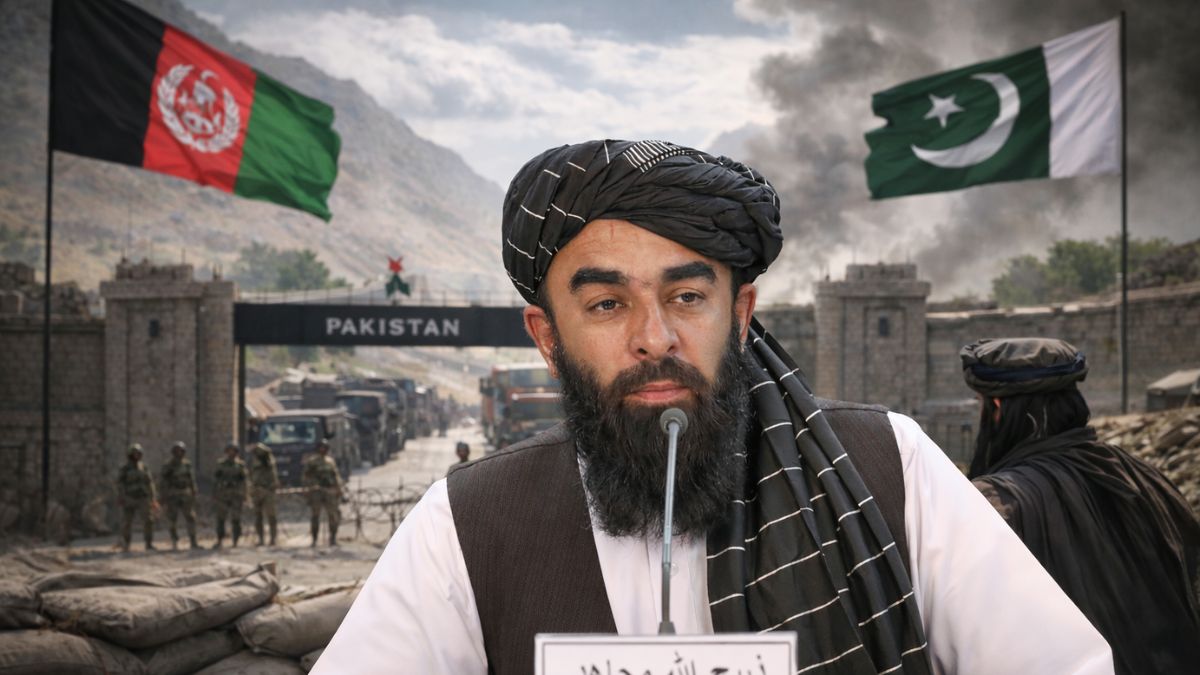
Taliban spokesperson Zabihullah Mujahid has publicly rejected the prospect of a conflict with Pakistan, declaring that rising tensions between Kabul and Islamabad do not serve Pakistan’s interests and are instead damaging regional stability and economic survival, particularly as prolonged border closures with Afghanistan continue to bleed Pakistan’s already fragile economy.
What did Taliban say about Pakistan tensions?
Speaking to Afghan media, Mujahid said the Taliban’s governing policy is based on good neighbourly relations and that confrontation with Pakistan benefits neither side.
“This is not Pakistan’s war,” he said, suggesting that the current hostilities are being driven by external actors or miscalculations within Pakistan’s security establishment rather than genuine national interest.
His remarks come at a time when border mismanagement and political distrust have frozen trade routes through Balochistan, triggering severe economic losses across Pakistan.
How Taliban views Kabul-Islamabad Tensions as Destabilising?
Mujahid argued that tensions between Kabul and Islamabad have harmed multiple sectors and created instability that could have been avoided through dialogue.
He offered two explanations for the standoff: that certain circles in Pakistan may be acting at the behest of another country, or that Islamabad wrongly assumed the Taliban government would remain under Pakistan’s influence after returning to power in Kabul.
According to Mujahid, this assumption has proven false and has contributed to misguided policy choices.
How Taliban sees TTP as Pakistan’s internal matter?
Rejecting Pakistani claims that Afghan territory is being used by Tehrik-i-Taliban Pakistan (TTP), Mujahid described the militant group as an internal Pakistani issue.
He said the TTP operates entirely within Pakistan, maintaining its own bases, command zones, and areas of control. “They do not need to come to Afghanistan,” he asserted, directly challenging Islamabad’s justification for border pressure and security escalations.
Why Taliban rejects any foreign support?
The Taliban spokesperson also dismissed allegations that the group received foreign backing during its two-decade insurgency.
He stressed that the conflict was fought entirely inside Afghanistan and was rooted in domestic support across provinces such as Kandahar, Helmand, Kunduz and Herat. “No country has done us a favor,” Mujahid said, underlining the Taliban’s claim of strategic independence.
How are border tensions hitting Pakistan’s economy?
While political tensions continue to simmer, the economic fallout for Pakistan has been severe. Border closures between Balochistan and Afghanistan since last October have paralysed bilateral trade, with Punjab alone reportedly losing more than PKR 80 billion every month due to stalled commerce.
Business leaders warn that Pakistan’s inability to maintain stable cross-border trade is worsening inflation, shrinking exports and further eroding investor confidence.
According to business chambers, key industries dependent on Afghan markets, including cement, agricultural chemicals and food exports, have suffered heavy losses.
Thousands of traders remain stranded on both sides of the border, with estimates suggesting nearly 3,000 traders, many of them Pakistani, unable to move goods.
Truckloads of fresh fruits, dry fruits and other perishable items imported from Afghanistan are reportedly rotting at border crossings, causing massive financial damage.
How has Pakistan’s exports been adversely impacted?
At the same time, Pakistan has been unable to export vegetables, medicines and construction materials to Afghanistan, weakening its export base and disrupting supply chains.
The transport and logistics sectors have been hit particularly hard, with drivers, loaders and small operators struggling to survive as trade grinds to a halt.
Trade experts note that the Afghan border is not just vital for bilateral commerce but also Pakistan’s gateway to Central Asia. With exports already heavily reliant on neighbouring countries, the continued shutdown is intensifying economic stress, reducing household incomes and fuelling public frustration.
Why is criticism mounting on Pakistan government?
Criticism is mounting against the federal government and revenue authorities for failing to provide relief to affected traders. Business groups say consignments have perished without compensation, while the absence of emergency measures reflects policy paralysis rather than unavoidable circumstances.
Amid the growing crisis, religious scholars and political figures from both sides have called for the immediate resumption of dialogue to rebuild trust and reopen border crossings.
Their message echoes Mujahid’s core assertion: prolonged confrontation serves no one, least of all Pakistan, whose economic and strategic costs continue to mount with every passing day.