


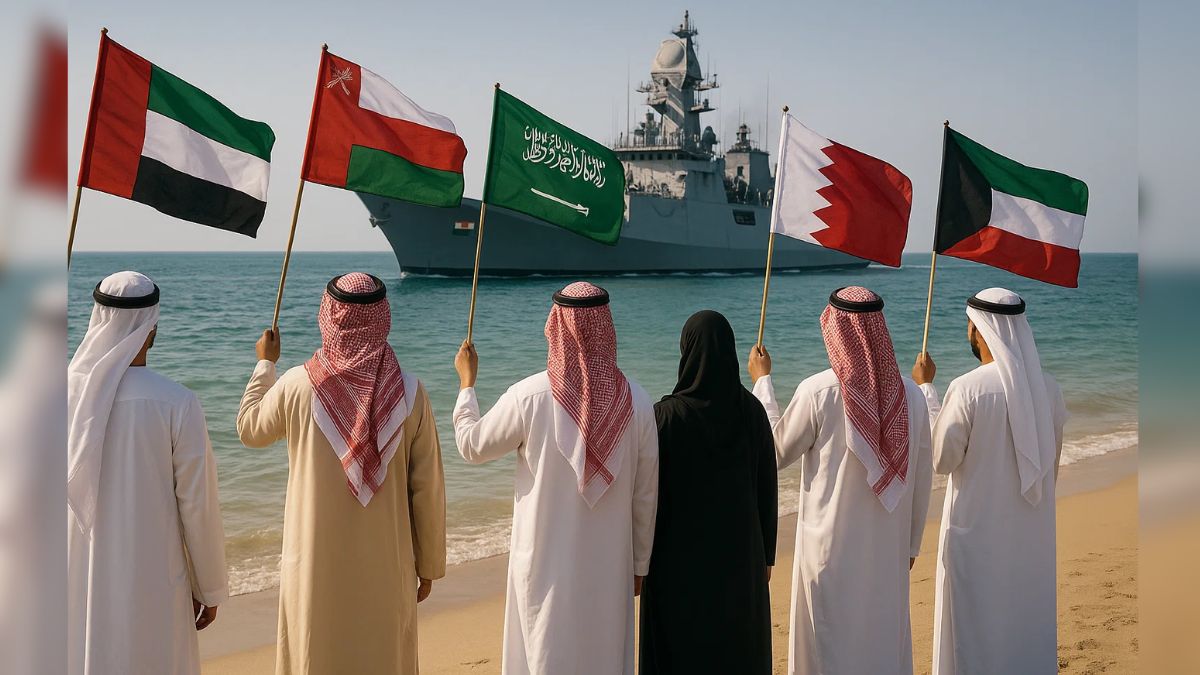
Across the Arabian Sea, two parallel realities shape the region’s maritime security environment. On one side is Pakistan, whose Makran coastline features prominently in narcotics routes that supply heroin and methamphetamine to the Gulf, East Africa and beyond. On the other is India, increasingly regarded by Gulf states as a reliable security partner capable of providing intelligence, maritime surveillance and consistent interdictions.
The divergence is not ideological. It is practical. States in the Gulf and western Indian Ocean rely on credible enforcement to protect their maritime borders, ports and commercial routes. Their behaviour over the past decade indicates clear preferences: Pakistan is identified as a point of origin in many interdictions, while India is approached for training, technical cooperation and maritime domain awareness support.
Why do Gulf and East African seizures repeatedly trace back to Pakistan?
Maritime interdictions by the United Arab Emirates (UAE), Oman, Kenya, Tanzania and Seychelles often reveal similar patterns. Vessels carrying narcotics, typically heroin or methamphetamine, are frequently crewed by Pakistani nationals or trace their last port of call to stretches of the Makran coast. These dhows commonly present irregular fishing licences, excess fuel and unused nets — indicators associated with multi-purpose smuggling vessels rather than legitimate fishing operations.
Over more than a decade, these patterns have remained consistent. Despite Pakistan’s claims that these boats are “stateless”, multiple port authorities in the Gulf have noted documentation or crew links pointing back to Pakistani territory. This continuity suggests structured trafficking routes rather than sporadic criminal activity.
For states on the receiving end of these smuggling flows, origin matters. It shapes operational planning, targeting priorities and intelligence assessments. When interdictions consistently point in the same direction, trust in the origin country’s enforcement capabilities diminishes.
Why is India seen as a more dependable enforcement actor?
India’s reputation in maritime counter-narcotics rests on predictable enforcement rather than episodic displays. The Indian Navy and Indian Coast Guard conduct surveillance and interdiction operations that routinely result in public trials, documented charges and transparent reporting. Agencies such as the Directorate of Revenue Intelligence and the Narcotics Control Bureau take custody of seized cargo, maintain evidence chains and publish updates on prosecutions and sentencing.
This clarity establishes India as a partner that can be relied upon for sustained engagement. Gulf states have increasingly approached India for joint patrol training, operational coordination and maritime domain awareness support. The Information Fusion Centre–Indian Ocean Region (IFC-IOR), operated by the Indian Navy, has become a central node for real-time information-sharing among regional navies. Its vessel tracking, suspicious movement alerts and collaborative analysis have enhanced situational awareness for partners who lack similar capabilities.
The emphasis is not on spectacle but on systems. India’s approach blends surveillance, policing, legal procedure and long-term engagement, providing predictability that external stakeholders value.
How does this credibility divide affect regional security partnerships?
The gap between Pakistan’s origin problem and India’s enforcement capability has reshaped the maritime partnerships of Gulf and East African states. Countries that once treated both as comparable security actors now differentiate sharply. India is seen as a net security contributor — a navy with the capacity and willingness to share intelligence, conduct joint operations and support prosecution-based outcomes.
Pakistan’s inconsistent enforcement posture, marked by high-profile seizures lacking documented follow-through, has limited its appeal as a security partner. When cooperation appears driven by external review cycles or international pressure, trust erodes. For Gulf states reliant on uninterrupted shipping lanes and secure ports, uncertainty is costly.
This credibility divide carries strategic implications. As India expands its cooperative footprint — from training Sri Lankan and Seychelles coast guard teams to supporting information-sharing with Oman and the UAE — its maritime diplomacy strengthens. Pakistan, meanwhile, risks being viewed primarily through the lens of origin-based risk rather than enforcement-based reliability.
India’s rise as a preferred maritime security partner is thus not the result of diplomatic signalling alone. It stems from practical, verifiable performance. In a region shaped by illicit flows, Gulf states prefer a partner that can deliver consistent results over one struggling to demonstrate control over its own coastline. The divide between the “cartel next door” and the “credible cop” is therefore not rhetorical — it is rooted in observable outcomes.