


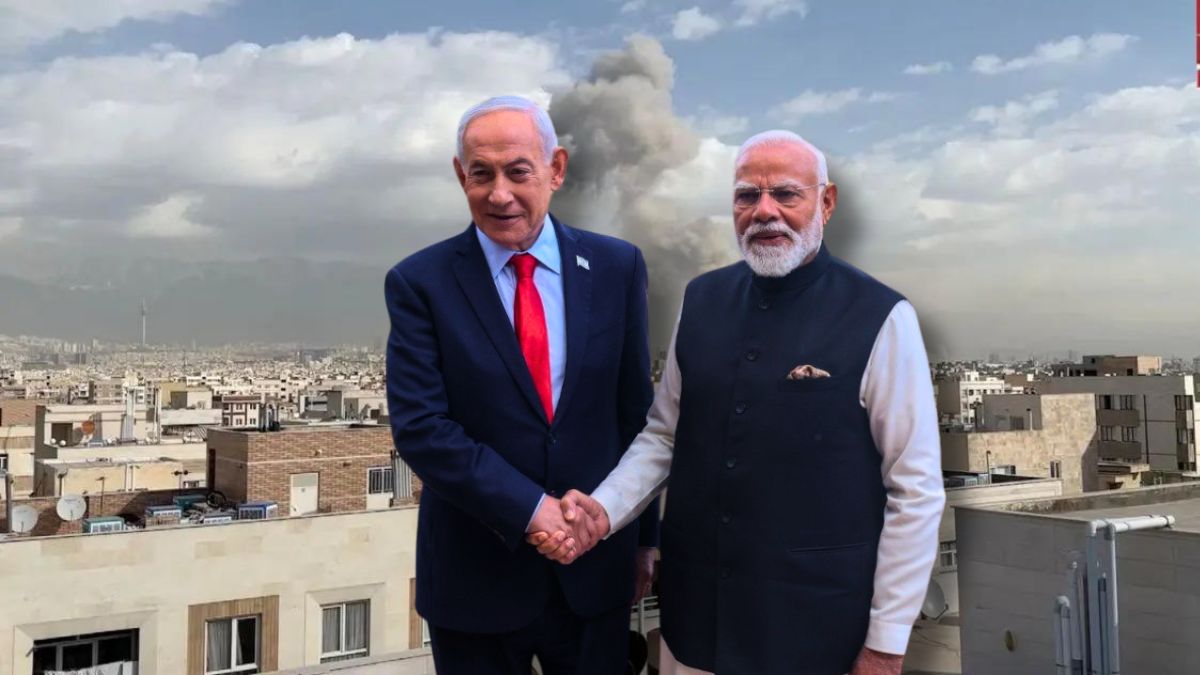
Remember how Israel conducted “pre-emptive” strikes on Iran last week, and how they came just around 2 days after Prime Minister Narendra Modi’s Israel visit? Turns out, there was no plan to hit Tehran then and the operation was an operational opportunity that came up only after PM Modi left.
In a striking revelation amid the escalating West Asia conflict, Israel’s Ambassador to India Reuven Azar has said that the joint US-Israeli strikes on Iran were carried out only after PM Modi concluded his visit to Israel, adding that it was launched during an “operational opportunity”.
Speaking to The Indian Express, Azar noted that the “operational opportunity” emerged only after PM Modi had departed Tel Aviv, emphasising that the decision to strike Iran was taken later and was not part of discussions during the visit. “During the conversations with PM Modi we discussed regional developments, but we couldn’t have shared something that we didn’t know,” Azar said.
Israel-Iran war: What was the significance of PM Modi’s visit?
Prime Minister Modi visited Israel on February 25-26, marking his second trip to the country after the historic 2017 visit that transformed bilateral relations. During the visit, India and Israel further strengthened their ‘Special Strategic Partnership’, signing 17 agreements spanning defence, technology, agriculture and innovation after talks between Modi and Israeli Prime Minister Benjamin Netanyahu.
The visit came at a time when tensions in West Asia were simmering over Iran’s nuclear programme and regional proxy conflicts.
According to the Israeli envoy, it took around two days after Modi’s departure for Israeli leadership to decide on the attack, which was later approved by Israel’s security cabinet on the morning of February 28.
What happened during ‘Operation Epic Fury’?
Just days later, on February 28, the United States and Israel launched a coordinated military operation against Iran, targeting several strategic sites across the country, including the capital Tehran. The strikes, codenamed Operation Epic Fury, came after stalled nuclear negotiations and intelligence claims that Iran had resumed sensitive nuclear activities.
The attack resulted in over 700 deaths, including senior Iranian leadership figures. Among those killed was Iran’s Supreme Leader Ayatollah Ali Khamenei, who had ruled the country for 36 years. Reports said he was inside his secure compound when the strikes occurred. Several members of his family, including his daughter, son-in-law and granddaughter, were also killed, while his wife later died of injuries.
How did Israel build the intelligence for the strike?
Azar revealed that Israel had spent years developing intelligence capabilities and technological systems to track Iran’s military leadership and strategic infrastructure. “We had to create the intelligence capability to understand the Iranian regime and its military machinery, including who makes the decisions and where they are located,” he said.
According to the envoy, Israel invested billions of dollars over the years to develop advanced technologies capable of penetrating Iran’s air defence networks and countering missile threats. These capabilities were necessary because Iran and its regional proxies had repeatedly launched ballistic missiles, rockets and drone attacks against Israel.
Talking about the planning and preparations before the strikes, the Israeli envoy underlined that Israel has been suffering from threats from Iran for decades and therefore it had to create the intelligence capability to understand the Iranian regime, their military machinery. Azar said they had to know what Iran is intending to do next, including who are the people there making decisions, where exactly they are located.
“So, only towards that effort, we have invested billions of dollars throughout the years because of the nature of the threat,” he said, adding that Israel had to build up its military and develop the technologies that allow it to overcome the air defence systems of Iran.
What role did the Abraham Accords and US coordination play?
Azar credited the Abraham Accords, the agreements normalising Israel’s relations with several Arab nations, with enabling broader regional coordination. Through these partnerships and cooperation with US Central Command (CENTCOM), Israel was able to enhance regional surveillance and airspace monitoring across the Middle East.
“And before this operation, we had been coordinating with the United States for a long time, waiting for the right moment, which we didn’t know when it would happen,” Azar said.
What happens next in Iran after Khamenei’s death?
The killing of Ayatollah Khamenei triggered a major leadership crisis in Iran, as the long-time Supreme Leader had not formally named a successor.
In the immediate aftermath, a three-member interim Leadership Council comprising Ayatollah Alireza Arafi, President Masoud Pezeshkian and Chief Justice Gholamhossein Mohseni Ejei assumed authority.
How has the region reacted to the strikes?
The operation has dramatically escalated tensions across West Asia. Within hours of the attack, Iran launched missiles and drones targeting Gulf nations, with impacts reported in Dubai, Abu Dhabi, Qatar and Bahrain.
Iran has vowed to avenge the killing of its top leader, while US President Donald Trump warned that it was “too late” for Tehran to seek negotiations to avoid a broader war. With multiple fronts opening across the region and proxy groups mobilising, analysts warn that the conflict risks expanding into one of the most volatile Middle East crises in decades.