


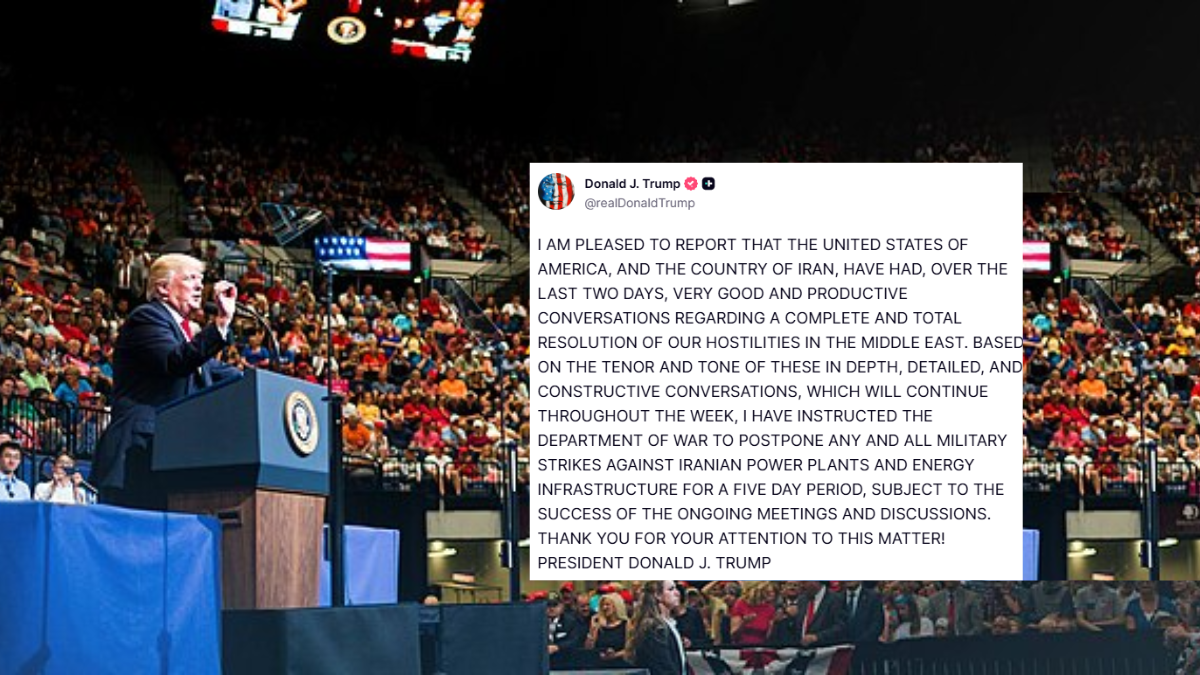
President Donald Trump announced that the United States has been engaged in direct talks with Iran to end a war now in its fourth week, and that he has ordered the military to stand down on threatened strikes against Iranian energy infrastructure for a five-day window.
Trump posted the announcement in an all-caps message on Truth Social, writing, “I am pleased to report that the United States of America, and the country of Iran, have had, over the last two days, very good and productive conversations regarding a complete and total resolution of our hostilities in the Middle East.” Trump reportedly told reporters that both sides are keen to “make a deal” and that there exist “major points of agreement”.
According to Trump, the major goal remains stopping Iran from obtaining a nuclear weapon. In addition, Trump said his son-in-law, Jared Kushner, and US special envoy Steve Witkoff participated in talks with “a top person” in Iran, without naming the leader.
“They want, very much, to make a deal. We’d like to make a deal too,” he said.
Iran Disputes the Claim
Tehran, however, dismissed Trump’s statement. Iranian state media, Press TV, said on X, “An Iranian source says there was no contact—whether direct or indirect—with Trump, adding he backed down after being warned their targets would include power plants across West Asia.”
Background
The United States and Israel launched military strikes on Iran on February 28, in an operation dubbed “Operation Epic Fury,” killing Supreme Leader Ayatollah Ali Khamenei and prompting Iranian counterstrikes against Israel, US military bases in the region, and Persian Gulf states. The strikes came just two days after US and Iranian negotiators met in Geneva for what Omani mediators described as productive negotiations on a nuclear deal.
Despite that characterisation, Trump said he was “not happy” with the pace of progress and the talks collapsed. Since then, 13 U.S. service members have been killed and at least 200 others wounded. More than 1,500 people in Iran have been killed, according to Iranian officials, and at least 1,000 people in Lebanon have been killed according to that country’s Ministry of Health. The Strait of Hormuz and the Energy Crisis The immediate trigger for Trump’s announcements and the subsequent developments was the closure of the Strait of Hormuz.
Shipping traffic through the strait has virtually ground to a halt since the US and Israel launched their airstrikes. Iran has retaliated by targeting ships trying to pass through the strait, with several incidents reported in recent weeks. Over the weekend, Trump issued a 48-hour ultimatum to Tehran to reopen the strait or face strikes on Iran’s power plants. The deadline was set to expire on the evening of March 23, when Trump came out with an announcement.
The International Energy Agency’s head, Fatih Birol, warned that the global economy faces a “major, major threat” from the war’s disruption to oil and gas flows, saying “no country will be immune to the effects of this crisis if it continues.” He said the current situation is worse than the combined oil crises of 1973 and 1979 and that “at least 40 energy facilities across nine countries have also been severely damaged in the conflict.”
What Comes Next
One Israeli official has reportedly said mediating countries were trying to convene a meeting in Islamabad, with Iranian and US representatives attending. Iranian officials warned that if the US attacks Iran’s power plants, Iran would retaliate against energy and water infrastructure across the Gulf region, including in countries that host US military bases.