


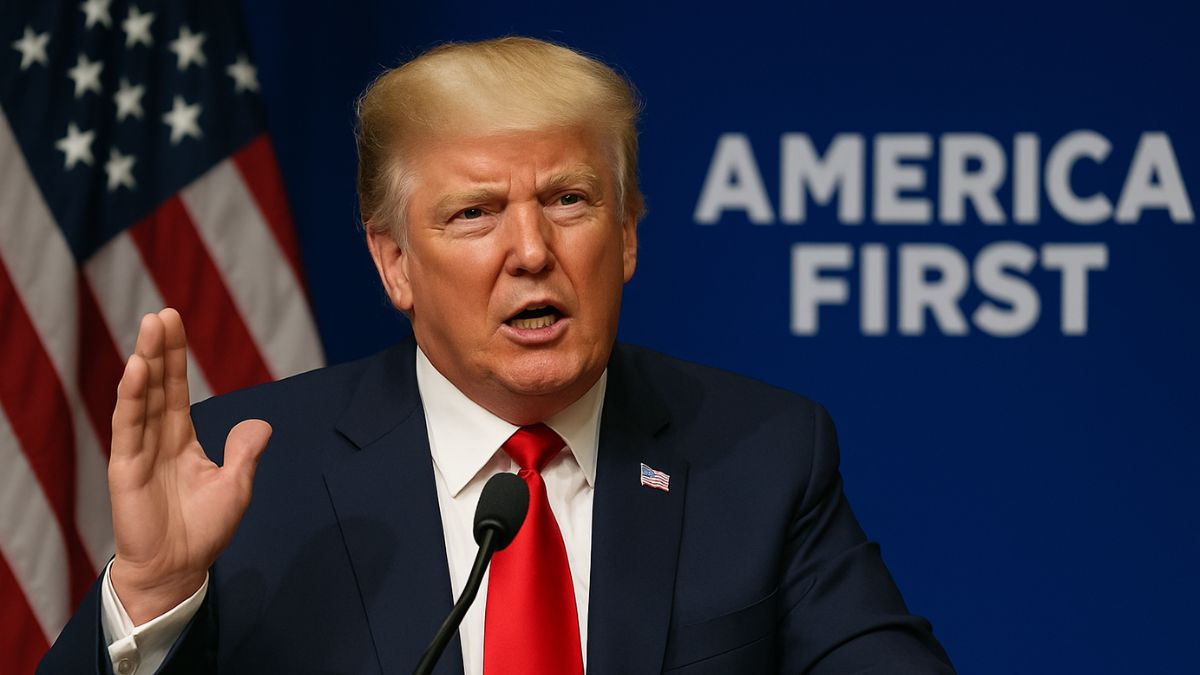
One of the first things that Donald Trump announced after taking oath as the 47th President of the United States was the imposition of reciprocal tariffs on several countries, including India. Dubbing it “Liberation Day” for America, President Trump unveiled reciprocal tariffs earlier this year in April 2025.
“For decades, our country has been looted, pillaged, raped and plundered by nations near and far, both friend and foe alike,” Trump had said while announcing the tariffs. Now in his latest defence of sweeping trade measures, US President Donald Trump has once again positioned tariffs not merely as an economic tool but as an extension of national security strategy.
According to US President Trump, his tariffs are a means to rapidly punish foreign governments he accuses of exploiting the United States.
Trump’s tariffs: How they fit into his strategy of punishment politics?
With tariff disputes intensifying across multiple regions, Trump’s comments mark a continuation of his controversial approach: using import duties as political leverage, economic pressure and, increasingly, as an assertion of presidential authority.
Posting on Truth Social, the President argued that the current legal pathway for imposing tariffs, now under scrutiny at the US Supreme Court, is “far more direct, less cumbersome, and much faster, all ingredients necessary for a strong and decisive national security result.” His message comes as the court is weighing the legality of his broad tariff powers.

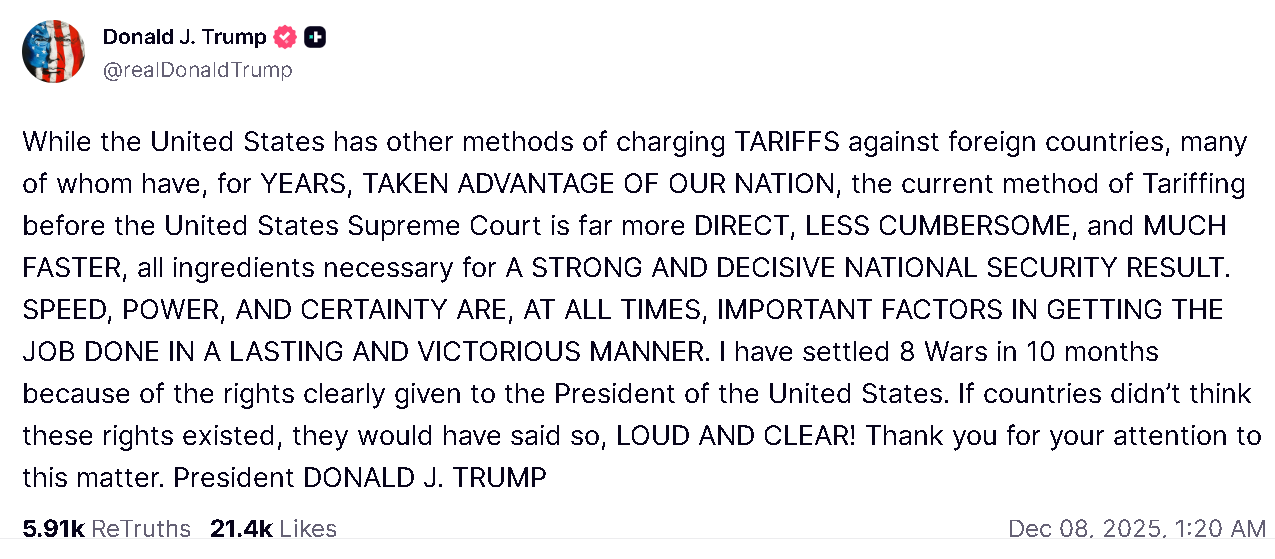
Trump has consistently framed tariffs as instruments that deliver immediate consequences to nations he claims have “taken advantage” of the United States. The administration’s recurring “Liberation Day” tariffs have hit multiple foreign trading partners since April, each round marketed as a strategic victory.
Have tariffs boosted the US economy?
President Trump asserts that tariffs have strengthened the country’s economy, boosted markets and deterred adversarial behaviour, claiming “tariffs have made our country rich, strong, powerful, and safe… we have all the cards.” Trump even linked tariffs to geopolitical conflict resolution, saying, “I have settled 8 wars in 10 months because of the rights clearly given to the President.”
Since returning to office earlier this year, the Trump administration has presided over an unprecedented rise in tariff revenue. Data cited by Fox Business shows that total duty collections reached $215.2 billion in Fiscal Year 2025, which ended on September 30, 2025. The momentum continued into the new fiscal year as October 2025 brought in a record-breaking $34.2 billion.
The US Treasury has already logged $41.6 billion in tariff revenue for Fiscal Year 2026. The figures highlight the rapid acceleration in US tariff income under the administration’s aggressive trade policy.
Why is the Supreme Court now central to Trump’s tariff agenda?
The US Supreme Court is reviewing whether Trump’s emergency powers under the 1977 International Emergency Economic Powers Act (IEEPA) legally justify imposing sweeping tariffs. The law has never previously been used in this manner. Several conservative justices signaled scepticism during November hearings.
Justice Amy Coney Barrett warned that striking down the tariffs could create “a mess,” while critics argue that upholding them may vastly expand presidential economic powers. Trump, aware of the court’s potential to derail his trade strategy, openly appealed to the nine justices, “Pray to God that our Nine Justices will… do the right thing for America!”
He also attacked opponents as “Evil, American hating Forces… fighting us at the United States Supreme Court.”
What does Trump claim tariffs have achieved at home?
Trump credits his tariff regime for positive economic indicators like rising stock markets, lower inflation and taxes, strengthened military and border security, along with a restored US global “respect”
These claims are disputed by economists, who have repeatedly argued that tariffs can increase consumer costs and hurt American manufacturers reliant on imported inputs.
Reflecting those pressures, Trump recently signed an executive order reducing tariffs on several products to offset rising grocery prices. He has also floated a $2,000 “tariff dividend” for working families.