


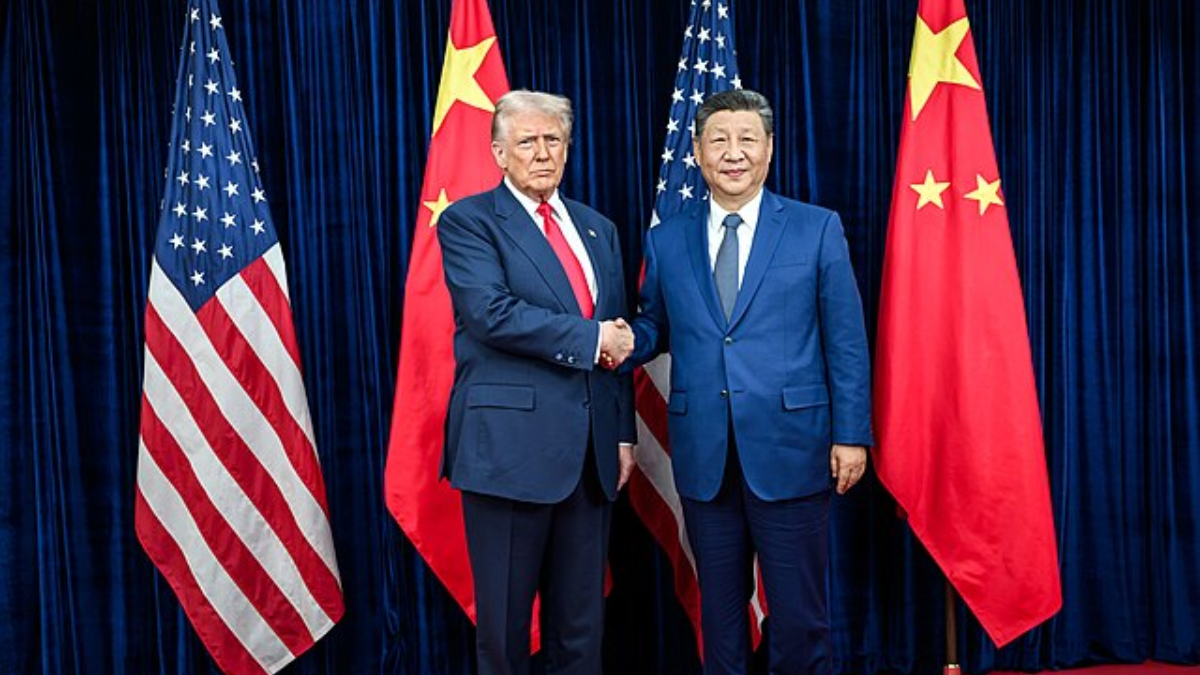
US President Donald Trump has won an upper hand after the joint military airstrikes in Iran with Israel that killed Supreme Leader Ayatollah Ali Khamenei, just ahead of his meeting with Chinese counterpart Xi Jinping at the end of March 2026, as it came close on the heels of the American operations against Venezuela’s Nicolas Maduro.
Trump would arrive in Beijing for the summit meeting as he took on the leaders of two nations — Iran and Venezuela — with which China has had an oil trade for a long time.
Both Iran and Venezuela were critical for China’s energy security, and Trump’s actions against Khamenei and Maduro have the potential to disrupt the oil supplies to Beijing.
Geopolitical watchers would be keenly watching the Trump-Xi meeting and how it goes, as the summit has the potential to signal how the global trade war and the power struggle for being the world’s superpower would play out.
Only last week, Trump appeared weakened after the US Supreme Court struck down his tariffs. But now, after the Iran and Venezuela operations, it is Xi who seemed offbalance and struggling to mount a forceful response to the US military operations since the Iraq war.
Beijing has, along with Russia, already condemned the US-Israel strikes on Iran, calling the military operations “unacceptable” and urging all sides to show restraint. The Chinese foreign ministry statement was seen as a mellowed response, indicating Beijing’s limited ability to influence the US and the transactional nature of the bilateral relationship.
The meeting, slated between March 31 and April 2, 2026, could put Xi, the host, in an awkward position of celebrating Trump, or to entirely back out of the summit. However, if Xi decides to meet Trump anyway, he would hope to diminish the US for getting entangled in the West Asian conflict.
If Trump carries through with his threat to prolong the West Asian conflict and the attacks on Iran, the war could spread close to his meeting with Xi. However, Beijing has yet to confirm the dates of Trump’s visit to China, or a change in plans to host the US President at this time.
China is majorly exposed to oil supply disruptions due to the West Asian conflict, as its imports from Iran last was 13.4% of the nation’s oil purchases.
The US-Israel attacks on Iran are also a reminder to China that Washington can strike at will at Beijing’s partners around the world. Trump and his administration, on the other hand, would be hoping that Xi doesn’t get involved in the Iran war with a military response.
The US security establishment’s concern is the rapid replenishment of the munitions used in Iran, and that the depleting reserves should not provide an opportunity to China to mount a military operation on Taiwan.
Chinese Foreign Minister Wang Yi, meanwhile, had a telephonic call with Iranian counterpart Seyed Abbas Araghchi and expressed Beijing’s support to Tehran in the ongoing military conflict in West Asia.
Wang told Araghchi that China supported Iran in safeguarding its sovereignty, security, territorial integritym and national dignity, and upholding its lawful rights and interests.
China asked the US and Israel to immediately stop all military operations in West Asia and prevent further escalation of the conflict. China also called for arresting the escalation of the conflict to other parts of West Asia and the world.