


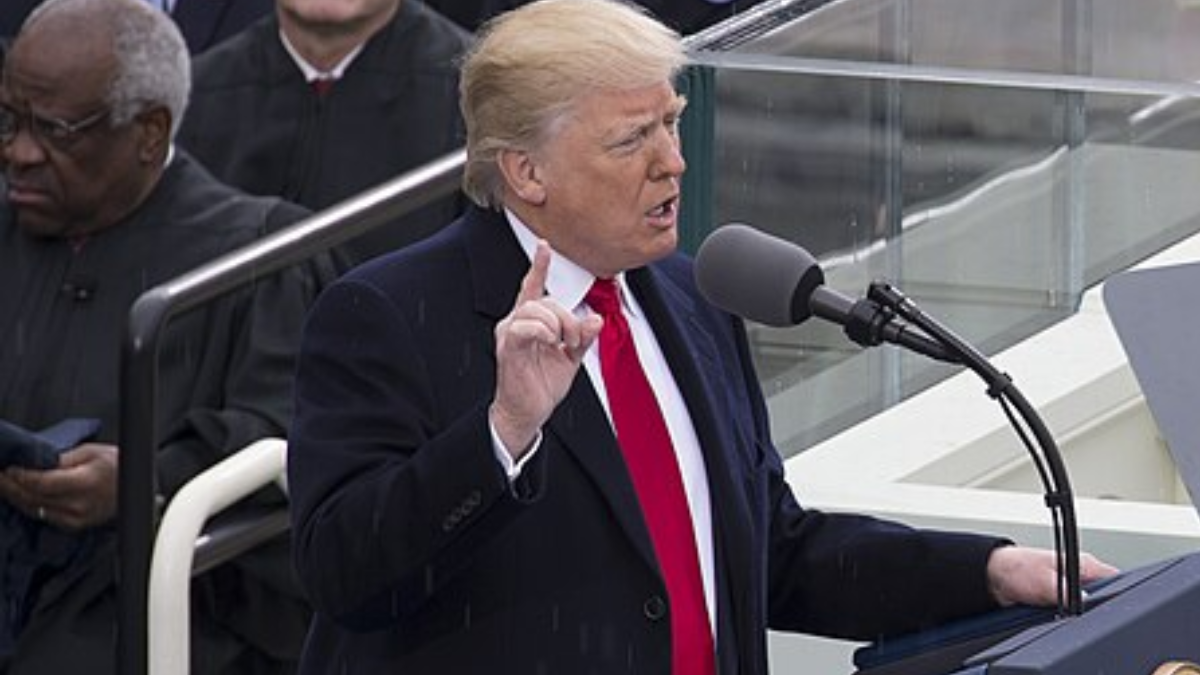
US President Donald Trump on Monday (March 2, 2026) warned Iran that he may send American troops into Iranian territory in a “Boots on the Ground” operation if the situation demanded, even as he flaunted “an unlimited weapons supply” for the American armed forces in its military engagement with Iran since February 28.
Claiming that the US-Israel military strikes on Iran had already surpassed his expectations, Trump said he would not rule out sending American ground troops if needed to take out the Iranian political leadership and present regime.
His remarks came after the US Embassy in Riyadh, Saudi Arabia, was attacked by Iranian drones, prompting Trump to warn Tehran about retaliation soon.
Trump, in a telephone interview with the New York Post, was direct, unlike past US presidents when talking about foreign intervention, ditching any cautious language.
“I don’t have the yips with respect to boots on the ground. Like, every president says, ‘There will be no boots on the ground.’ I don’t say it,” Trump said. “I say, ‘Probably don’t need them,’ (or) ‘if they were necessary.'”
The US-Israel latest military campaign against Iran began on Saturday (February 28) when their airstrikes hit the Iranian Supreme Leader Ayatollah Ali Khamenei’s office, killing him on the spot.
“We projected four weeks to get rid of their military leadership. We did it much faster than that, so we’re ahead of schedule there,” Trump said.
At a separate White House event, he said the US had initially projected a four-to-five-week window for the core phase of the operation but insisted that the Pentagon could sustain military action for far longer if required. “We can go far longer than that,” Trump said. “I don’t get bored. Nothing is boring about this,” he said.
Meanwhile, US Defence Secretary Pete Hegseth told reporters the same day that no American forces were currently inside Iran, but echoed Trump’s refusal to rule out future deployment.
“President Trump ensures our enemies understand we’ll go as far as we need to go to advance American interests. But we’re not dumb about it,” Hegseth said. “You don’t have to roll 200,000 people in there and stay for 20 years.”
Before the strikes began, Vice President JD Vance told The Washington Post there was “no chance” the US would be pulled into a prolonged West Asian war. Trump acknowledged that American casualties are always possible in wartime, but has not committed to a long-term ground presence.
Trump also claimed a “virtually unlimited supply” of medium and higher-grade weapons, indicating that the US was fully loaded and prepared for a prolonged West Asian war if necessary.
Trump wrote, in a Truth Social post, that US munitions stockpiles “have, at the medium and upper medium grade, never been higher or better,” adding, “As was stated to me today, we have a virtually unlimited supply of these weapons. Wars can be fought ‘forever,’ and very successfully, using just these supplies (which are better than other countries’ finest arms!).”
Trump acknowledged, while expressing confidence in mid-tier weapons reserves, that at the highest grade of weaponry, supplies were not yet where he wanted them to be. “At the highest end, we have a good supply, but we are not where we want to be. Much additional high-grade weaponry is stored for us in outlying countries,” he wrote.
Meanwhile, the Institute for the Study of War, a leading international policy research organisation, noted in a report that the US-Israeli strikes into Iran on Monday (March 2) struck the Natanz Nuclear facility, causing severe damage to at least three buildings.
Sharing the analysis in a series of posts on X, ISW said that the combined US-Israeli force continued to degrade Iranian air defences to maintain air superiority over western Iran and Tehran.
“The combined force struck the Natanz Nuclear Facility in Esfahan Province on March 2, which marks the first attack on an Iranian nuclear site since the start of the US-Israeli campaign on Saturday (February 28).
An Israeli analyst, citing March 2 satellite imagery, reported that strikes targeted Natanz and severely damaged at least three buildings,” the post said.
It further noted that the combined and several airstrikes on Monday (March 2) targeted Iranian internal security sites responsible for maintaining security, suppressing protests, and spreading regime propaganda.
In another post, it mentioned that the IDF continued to conduct airstrikes targeting Hezbollah military sites and institutions in Lebanon on Monday (March 2) and said that it degraded Hezbollah’s ability to conduct retaliatory attacks against Israel.