


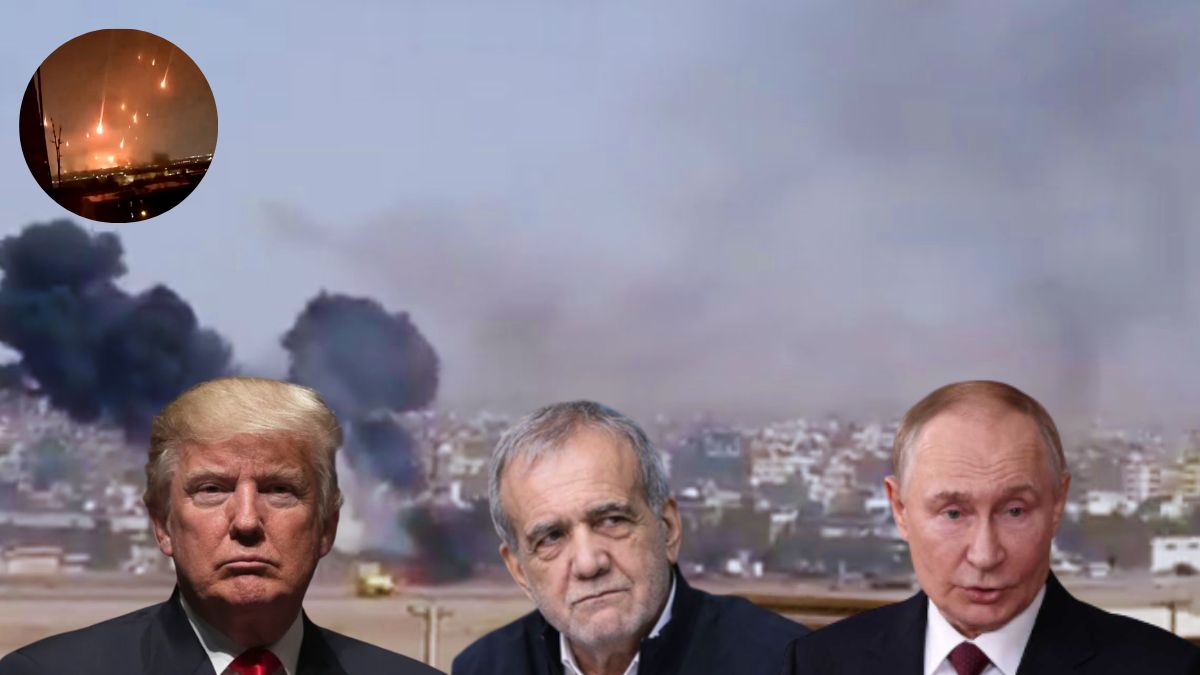
US President Donald Trump on Friday (March 6, 2026) asked for Iran’s “unconditional surrender” as the only acceptable outcome to end the West Asia war, a demand totally rejected by Iranian President Masoud Pezeshkian the same day.
While offering to help rebuild Iran’s economy if it complied and installed a new leadership, Trump wrote on his Truth Social platform, “There will be no deal with Iran except UNCONDITIONAL SURRENDER.”
Trump’s post came even as Israel continued its air strikes and bombing of targets in Iran and Hezbollah in Beirut. US War Secretary Pete Hegseth warned that the US strikes on Iran were “about to surge dramatically.”
The US President assured that once Iran surrendered, the US and its allies would work to bring Iran “back from the brink of destruction, making it economically bigger, better, and stronger than ever before,” provided Tehran installed “a GREAT & ACCEPTABLE Leader(s). MAKE IRAN GREAT AGAIN (MIGA!)”
Soon after, Pezeshkian announced that Iran would stop attacking neighbouring countries that housed US military assets, provided no strikes on Tehran’s territories came under attack from its neighbours’ territory.
Pezeshkian also apologised to the neighbouring country for its strikes in the last week after Iran came under attack from the US and Israel beginning last Saturday (February 28), in which its Supreme Leader Ayatollah Ali Khamenei was killed.
The Iranian president’s comments were a de-escalation of the West Asian conflict, though just symbolic. His true intent came when he said, “That we surrender unconditionally is a dream that they must take with themselves to the grave. What we adhere to are international laws and humanitarian frameworks.”
Later, Iran’s powerful Islamic Revolutionary Guard Corps (IRGC) said in a statement, “Following the statements of the president, the armed forces once again declare that they respect the interests and national sovereignty of neighbouring countries and, up to this point, have committed no aggression against them.”
“However, should the previous hostile actions continue, all military bases and interests of criminal America and the fake Zionist regime on land, at sea, and in the air across the region will be considered primary targets and will come under the powerful and crushing strikes of the mighty armed forces of the Islamic Republic of Iran,” it said.
In an indication of how the world is divided on the West Asian military conflict, Russian President Vladimir Putin held a telephonic conversation with his Iranian counterpart, Masoud Pezeshkian, on Friday (March 6) and conveyed his condolences on the killing of Ayatollah Khamenei.
Putin reaffirmed Russia’s stance of immediate cessation of hostilities and said that he was in constant contact with leaders of the Gulf Cooperation Council member states. The two leaders agreed to maintain contact through multiple channels. Russia’s Foreign Ministry released the details of the phone call.
“During the telephone conversation with President of the Islamic Republic of Iran Masoud Pezeshkian Vladimir Putin has once again expressed his heartfelt condolences on the assassination of Supreme Leader of the Islamic Republic of Iran Grand Ayatollah Seyyed Ali Khamenei along with his family members and the country’s military and political leadership, as well as the numerous civilian casualties resulting from the United States and Israel’s armed aggression against Iran,” the Russian Foreign Ministry said.
“Vladimir Putin reaffirmed Russia’s principled stance in favour of an immediate cessation of hostilities, the rejection of force as a method to solve any issues surrounding Iran or arising in the Middle East, and a swift return to the path of diplomatic resolution. In this regard, the President of Russia noted that he was in constant contact with the leaders of the Gulf Cooperation Council member states,” the telegram post added.
Pezeshkian expressed gratitude for Russia’s solidarity with the Iranian people, “as they defend their sovereignty and the independence of their country.” He also provided a detailed update on the developments during the latest active phase of the conflic