


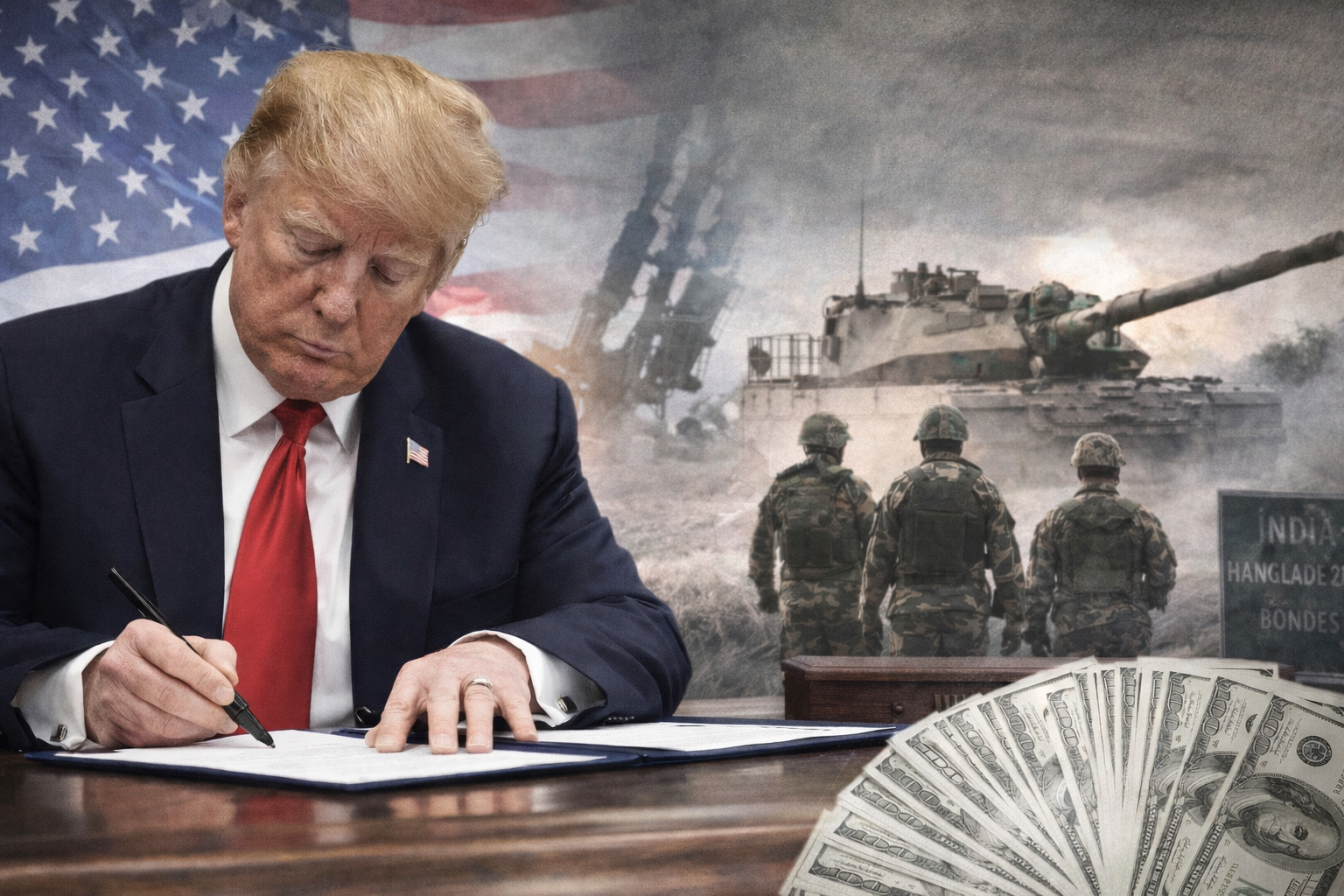
United States (US) President Donald Trump has signed into law the fiscal 2026 National Defense Authorization Act (NDAA), authorising nearly $1 trillion in annual military spending, despite provisions that provide new assistance to Ukraine and limit his ability to scale back US troop levels in Europe.
The White House confirmed the signing on December 18. The move took place without a public Oval Office ceremony or remarks from the President.
What does the 2026 National Defense Authorization Act provide for?
The fiscal 2026 NDAA authorises a record $901 billion in defence spending, around $8 billion more than the amount requested by the Trump administration. The legislation governs a wide range of military policy decisions, including procurement of ships, aircraft and missile systems, troop pay, and responses to global security challenges.
The bill represents a compromise package, combining separate measures passed earlier by the House of Representatives and the Senate, where Republicans currently hold majorities.
Why is the bill significant for Ukraine and Europe?
Despite President Trump’s long-standing scepticism towards expanding US security commitments in Europe, the NDAA includes provisions aimed at strengthening European defence.
The legislation allocates $800 million for Ukraine under the Ukraine Security Assistance Initiative, with $400 million earmarked in each of the next two years. The funding is used to pay US defence companies to supply weapons to Ukraine’s military.
The bill also authorises the Baltic Security Initiative and provides $175 million to support the defence capabilities of Latvia, Lithuania and Estonia.
In addition, the NDAA limits the Department of Defence’s ability to reduce US troop levels in Europe below 76,000 personnel and prevents the US European Commander from relinquishing the role of Supreme Allied Commander Europe under the North Atlantic Treaty Organisation (NATO).
How does the bill align with Trump’s defence priorities?
The White House said President Trump supported the legislation because it codifies into law several aspects of his executive orders. These include funding for the Golden Dome missile defence system and the removal of diversity, equity and inclusion programmes within the Pentagon.
Trump has previously argued that European allies should bear a greater share of their own defence costs and has signalled a reassessment of US security commitments on the continent in his recently published National Security Strategy.
How does this compare with Trump’s past stance on the NDAA?
Congress has passed the NDAA every year for 65 consecutive years, though the tradition nearly ended during Trump’s first term. In December 2020, Trump vetoed the defence bill over disagreements related to renaming military bases bearing Confederate names and provisions concerning legal protections for technology companies.
That veto was overridden by Congress in January 2021, shortly before Trump left office, marking the only successful veto override of his first term.
The signing of the 2026 NDAA highlights the continued role of Congress in shaping US defence policy, even as the White House seeks to recalibrate America’s military posture abroad.