


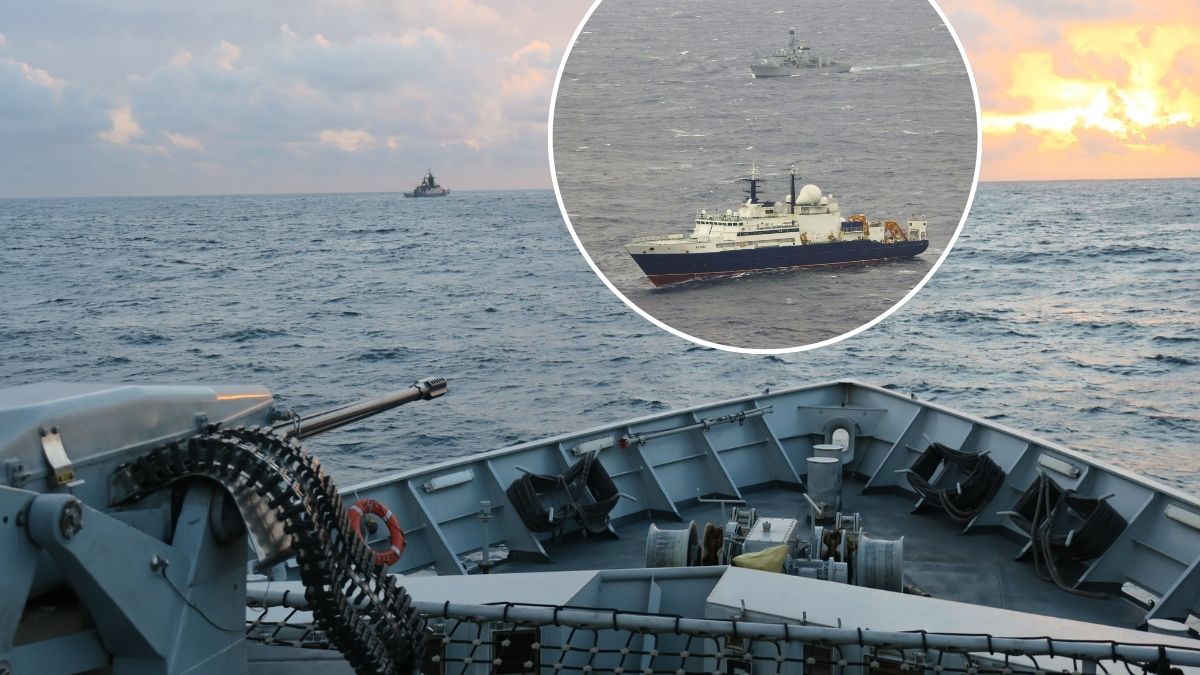
In a fresh escalation that underscores Moscow’s expanding pattern of brinkmanship, the United Kingdom has intercepted a Russian Navy corvette and a tanker sailing through the English Channel. According to the British Defence Ministry, HMS Severn shadowed the Russian corvette RFN Stoikiy and the tanker Yelnya.
According to UK Defence Secretary John Healey, there has been a sharp 30% rise in Russian naval activity around UK waters over the past two years. Just last week, it was learnt that the Russian spy ship Yantar was spotted off the coast of Scotland and it used lasers to disrupt RAF pilots tracking its movements.
London has significantly bolstered its maritime vigilance, stationing warships along its coastline and deploying three RAF Poseidon maritime surveillance aircraft to Iceland under a NATO mission to track Russian submarines and surface vessels in the North Atlantic and Arctic.
Russian naval activity in English waters
This latest maritime standoff comes just days after a startling revelation that the Russian spy ship Yantar used lasers to target the pilots of British surveillance aircraft monitoring its movement near Scotland. British Defence Secretary Healey called the act “reckless and dangerous,” warning Moscow that the UK would be ready for any incursion.
These disruptive maneuvers reflect a familiar pattern, indicating a deliberate attempt by the Kremlin to push boundaries while avoiding direct conflict, similar to its tactics in Ukraine, where Russia has repeatedly stalled peace efforts, violated ceasefires, and escalated hybrid warfare.
Healey made it clear that such provocations will not shake Britain’s commitment to Ukraine. “My message to Russia and to President Putin is this: We see you, we know what you’re doing, and we are ready,” he stated.


Is Moscow provoking Europe to create a new security crisis?
The Russian Embassy in London accused the UK of “whipping up militaristic hysteria” and insisting that Moscow has no intention of undermining British security. “London’s Russophobic course and the whipping up of militaristic hysteria are contributing to the further degradation of European security, creating the conditions for new dangerous situations,” the embassy said.
Yet these claims stand at odds with a long trail of destabilising actions – Russian drones crossing into NATO airspace, sabotage attempts across European infrastructure, interference operations targeting ports, power grids, and undersea cables, among other things.
As the war in Ukraine drags on, fuelled by Russia’s refusal to engage in meaningful peace efforts, Moscow appears increasingly intent on widening the theatre of provocation. The intercept in the English Channel is not an isolated incident but a symptom of Russia’s growing appetite for brinkmanship.


Meanwhile, it is perntinent to recall that the UK Royal Navy had in May 2025 dispatched two vessels and the 814 Naval Air Squadron – also known as the “flying tigers” – to shadow the Russian warship as it sailed west through the English Channel to meet the Sparta IV and General Skobelev. The vessels were returning from the Mediterranean.
Defence Secretary Healey underscored that the rise in Russian activity in UK waters was evidence of increased “Russian aggression right across the board” which, according to him, is impacting Europe, not just Ukraine.