


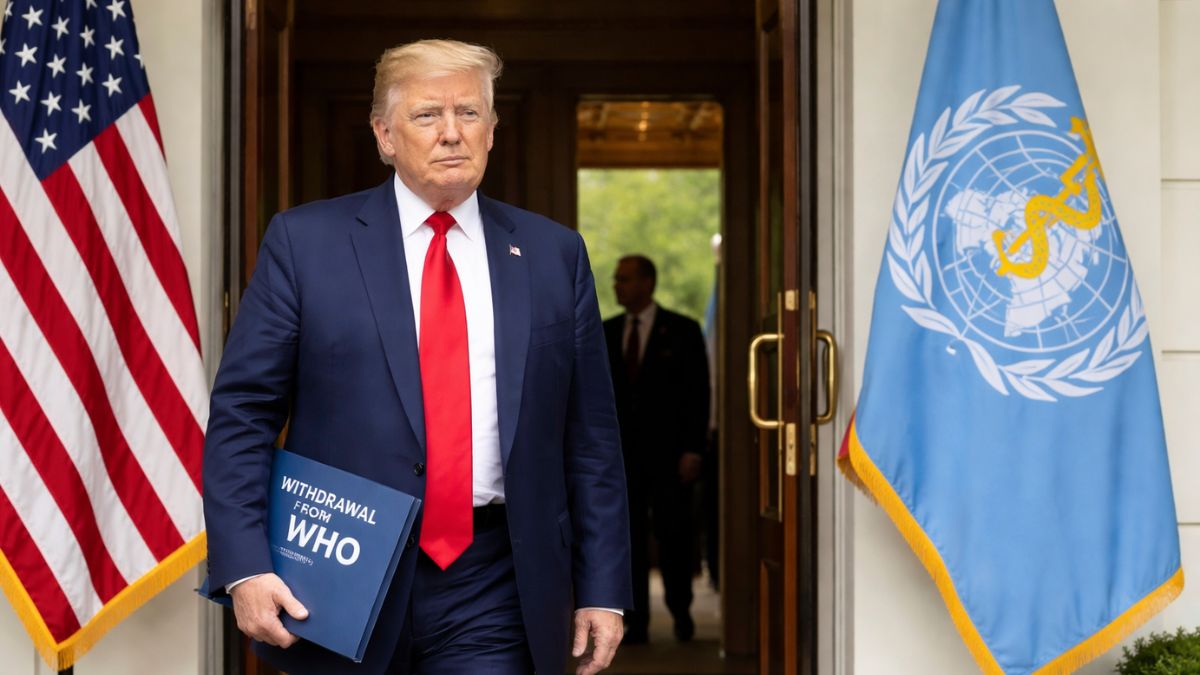
Days after announcing that it will exit 66 international organisations, many of which are United Nations (UN) bodies, the United States has formally exited the World Health Organisation (WHO), a move that could impact the global public health system in a big way. US President Donald Trump had ordered the withdrawal a year ago, accusing the agency of failing to adopt reforms and mishandling the pandemic.
The decision, finalised on Thursday (January 22, 2026), marks a dramatic escalation of President Trump’s long-standing criticism of the UN health body and could have far-reaching consequences for disease surveillance, emergency response and global health financing.
Why did the US quit the WHO?
Washington said the decision reflects what it described as the WHO’s “failures” in handling the COVID-19 pandemic. President Trump had signalled the move on the first day of his presidency in 2025, issuing an executive order to initiate the withdrawal process.
US health and State Department officials argued that the organisation had cost the country trillions of dollars through mismanagement and lack of accountability. The US has “no plans to participate as an observer” and “no plans of rejoining” the WHO in the future, according to a press release from the US Health and State Departments.
Instead, the US plans to pursue bilateral cooperation with countries on disease surveillance and public health priorities, bypassing multilateral institutions altogether.
What about the legal and financial obligations?
Under US law, Washington was expected to give a year’s notice and clear all outstanding dues, estimated at around $260 million, before leaving the organisation. However, the State Department disputed that payment of arrears was a legal precondition for withdrawal. “The American people have paid more than enough,” a State Department spokesperson said.
On Thursday, witnesses reported that the US flag had been removed from outside the WHO headquarters in Geneva, symbolising the formal end of America’s membership.
How will this impact the WHO financially?
The US has historically been the WHO’s single largest donor, contributing nearly 18% of its total funding. Its exit has already triggered a financial crisis at the agency. “For decades, the United States has been the world’s largest and most consequential contributor to global health, saving millions of lives,” US Health department said.
In recent years, the US assessed contributions (mandatory dues) averaged approximately $111 million annually. In addition, the United States provided voluntary contributions averaging roughly $570 million per year, amounting to billions of dollars over time, often exceeding the combined contributions of many other member states.
The WHO has cut its senior management team by half, scaled back programmes across regions and announced plans to reduce its workforce by about 25% by mid-year. The organisation has also warned that it is yet to receive US membership fees for 2024 and 2025.
What are global leaders and experts saying?
WHO Director-General Tedros Adhanom Ghebreyesus has repeatedly urged Washington to reconsider, warning that global health security depends on cooperation rather than fragmentation.
Legal experts have also raised concerns. Lawrence Gostin, a leading authority on global health law at Georgetown University, told Reuters that the move is “a clear violation of US law,” though he added that Trump was “highly likely to get away with it.”
Bill Gates, whose foundation is a major funder of global health initiatives, said he does not expect the US to reverse course soon but vowed to continue advocating for re-engagement. “The world needs the World Health Organization,” Gates said on the sidelines of the World Economic Forum in Davos.