


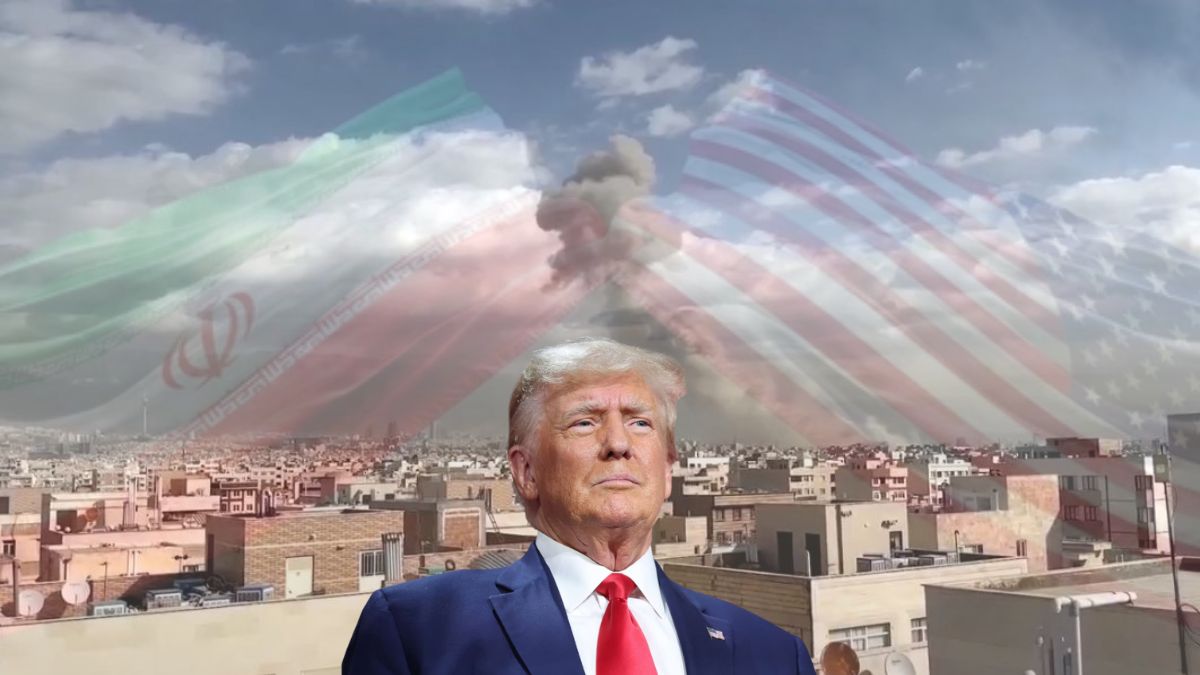
The US has declared that its ultimate goal in West Asia is to ensure a transition that no longer poses a global security threat, outlining the Trump administration’s strategic objective in its current military conflict with Iran.
At the Raisina Dialogue, United States Deputy Secretary of State Christopher Landau said the historical friction between the two nations over decades was manifested in Iran’s call for “death to America” since the Iranian Shah was overthrown by an Islamic revolution, when he was still 15 years old.
Landau said the US military action on Iran was due to the failure of diplomatic overtures on Tehran’s nuclear programme and emphasised that the Trump administration “did not start out seeking to reach this state of affairs.”
“We tried very, very hard to explain our red line, which is no development of a nuclear weapon,” he said, noting that Iran posed a global instability that its nuclear goal followed.
“I mean, could you imagine what a threat to the world it would be to have an Iran that basically was able to blackmail the world with a nuclear device?” he said.
“And I think we tried very hard to talk sense into the Iranians, to say this is our red line. Ultimately, we concluded that it would not work. So, you know, these are unsettled days right now,” the senior official added.
Looking ahead, Landau called for a collaborative international effort to support change in Iran’s political landscape, while stressing that the final decision rests with Iran’s citizens.
In a signal to India, he proposed that the ideal substitute for traditional fuel for New Delhi’s energy security would be the US.
“I hope you are thinking of alternate sources. I don’t see a better alternative source than the United States of America. We are an energy-rich country. We want to cooperate with you. That is one of the areas where we can cooperate,” he said.
Landau, a Trump administration official, promised India “a steadfast partnership” to navigate the logistical challenges posed by the war in Iran. “Obviously, you know, there are long-term and short-term issues here, and we will work with you to make sure that your energy needs are met in the short term as well as the long term.”
US Pledges Support to Israel as Iran Takes Battle to Entire West Asia
Meanwhile, Israeli Defence Minister Israel Katz spoke with his American counterpart Pete Hegseth, as the fighting between the US-Israel combine and Iran continued.
The Israel Defence Ministry said Hegseth thanked Katz for Israel’s condolences following the deaths of six US soldiers. “Keep going to the end – we are with you,” the US War Secretary told his Israeli counterpart. He also promised to deploy additional American forces in West Asia.
From Iran, the Islamic Revolutionary Guards Corps (IRGC) launched the 19th wave of attacks on US and Israeli assets in West Asia under ‘Operation True Promise 4’ with a combined missile and drone strikes, it said on Thursday (March 5, 2026).
“This operation against the positions of American-Zionist terrorists in the heart of the occupied territories and American terrorist bases began with massive explosions under the blessed code name ‘Ya Hassan ibn Ali (peace be upon him)’,” it said.
The IRGC said it launched hundreds of ballistic missiles and explosive drones during the operation against what it described as “sensitive and strategic targets.”
Targets cited by the group included locations in Tel Aviv and Jerusalem, as well as American military positions and interests in regional states such as Kuwait, Bahrain, and Qatar.
The IRGC also claimed attacks on US naval assets, including the aircraft carrier USS Abraham Lincoln (CVN-72) and an American destroyer operating in the Indian Ocean.
In a separate statement, the IRGC said it carried out a “critical strike” against the largest American data centre in the region, identifying the facility as an Amazon facility in Bahrain.
Iran also announced that it had hit Kurdish groups in Iraq, and warned them against escalating the military action. Hezbollah’s secretary-general, Naim Qassem, said the Lebanese resistance movement’s military actions were after a year of strategic patience.
In a televised address on Wednesday (March 4), Qassem said: “For a year and three months, the Israeli and American enemy has continued its aggression. We adhered to the ceasefire agreement of November 27, 2024, alongside the Lebanese state, but Israel did not adhere to a single clause.”
He said that despite the deal intended to end deadly escalations, Israel has claimed the lives of approximately 500 people across Lebanon since its conclusion.
The period also saw more than 10,000 Israeli land, sea, and air violations against Lebanese territory, Qassem said, asserting that Hezbollah had avoided retaliation to facilitate global mediation.
“We did not respond to repeated Israeli attacks so as not to be accused of obstructing diplomatic efforts, and because responsibility lies with the state,” he remarked, noting that these efforts “achieved nothing over fifteen months,” he claimed.
The Hezbollah chief also defended the group’s arsenal as a fundamental necessity, stating that “as long as occupation exists, the resistance and its weapons are a legitimate right” that remains “legally and internationally recognised.”