


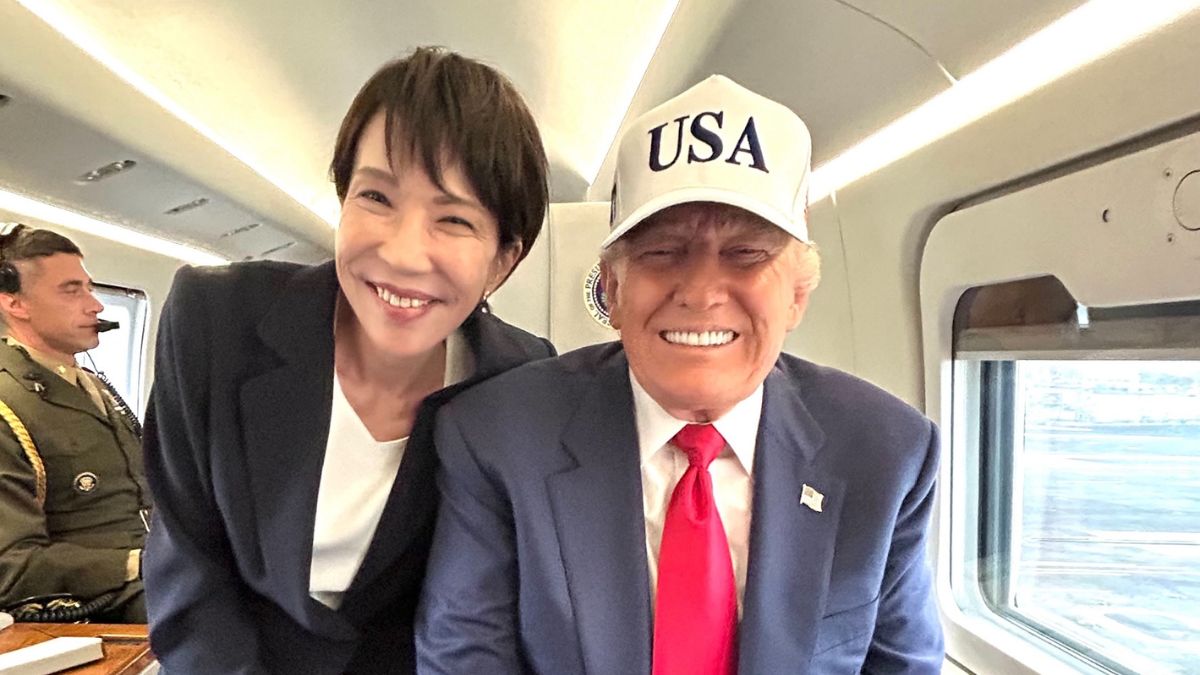
Japan on Thursday (November 27, 2025) firmly denied media reports claiming US President Donald Trump privately urged Prime Minister Sanae Takaichi not to provoke Beijing over Taiwan. A Wall Street Journal report said Trump subtly advised Takaichi during a recent call to avoid escalating tensions with China.
This comes after Japan’s first woman PM declared that a Taiwan attack could trigger Japan’s military response under national security laws. However, the WSJ report has been dismissed by Japan’s Chief Cabinet Secretary Minoru Kihara, who said, “there is no such fact.”
He added that Tokyo had formally sought clarification from the WSJ. Japanese officials speaking off-record also rejected the reports, refusing to disclose what the two leaders actually discussed.
Did Trump really ask Japanese PM to not provoke China?
The WSJ report claimed that US President Trump spoke with Takaichi after Chinese President Xi Jinping called him and spoke about China’s historic claim to the democratic self-governing island as well as Washington and Beijing’s joint responsibility to manage the world order.
“The article you mentioned contains a statement that President Trump advised not to provoke the Chinese government over Taiwan sovereignty issues, but there is no such fact,” Japanese Chief Cabinet Secretary Kihara said at a regular press conference on Thursday afternoon, when asked about the report.
Kihara reaffirmed that Trump described Takaichi as a “very close friend” and assured her she could call him anytime. China, meanwhile, continues to pressure Takaichi to retract her statement linking Japan’s security directly to a Taiwan contingency.
Why are Takaichi’s Taiwan remarks so sensitive?
In early November, the new Japanese prime minister made a rare and politically consequential statement that a Chinese attack on Taiwan could be considered a “survival-threatening situation” for Japan, a designation that legally allows Tokyo to deploy its Self-Defense Forces to support allies like the United States.
The declaration stirred anger in Beijing, sensitivity in Washington, and unease in Tokyo. Takaichi has since avoided further specifics but maintains that Japan will judge any crisis based on “all relevant information”.
Taiwan gearing up with a $40 billion defence jolt?
Across the strait, Taiwan has responded to China’s growing assertiveness with its largest military funding push in years. President Lai Ching-te on Wednesday (November 26, 2025) unveiled a $40 billion supplementary defence budget, aimed at accelerating US weapons purchases and achieving “high level” of readiness by 2027 to deter China.
In a Washington Post op-ed, Lai framed the spending as essential for “defending democratic Taiwan”, stressing that Beijing seeks to turn the island into “China’s Taiwan.” “There is no room for compromise on national security,” Lai said, warning that concessions to aggression only bring “enslavement.”
Taipei plans to raise defence spending to 5% of GDP by 2030, the highest level in over a decade. Washington’s de facto ambassador, Raymond Greene, welcomed the decision, calling it crucial for acquiring “critical asymmetric capabilities.”
How is China responding to both Tokyo and Taipei?
Beijing has reacted sharply to recent developments on both fronts. It continues to demand that Takaichi retract her Taiwan remarks, it has warned Japan over missile deployments on islands near Taiwan, and reiterated that it will “crush all foreign interference” in its Taiwan policy
Peng Qingen of China’s Taiwan Affairs Office declared that Beijing has the “strong ability” to defend territorial claims and accused foreign governments of undermining regional stability.