


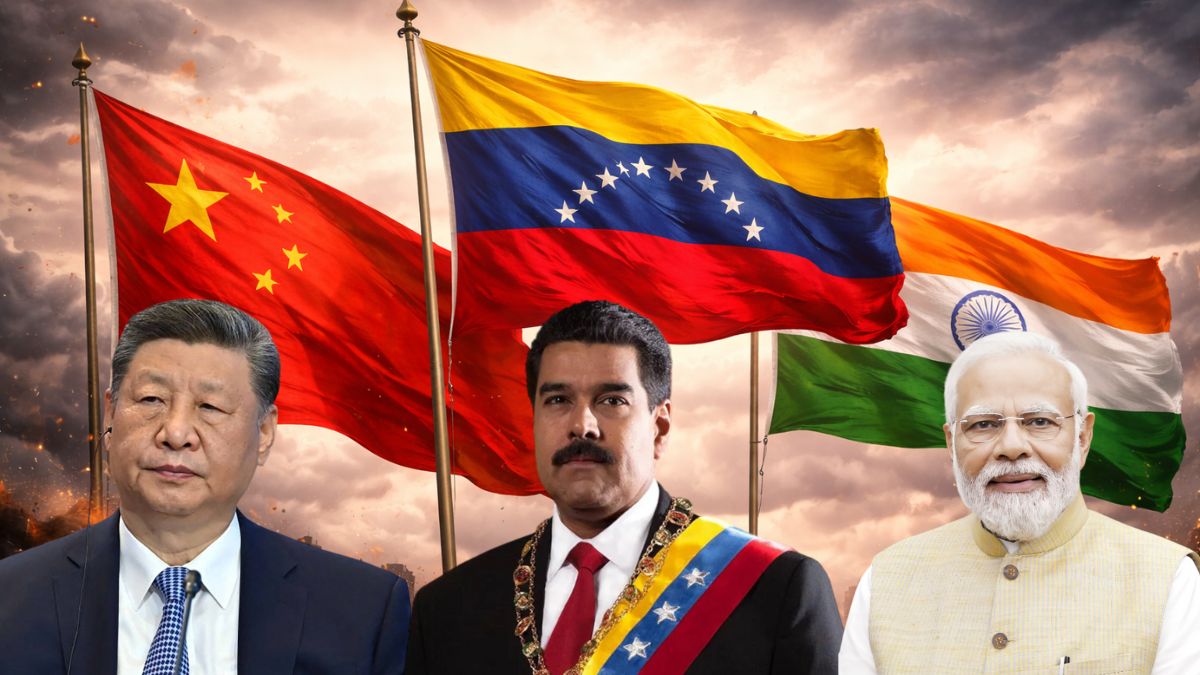
The dramatic crisis in Venezuela, marked most recently by a surprise US military operation leading to the capture of President Nicolás Maduro, has triggered global geopolitical alarm, with far-reaching implications for major emerging powers like India and China.
Washington’s actions have intensified tensions over international law, sovereignty, and energy supply routes, drawing sharp criticism from Beijing and stoking debate in New Delhi over strategic interests and autonomy.
What is the immediate global reactions and strategic context?
China has strongly condemned the US intervention, branding it a violation of international law and a threat to regional peace, reflecting Beijing’s significant political and financial ties with Caracas.
The United Nations Secretary-General has warned that such actions could set a “dangerous precedent,” intensifying diplomatic fault lines across the Global South.
Former Indian diplomats and commentators, echoing themes similar to those shared by NITI Aayog member Dr. Arvind Virmani and former foreign secretary Kanwal Sibal on social media, have underscored that foreign interventions undermine sovereign norms and warrant sober diplomatic responses, particularly for states like India that champion non-alignment.
How is India affected, economically insulated but strategically alert?
Despite headlines about dramatic events in Caracas, India’s direct economic exposure remains limited. According to the India-based think tank Global Trade Research Initiative (GTRI), trade and oil imports from Venezuela have sharply declined due to longstanding US sanctions, leaving bilateral economic engagement small and unlikely to alter India’s energy security significantly.
In 2024-25, Venezuelan crude comprised only a fraction of India’s total oil imports, a steep fall from earlier years when India was a meaningful buyer. This has led major Indian outlets to conclude that India is largely insulated from the immediate energy shock caused by Venezuelan instability.
What are India’s precautionary measures regarding Venezuela?
However, New Delhi is taking precautions: the Ministry of External Affairs has issued advisories urging Indian citizens to avoid non-essential travel to Venezuela amid escalating volatility.
Analysts also argue that India must guard its strategic autonomy and avoid entanglement in great-power rivalries, ensuring that energy procurement decisions are not dictated by external geopolitical pressures.
This echoes Dr. Virmani’s broader warnings about the risks of ceding autonomy to major powers in global crises.
What are China’s stakes that are more tangible but muted by market dynamics?
China remains a major historical buyer of Venezuelan crude and a key lender to Caracas, with long-standing financial and energy investments. While Chinese imports have fluctuated, Beijing’s reaction to US action underscores its broader geopolitical contest with Washington for influence in Latin America.
Beijing’s rhetoric reflects strategic concerns that go beyond oil, including a desire to counter US unilateralism and maintain access to diversified energy sources.
Global energy analysts note that Venezuela’s massive oil reserves, though underproduced due to years of mismanagement and sanctions, still matter to China’s long-term diversification strategy.
Does the Venezuela crisis have strategic echoes?
In sum, the Venezuela crisis has limited direct economic fallout for India due to reduced oil dependence and diversified energy sourcing, but it underscores broader geopolitical dynamics that New Delhi must navigate carefully.
For China, the situation highlights persistent friction with the US over global influence, particularly in energy-rich regions beyond the Asia-Pacific.
Both countries, along with other emerging powers, face strategic choices in balancing economic interests, great-power competition, and principles of sovereignty as the Venezuelan crisis unfolds.