


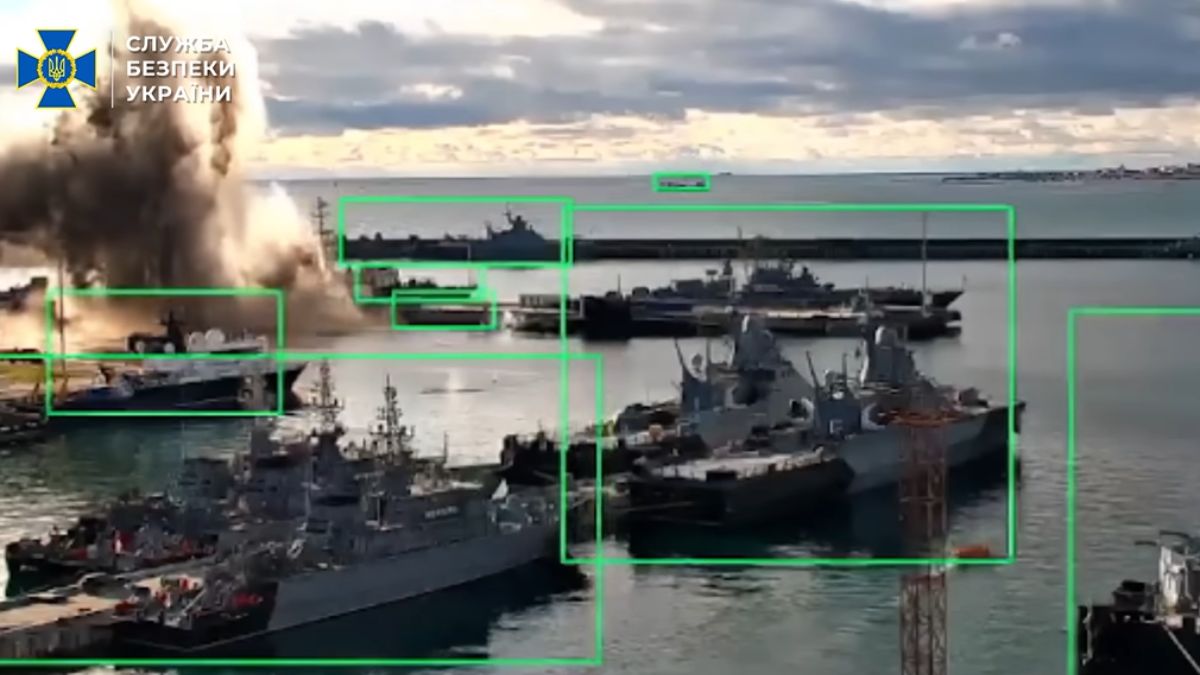
In a first-of-its-kind operation nearly four years into the Russia–Ukraine war, Ukrainian underwater drones have struck a Russian submarine, marking the first publicly acknowledged use of Kyiv’s sub-sea unmanned weapons against an enemy vessel. Ukraine’s domestic intelligence agency said the attack caused critical damage.
Even Russia has acknowledged the claim but only in part, confirming the strike but denying any serious harm to the submarine. According to a statement by Ukraine’s Security Service (SBU), the cost of a class ‘Varshavyanka’ (Kilo-class) submarine, which they destroyed, is about $400 million.
The incident signals a major escalation in Ukraine’s drone-centric warfare strategy and highlights a new dimension of the conflict, coming at a time when US-brokered peace negotiations that have sparked fears among Ukrainians that they will be bullied to accept settlement terms with Russia.
Ukraine hits Russian submarine: What did the SBU target?
According to the security agency, the target was a Kilo-class diesel-electric submarine docked at a Russian Black Sea port near Novorossiysk. At the time of the strike, the vessel was reportedly equipped with four launchers for Kalibr cruise missiles, a key weapon Russia has repeatedly used to strike Ukrainian cities and infrastructure.
Kilo-class submarines, while not nuclear-powered and not armed with nuclear ballistic missiles, are considered among Russia’s most capable conventional undersea platforms and play a central role in Moscow’s Black Sea operations.
How did Ukraine carry out the attack?
The operation was jointly conducted by Ukraine’s Security Service and Navy, underscoring the increasing integration of intelligence and military capabilities in Kyiv’s drone campaign. Officials said the strike was executed using a new class of underwater drones known as Sub Sea Baby.
While few technical details were released, Ukraine has been developing a fleet of unmanned mini-submarines, some as small as a foot in diameter and others exceeding a yard, designed to function as long-range torpedoes. Some models are believed to have ranges stretching hundreds of miles, allowing Ukraine to threaten Russian naval assets far from the front line.
“The cost of a class «Varshavyanka» submarine is about $400 million. Given the introduced international sanctions, the construction of a similar submarine can currently cost up to $500 million. This class of submarines is also known as «Black Hole» because of the hull’s ability to absorb sounds and remain inconspicuous to sonars,” the SBU stated.

Why now and what message was Kyiv sending?
The strike came on a politically significant day, as President Volodymyr Zelensky met US negotiators and European leaders in Berlin to discuss peace proposals. Ukrainian officials appear to be using battlefield successes to reinforce Kyiv’s position at the negotiating table.
“Strong positions inside the country translate into strong positions in negotiations to end the war,” Zelensky said earlier while visiting frontline positions near Kupiansk. The submarine strike reinforces his argument that Ukraine retains the ability to inflict meaningful damage on Russia’s superior military forces.
Alexander Kamyshin, an advisor to President Volodymyr Zelenskiy, wrote on X that it was the first time in history that an underwater drone had neutralised a submarine, a claim rejected outright by Russia’s Black Sea Fleet hours later.
How does this fit into Ukraine’s broader drone war?
The underwater attack is part of a wider surge in Ukrainian drone operations. On the same night, Ukraine launched a large-scale aerial drone strike targeting a gas processing plant inside Russia, according to Ukrainian Armed Forces statements.
Over the course of the war, drones have emerged as one of Kyiv’s most effective asymmetric tools. Ukrainian unmanned attacks have pushed much of Russia’s Black Sea Fleet out of open waters, forced warships to remain in port, and disrupted Russian oil refineries and so-called “shadow fleet” tankers used to bypass Western sanctions.
Is this Ukraine’s first strike on a Russian submarine?
While this marks Ukraine’s first confirmed use of underwater drones against a submarine, it is not the first time Kyiv has targeted Russian undersea assets. Ukraine previously struck the Kilo-class submarine Rostov-on-Don twice with missiles while it was docked in Crimean ports, once in September 2023 and again in August 2024.
Despite these high-profile strikes, Ukraine remains under pressure on the ground, largely holding defensive positions against a Russian offensive making incremental gains along parts of the front line. With this successful deployment of underwater drones, Kyiv could be aiming to signal it is steadily expanding its ability to offset manpower and firepower disadvantages through innovation.