


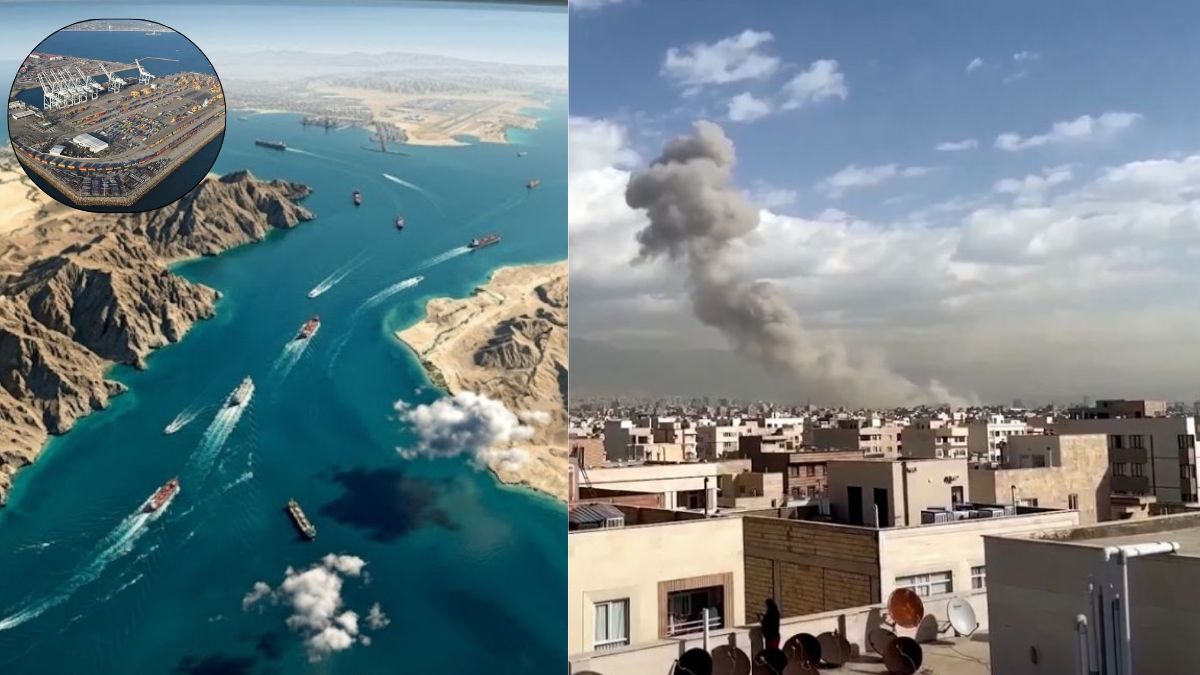
The US-Israel strike inside Iran on Saturday (February 28, 2026) and the retaliation by Tehran all over West Asia have sent shockwaves globally, as the military crisis in the region is set to hit international oil trade and strategic interests of nations, including India.
One of the fallouts from the war in West Asia would be felt in the Strait of Hormuz, a narrow waterway that is a key passage for oil supplies to other parts of the world.
Iran has already announced its intent to shut down the Hormuz Strait as a retaliatory action for the US-Israel strike on its territory that killed some top political and military leaders of the country.
The closure of the Hormuz Strait and the West Asia war would have an adverse impact on crude oil prices, which are expected to rise as production and supply chains are disrupted.
Why is the Hormuz Strait a key lifeline for the oil trade?
Situated between Iran in the north and the UAE and Oman in the south, the Hormuz Strait is the main supply route between the Persian Gulf and the Indian Ocean, stretching about 160 km.
Its importance can be gauged from the one-fourth of all global seaborne oil shipments (over 20 million barrels per day) passing through it day in and day out.
The Hormuz Strait is the critical artery for the energy security of the world, as Gulf and OPEC nations entirely depend on it to keep their supply chains running smoothly.
Attempts by Iran or the US to stop shipments through the Hormuz Strait would mean denying several nations and blocs, including China, India, Europe, and the US itself, with oil and gas supplies, causing an upheaval in crude prices, potentially unsettling the global economy.
How will the Hormuz Strait closure impact India?
India’s energy security depends on supplies passing through the Hormuz Strait. Estimates indicate that about 90% of India’s crude oil demand depends on overseas supplies.
Though India has reduced its dependence on Iran for crude oil and diversified its sourcing, roughly 40% of its purchases still come from West Asian nations such as Iraq, Saudi Arabia, the UAE, and Kuwait.
India has also been reducing its sourcing of Russian oil in recent months following US sanctions on Russian suppliers.
Hence, a rise in oil prices due to the West Asian conflict could impact bottomline of Indian oil companies, as they shell out more for sourcing and supply chains, affecting energy security.
How does the West Asia Conflict impact India’s interest in Chabahar?
The West Asia conflict not only impacts India’s energy security, but also its strategic interests in Iran, including the Chabahar port, in which New Delhi has ploughed in over $120 million investment and another $250 million credit line.
The West Asia war would impact India Ports Global Limited’s operational control over the Shahid Beheshti Terminal, which has handled over 8.4 million tonnes of bulk and general cargo since 2018.
The Chabahar port also provides India with a direct route to Afghanistan and Central Asia, critical for humanitarian aid and economic connectivity, along with being central to the International North-South Transport Corridor (INSTC) to connect the Eurasian region.
The US sanctions on Iran were previously conditionally waived for India. However, in the 2026-27 Ministry of External Affairs budget announced in early February, India has provisioned no money at all to spend on Chabahar in the next fiscal.
Why would some Indian diaspora in West Asia need to be concerned?
India’s state like Kerala would now be on their toes after West Asia erupted into a military conflict again, as the Indian diaspora living and earning there would find themselves squeezed by the war.
Kerala alone has over 3 million diaspora living and working in West Asia in places like Bahrain, Qatar, the UAE, Saudi Arabia, Kuwait, and Israel.
The Indian diaspora is an important source of foreign remittances that help New Delhi to maintain a strong balance of payments in global trade.
Apart from that, Indians who visited their hometown on holidays in the recent weeks would find themselves stuck in India, unable to return to work in West Asia as airlines and airports close operations.
The Indian Ministry of External Affairs, on Sunday (March 1, 2026) issued an advisory to them to get their visas renewed and has facilitated the same at the immigration offices nationwide.
A day earlier, the Indian Embassy in Tel Aviv advised all its citizens to register with it immediately to facilitate swift assistance after the country launched a joint attack. It is estimated that around 40,000 Indians live and work in Israel.