


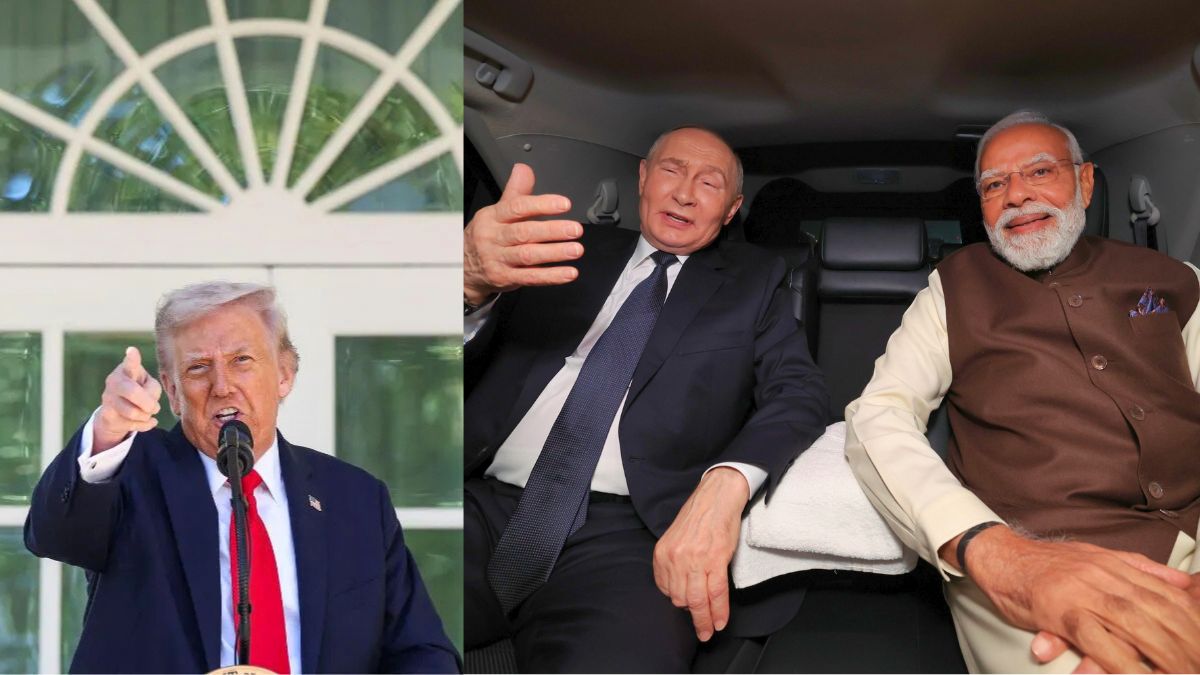
On the one hand, US President Donald Trump calls Prime Minister Narendra Modi a very good friend, on the other, he resorts to punitive measures for India like tariffs. However, it isn’t just New Delhi that is seeing the ill effects of such measure on the bilateral relations, but even US lawmakers feel the same.
From H-1B visa issue to heavy tariffs, US lawmakers have called out Trump for his policies that are damaging India but could do harm to the United States. They feel that President Trump’s policies are pushing India away at a moment of deep strategic importance. They even cited PM Narendra Modi’s recent picture with Russian President Vladimir Putin, saying that a picture speaks a thousand words.
At a House Foreign Affairs South and Central Asia Subcommittee hearing, US representatives Sydney Kamlager-Dove, Pramila Jayapal and Bill Huizenga said that Trump’s tariff threats, immigration restrictions, and coercive diplomacy were eroding years of progress in the US–India partnership.
Trump’s policies trigger alarm among US lawmakers
At the committee hearing, Representative Kamlager-Dove said that Trump’s approach toward India was “cutting our nose to spite our face.” Referring to the well-publicised car selfie of PM Modi with Putin, she said the image “is worth a thousand words” in explaining how coercive US policies are pushing India toward other major powers.
“Trump’s policies towards India can only be described as cutting our nose to spite our face… Being a coercive partner has a cost. And this poster is worth a thousand words. You do not get a Nobel Peace Prize by driving US strategic partners into the arms of our adversaries,” she stated.
The US lawmaker evern also condemned Trump’s newly announced $100,000 H-1B visa fee, calling it an attack on people-to-people ties. “Trump has also attacked the people-to-people ties between the US and India. The $100,000 fee on H-1B visas, 70% of which are held by Indians, is a rebuke of the incredible contributions Indians have made to science, technology, medicine, and the arts in the United States.”
Trump worsening India-US bilateral relationship?
She argued that President Trump inherited a strong bilateral relationship and squandered it. “Flush, flush, flush down the toilet, the capital that Americans have built over decades in service of Trump’s personal grievances and at the expense of our national interests.” Kamlager-Dove warned that, “Unless he changes course, Trump will be the American president who lost India.”
The US Representative noted that Biden handed over India’s bilateral relationship to Trump as a product of strategic discipline, but the current president changed course due to personal grievances, chasing India away.
How are tariffs deepening the US–India rift?
Trade friction further escalated sharply this week after Trump accused India of “dumping” cheap rice into the US market and suggested new tariffs may be coming. The comments were made as he announced a $12 billion support package for American farmers. When a US rice mill owner said imports from India, Vietnam and Thailand were depressing US prices, Trump blurted out he would “take care” of the issue.
These threats come on top of the 50% tariffs the US imposed on most Indian goods in August 2025, ostensibly over trade disputes and India’s continued purchases of Russian oil. Ongoing US trade delegation talks in India (December 10–11, 2025) have made little substantive progress and nothing major has been announced yet.
Representative Pramila Jayapal echoed these concerns, noting, “We also are facing challenges around tariffs, both here in the United States and in India. These tariffs are damaging India’s economy and also hurting American businesses and consumers.” She cited a Washington State family business that relies on Indian agricultural imports.
“They told me that these tariffs are the greatest threat to their business in over 120 years.”
Why are India-Russia ties adding to US anxiety?
Representative Bill Huizenga said that recent India–Russia engagements — including Putin’s warm visit to India and India’s participation in the SCO Summit — were raising “understandable concerns.” He told the hearing:
“…the first thing [Latvian parliamentarians] brought up was, ‘Please ask them to stop buying Russian oil so they don’t have the cash to be a threat to us.’ Message received, message delivered…” For many in Washington, India’s closer proximity to Russia is a direct consequence of strained ties with the US.
How are immigration policies threatening people-to-people ties?
Alongside tariffs, immigration is emerging as a major flashpoint. Trump’s decision to impose a $100,000 fee on H-1B visas, which are overwhelmingly used by Indian professionals, has drawn bipartisan criticism. Jayapal said, “This president has threatened people-to-people ties by shutting down legal pathways to immigrate, reminiscent of a legacy of discriminatory quotas that made it extremely difficult for Indians to immigrate in the first place.”
According to lawmakers, such policies undermine one of the strongest pillars of the bilateral relationship: academic, tech, and cultural links driven by the Indian diaspora.
India-US ties: What is the way forward?
Highlighting such issues, Kamlager-Dove urged urgent corrective action stating, “We must move with incredible urgency to mitigate the damage that this administration has done to the US-India partnership and return to the cooperation that is essential to US prosperity, security, and global leadership.”
With stalled trade talks, intensifying tariff threats, and shrinking diplomatic space, US lawmakers fear the Trump administration’s approach could push India to strengthen ties with alternative partners, notably Russia and China-led groupings, at the expense of long-term US strategic interests.