


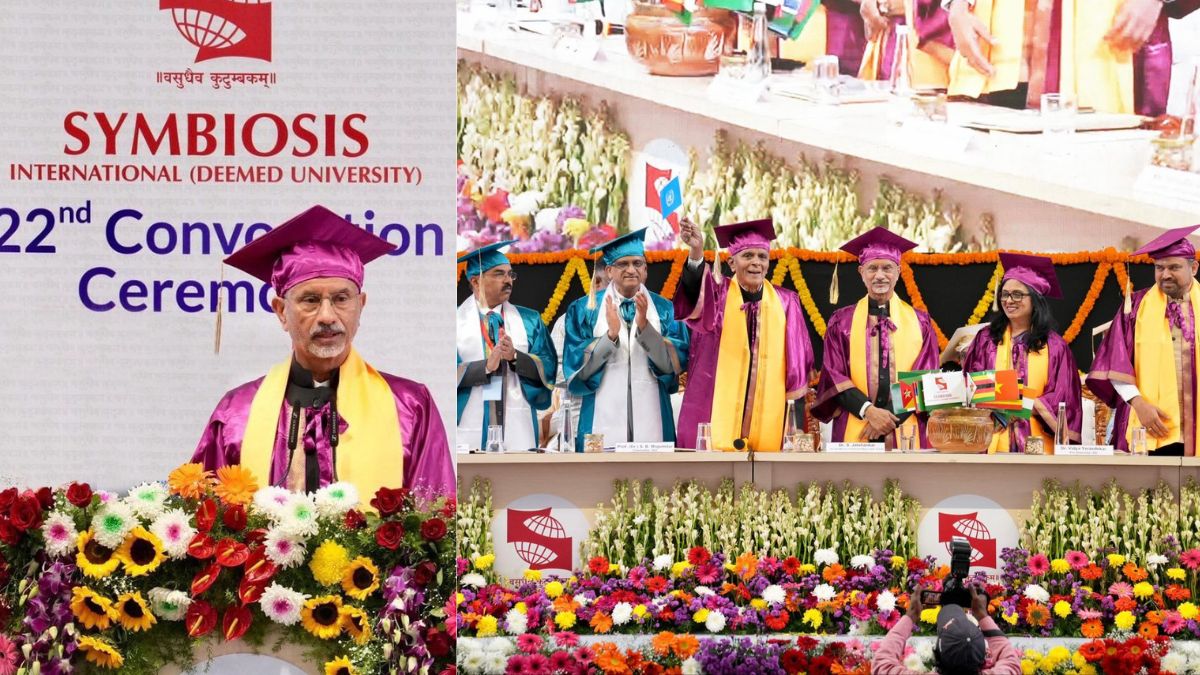
The global economic and political order has undergone a profound transformation, with multiple centres of power emerging and no single country capable of dominating world affairs across all issues, External Affairs Minister S Jaishankar said on Saturday (December 20, 2025), underscoring India’s growing confidence and relevance in a rapidly changing international system.
Speaking at the 22nd convocation of Symbiosis International (Deemed University) in Pune, Jaishankar said the era of universal global powers was over, giving way to a more competitive and complex multipolar world.
What was Indian EAM’s message to the world?
“No country, however powerful, can impose its will on all issues,” he said, adding that this shift has created a natural competition among nations and a new global balance.
According to the minister, power today is far more multidimensional than in the past. It now spans trade, energy, military strength, resources, technology, and talent, rather than being concentrated in a single domain.
“Several centres of power and influence have emerged,” he noted, pointing to the limits of traditional dominance in an interconnected world.
What was Jaishankar’s view on how nations operate?
Jaishankar said globalisation has fundamentally altered how nations and individuals operate. Unlike earlier eras, countries now operate effectively beyond their own borders in terms of resources, supply chains, markets, and partnerships.
This evolution, he said, has transformed the world not only into a global marketplace but increasingly into a “global workplace,” where talent and skills are increasingly moving across geographies.
Against this backdrop, the external affairs minister stressed the need for India to strengthen its manufacturing base alongside its globally competitive services sector.
A large economy like India, he argued, must develop substantial and contemporary manufacturing capabilities to keep pace with technological change and build a strong industrial work culture. Manufacturing and services, he said, are deeply interlinked and mutually reinforcing.
How does the world now perceive India?
Highlighting India’s improved global standing, Jaishankar said the country is now perceived abroad “much more positively and much more seriously” than before.
He attributed this to India’s national brand and the reputation of its people, noting that Indians are increasingly recognised for their strong work ethic, technological aptitude, and family-centric values. Praise for the Indian diaspora, he added, is a recurring theme in his conversations overseas.
How is India breaking old stereotypes?
Citing improved ease of doing business and living, Jaishankar said old stereotypes about India are steadily fading. The growth of global capability centres, rising demand for Indian professionals abroad, and numerous individual success stories all point to a deeper transformation.
“Perhaps more than others, India is today defined by its talent and by its skill,” he said.
How did decolonisation impact geopolitics?
On broader global economic shifts, Jaishankar observed that decolonisation allowed many nations to prosper by taking control of their destinies, though outcomes depended heavily on leadership and policy choices.
While China has gained the most in this period, India has also progressed significantly, particularly since economic reforms and even more so in the last decade.
In contrast, he said, much of the Western world now feels it has stagnated, contributing to a reshaped global pecking order