


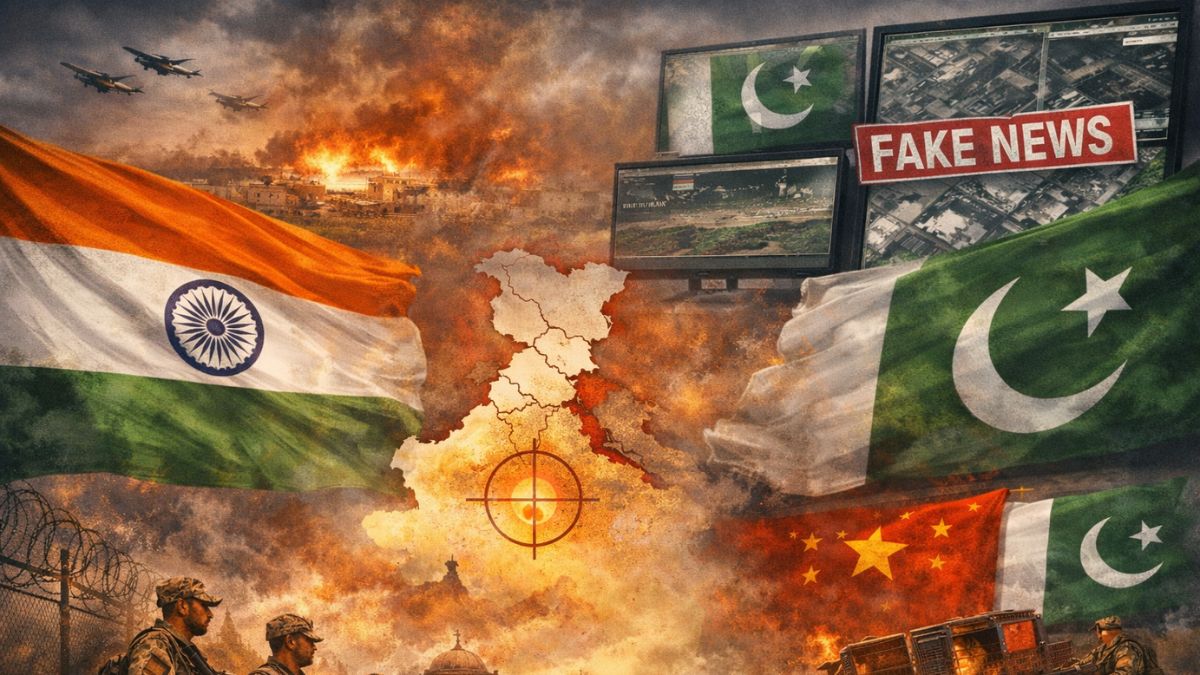
India has sent an unambiguous message to Pakistan on terrorism, deterrence, and sovereignty, even as Islamabad revives discredited narratives around Operation Sindoor and backs China’s claim of mediating the 2025 India-Pakistan confrontation.
External Affairs Minister S. Jaishankar’s blunt remarks — “You can’t ask for water and continue terrorism” — now frame New Delhi’s wider response to what officials and analysts describe as a mix of cross-border terror, digital disinformation, and diplomatic misrepresentation.
What did India’s EAM tell Pakistan?
Speaking at the inauguration of Shaastra 2026 at IIT Madras, Jaishankar made it clear that goodwill, cooperation, and issues such as water sharing cannot coexist with persistent terrorism.
India, he said, cannot be expected to extend concessions to a neighbour that “deliberately, persistently and unrepentantly” uses terror as state policy.
Emphasising India’s sovereign right to self-defence, Jaishankar underlined that no external power has the authority to dictate how New Delhi responds to threats to its citizens.
“How we exercise that right is up to us. Nobody can tell us what we should or should not do,” he said, calling it a matter of common sense and reciprocity.
How is Pakistan attempting to reshape perceptions of Operation Sindoor?
The remarks come amid a renewed Pakistani attempt to reshape perceptions of Operation Sindoor, India’s counterterrorism military response launched in May 2025 following a major terror provocation.
Months after the hostilities ended, Pakistan-based social media handles have begun circulating unverified satellite images claiming strikes on Indian military facilities, including sites near Amritsar in Punjab. The visuals allege damage to Indian installations, claims that analysts say collapse under basic scrutiny.
Independent verification of the images shows no evidence of destruction, blast impact, or secondary damage. Facilities cited in the posts remain fully intact, with no craters, debris fields, scorch marks, or structural collapse — indicators that would be unavoidable after aerial or missile strikes.
Open-source intelligence experts reviewing comparative imagery from before, during, and after the conflict found no observable changes at the alleged targets, directly contradicting the online narratives.
How has Pakistan never provided credible evidence to support its Sindoor claims?
The timing of this renewed push has raised further doubts. During the actual hostilities, Pakistan failed to present any credible satellite imagery or independently verifiable proof of successful strikes on Indian military assets.
The sudden appearance of these visuals seven months later, without timestamps, satellite-source metadata, or corroboration from neutral observers, has led analysts to conclude that the material is a post-facto attempt to manufacture evidence rather than document reality.
This pattern is not new. During and immediately after Operation Sindoor, Pakistani narratives were marked by exaggerated claims of “victory ratios” and vague assertions of striking India’s strategic “centre of gravity.”
None were supported by open-source intelligence or independent reporting, and they failed to gain international traction. Analysts say the recycling of such claims now appears aimed at domestic consumption, reinforcing morale at home while attempting to sow confusion abroad through repetition rather than proof.
Why has Pakistan rushed to endorse China’s mediation claims?
Parallel to the disinformation campaign, Pakistan has also endorsed China’s claim that it mediated during the May 2025 India-Pakistan conflict.
At a recent press briefing, Pakistan’s Foreign Office said Chinese leaders were in “constant touch” with Islamabad and had made “certain contacts” with Indian leadership during the four-day confrontation, asserting that these exchanges helped “bring down temperatures.”
The belated endorsement has raised eyebrows, not least because Islamabad had earlier credited the pause in hostilities to US President Donald Trump.
India, however, has consistently maintained that the military pause followed a direct request from Pakistan’s Director General of Military Operations to his Indian counterpart, rejecting any third-party mediation. New Delhi has also dismissed similar claims made by Chinese Foreign Minister Wang Yi.
Taken together, the episodes underscore India’s hardened counterterrorism posture after Operation Sindoor. Jaishankar’s message draws a clear red line: engagement cannot be divorced from behaviour.
Water, trade, and diplomacy, New Delhi insists, cannot be pursued in parallel with terrorism, propaganda, and revisionism. As analysts note, India’s response reflects a doctrine shaped by deterrence, factual transparency, and the refusal to allow either violence or disinformation to rewrite established realities.