


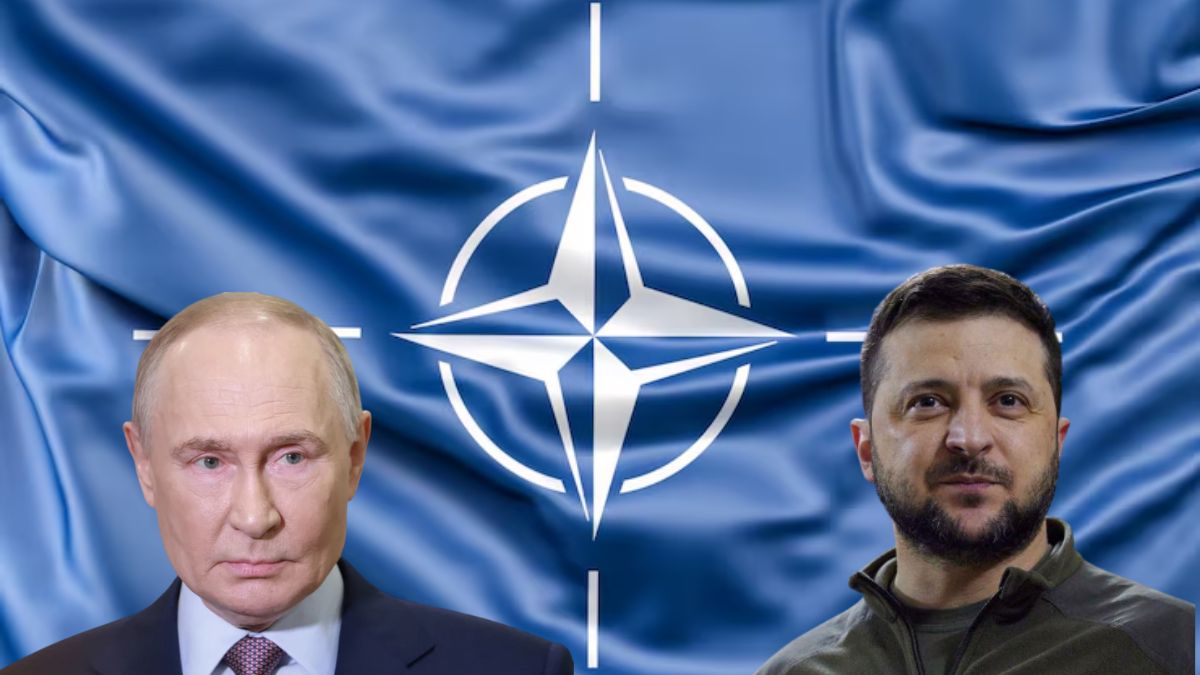
Ukrainian President Volodymyr Zelenskyy has offered to drop Ukraine’s long-standing ambition to join NATO in exchange for binding Western security guarantees, marking a major potential concession in talks aimed at ending the war with Russia.
However, Kyiv has firmly rejected US-backed proposals that would require Ukraine to cede territory to Moscow, even as discussions intensify around an accelerated path for Ukraine to join the European Union as early as 2027.
How did Zelenskyy agree to give up the NATO bid?
The shift emerged after more than five hours of talks in Berlin on Sunday (December 14, 2025) between Zelenskyy and senior US envoys, including President Donald Trump’s negotiator Steve Witkoff and Trump’s son-in-law Jared Kushner.
The discussions, hosted by German Chancellor Friedrich Merz, are part of Washington’s renewed push to broker a peace deal nearly four years after Russia launched its full-scale invasion in February 2022.
“A lot of progress was made,” Witkoff said, adding that negotiations would resume on Monday (December 15). Zelenskyy’s adviser Dmytro Lytvyn confirmed that draft documents were under review and that the Ukrainian president would comment publicly once talks conclude.
What does Zelenskyy want in return?
Ahead of the meetings, Zelenskyy said Ukraine was prepared to forgo NATO membership, an aspiration enshrined in its constitution, if it receives robust, legally binding security guarantees from the United States and its allies.
These would include bilateral US-Ukraine guarantees resembling NATO’s Article 5, along with commitments from European partners and countries such as Canada and Japan.
“This is already a compromise on our part,” Zelenskyy said, emphasising that Ukraine’s original goal of NATO membership was driven by the need for credible protection against future Russian aggression. Some Western partners, he noted, had long been reluctant to support Kyiv’s NATO bid.
How does this Ukraine shift align with Russian demand?
The offer aligns with one of Moscow’s core war demands. Russian President Vladimir Putin has repeatedly insisted that Ukraine renounce NATO aspirations, remain neutral, and bar NATO troops from its territory.
The Kremlin has also called for Ukrainian forces to withdraw from remaining areas of the Donbas still under Kyiv’s control and sought written guarantees that NATO will not expand further east.
Despite this flexibility on the NATO bid, Zelenskyy has drawn a red line on territorial concessions. Draft US proposals disclosed last month reportedly called for Ukraine to cede additional territory, limit its armed forces, and formally abandon NATO ambitions, terms Kyiv and its European allies have viewed as favoring Moscow.
Zelenskyy accused Russia of prolonging the war through continued bombardment of Ukrainian cities and infrastructure and said a ceasefire along current front lines could be a fair option, but not at the cost of sovereignty.
How have European leaders reacted to the development?
Germany’s Defence Minister Boris Pistorius welcomed Washington’s engagement but voiced skepticism about security guarantees without strong US backing.
He pointed to Ukraine’s experience under the 1994 Budapest Memorandum, when Kyiv surrendered its Soviet-era nuclear arsenal in return for assurances from the US, Russia, and Britain that ultimately failed to prevent invasion. “Mere guarantees, especially without significant US involvement, wouldn’t be worth much,” Pistorius warned.
European powers, including Britain, France, and Germany, are now working to refine the US proposals while seeking to stabilise Ukraine financially, including through the potential use of frozen Russian central bank assets.
How is EU membership for Ukraine an option?
Adding a new dimension to the talks, Ukraine’s potential fast-tracked accession to the European Union has emerged as a possible incentive.
According to officials familiar with the discussions, Ukraine could join the EU as early as January 1, 2027, under a proposal being explored by US and Ukrainian negotiators with support from Brussels.
A senior source confirmed that accelerated EU membership is included in the latest version of Washington’s peace plan.
EU accession typically takes many years and requires unanimous approval from all 27 member states, with Hungary among the most vocal opponents. Zelenskyy said the United States has sufficient leverage to persuade reluctant capitals, calling EU membership a strategic anchor for Ukraine’s post-war future.
European allies describe the moment as critical, with decisions taken now likely to shape Ukraine’s security, borders, and place in Europe for decades to come.