


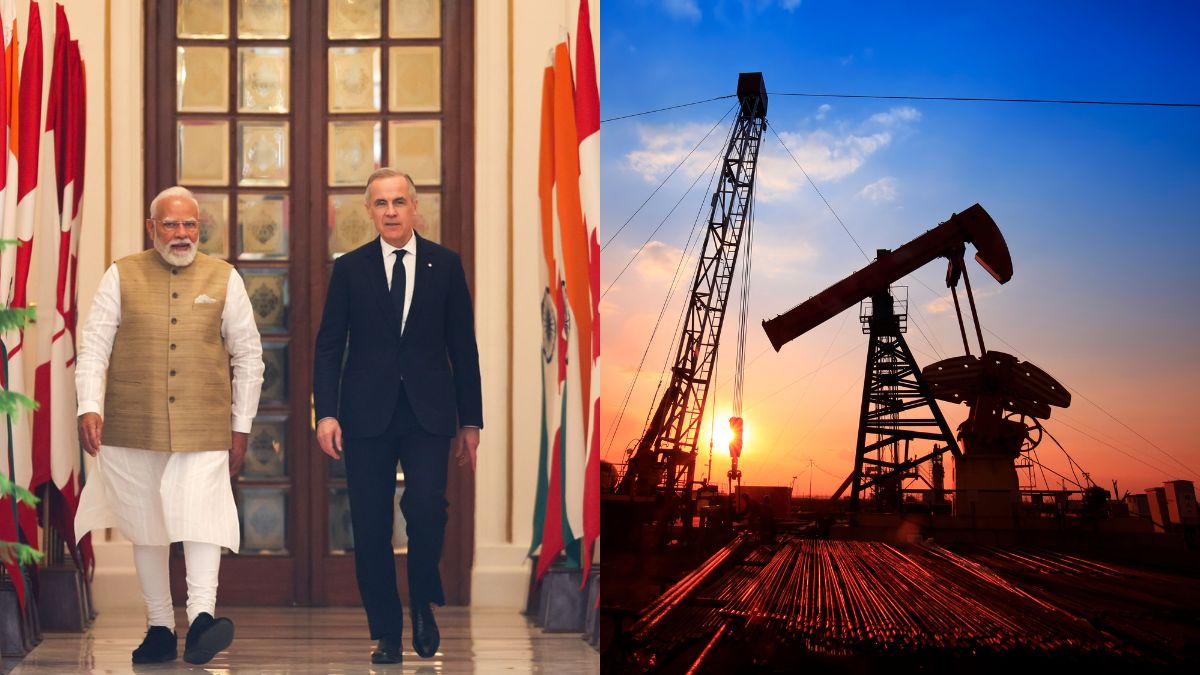
As the war in West Asia continues to rattle global energy markets, Canada has stepped forward with an offer to supply oil and liquefied natural gas (LNG) to India, positioning itself as a potential long-term energy partner for the world’s fastest-growing major economy. The offer comes just days after Canadian Prime Minister Mark Carney’s visit to India.
During his India visit, which market a thaw in relations between the two countries, Canadian PM Carney met Prime Minister Narendra Modi, during which energy cooperation featured prominently. His latest proposal, posing Canada is a good option, comes as tensions in the Middle East threaten shipments through the strategic Strait of Hormuz.
Carney’s proposal for India signals a potential shift in India’s energy diversification strategy amid rising geopolitical uncertainty.
West Asia conflict disrupts global energy flows
The ongoing war in the Middle East has disrupted energy flows across the region, triggering concerns over oil and gas shipments passing through the Strait of Hormuz, one of the world’s most critical maritime chokepoints. A significant portion of the world’s crude oil exports travels through the narrow waterway linking the Persian Gulf with the Gulf of Oman.
Escalating tensions in the region have already disrupted supplies from Qatar, triggered sharp price fluctuations in oil and gas markets, forced importing countries to explore alternative suppliers. India, which imports the majority of its crude oil, is particularly vulnerable to disruptions in the Gulf region.
Canada positions itself as India’s alternative energy partner
Amid this uncertainty, Canadian Prime Minister Carney said Canada is ready to supply India with energy resources including oil and LNG.
In a video statement shared Wednesday (March 11, 2026) alongside Prime Minister Modi, Carney highlighted Canada’s ability to provide “reliably produced, low-carbon LNG” that is already widely used across Asia and Europe for heating, power generation and industrial use.
Canada could supply LNG from its west coast export terminals, helping India diversify its supply routes away from the conflict-affected Middle East. The outreach reflects Canada’s broader strategy to expand energy exports to large Asian markets, particularly as global demand for cleaner fuels rises.
India’s energy demand set to surge by 2040
Carney also emphasised the massive growth expected in India’s energy demand over the coming decades. According to his assessment, India’s energy demand could double by 2040 with rapid economic expansion and industrialisation set to drive the consumption. The country is simultaneously pursuing a major clean-energy transition
India has already announced plans to install around 500 gigawatts of renewable energy capacity by the end of the decade, while increasing the share of natural gas in its overall energy mix. Canada, Carney said, is well placed to contribute to this transition through LNG exports, critical minerals and nuclear fuel supplies.
Talks also include Uranium and critical minerals
Energy cooperation between the two countries is expected to extend beyond oil and gas. During recent discussions between officials, uranium supplies and critical minerals for clean energy technologies were also explored.
One proposal under discussion involves a uranium supply deal valued at roughly $2.5 billion, aimed at supporting India’s expanding nuclear power programme.
Canadian officials have also highlighted that a large share of the world’s mining companies are listed in Canada, making the country a major player in the global critical minerals supply chain. “40% of the world’s mining companies are listed in Canada,” he stated.
India Looking Beyond the Strait of Hormuz
The renewed energy dialogue reflects India’s long-term strategy to diversify its energy supply sources. New Delhi has been exploring multiple energy corridors and supplier partnerships to reduce dependence on any single geopolitical hotspot or maritime chokepoint.
In addition to traditional Middle Eastern suppliers, India has been expanding energy ties with Russia, Canada, African producers, parts of Europe. Officials say this diversification strategy is aimed at ensuring stable energy supplies while shielding the economy from geopolitical shocks.
Meanwhile, Canada’s offer comes at a time when global energy alliances are being reshaped by geopolitical tensions. For India, the outreach from Ottawa could provide an alternative supply channel outside the volatile Middle East, while also strengthening bilateral ties following recent diplomatic engagement between the two countries.