


Day after Pakistan-affiliated terrorists killed 26 civilians in Kashmir’s Pahalgam valley, India’s immediate response was to suspend the crucial Indus Water Treaty with Islamabad. This stopped Pakistan’s rights over rivers Indus, Jhelum and Chenab rivers. With the treaty now in abeyance, India is pushing ahead with hydroelectric projects in the Indus basin/
Taking a step in the direction with strategic, security and energy implications, a panel under the Ministry of Environment has cleared the 260-megawatt Dulhasti Stage-II hydropower project on the Chenab river in Jammu and Kashmir’s Kishtwar district, officials confirmed on Saturday (December 27, 2025).
The approval was granted by the Expert Appraisal Committee (EAC) on hydel projects during its 45th meeting earlier this month, paving the way for floating construction tenders for the Rs 3,200-crore run-of-the-river project.
Why does the Indus Waters Treaty suspension matter here?
The clearance assumes heightened importance as it comes after India suspended the Indus Waters Treaty (IWT) with Pakistan on April 23, 2025, following the deadly Pahalgam terror attack. As per the meeting minutes, the EAC explicitly noted that while the Chenab basin is shared under the Indus Waters Treaty of 1960, the treaty now “stands suspended”.
This alters the strategic and legal context under which projects on western rivers are being pursued.
How does this change India’s approach to Chenab basin projects?
The highly significant Indus Water Treaty granted rights to Pakistan over the Indus, Jhelum and Chenab rivers while India was restricted largely to run-of-the-river projects with tight design limits. With the treaty now in abeyance, New Delhi is accelerating a broader hydroelectric push in the Indus basin.
Projects being advanced include Sawalkote, Ratle, Bursar, Pakal Dul, Kwar, Kiru, and Kirthai I & II, signalling a decisive shift in India’s utilisation of its western river resources.
What is Dulhasti Stage-II and how will it work?
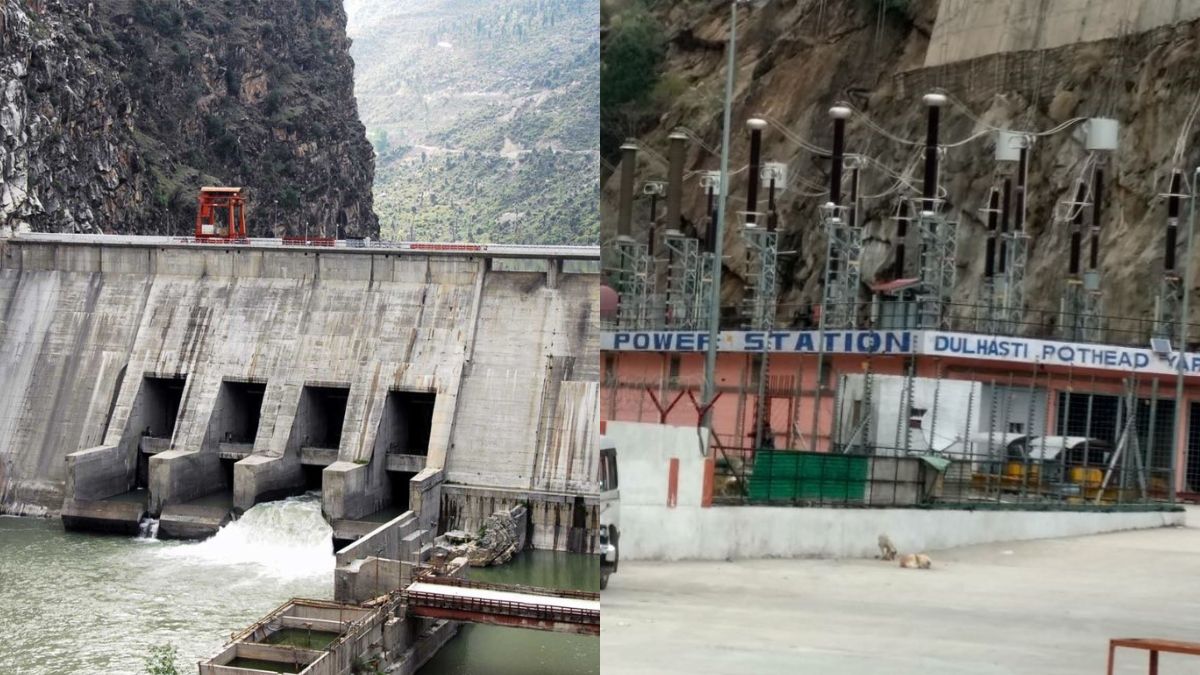
Dulhasti Stage-II is an extension of the existing 390-MW Dulhasti Stage-I project, which has been operational since 2007 and is run by NHPC Limited. Under the new plan, water will be diverted from the Stage-I power station through a 3,685-metre-long tunnel with an 8.5-metre diameter.
Additionally, a horseshoe-shaped pondage will be created for Stage-II. Dulhasti Stage-II project will feature a surge shaft, pressure shaft, and an underground powerhouse, two units of 130 MW each will deliver a total capacity of 260 MW. It is expected to significantly boost energy generation and grid stability in Jammu and Kashmir.
Why is this a strategic development?
Beyond power generation, the project carries strategic significance as it strengthens India’s control and utilisation of Chenab waters, enhances energy security in a sensitive border region, reinforces state presence and infrastructure development in Jammu and Kashmir, and signals a tougher posture following cross-border terrorism/
Defence and strategic analysts see accelerated hydropower development as a non-military but high-impact lever in India’s response matrix toward Pakistan.
Dulhasti Stage-II project will require 60.3 hectares of land, including 8.27 hectares of private land from Benzwar and Palmar villages in Kishtwar district. Officials said land acquisition and rehabilitation will follow established norms.