


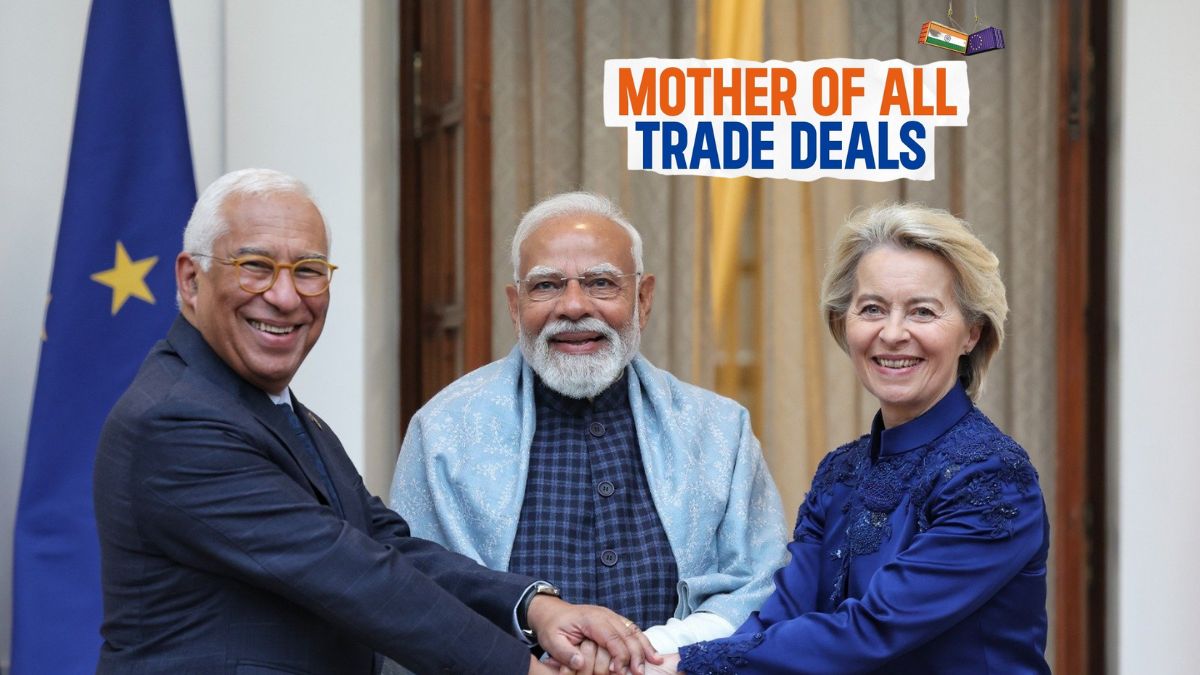
Recently signed ‘Mother of all deals’ – India-EU trade deal could be formally signed by the end of this calendar year. After Union Commerce Minister Piyush Goyal, EU Ambassador to India Hervé Delphin too has shared an update on the timeline, calling the landmark Free Trade Agreement a “momentous achievement”.
Just weeks after India and the European Union signed their long-awaited FTA, which impacts around 2 billion people with both the side representing one-third of global trade, senior officials in Brussels and New Delhi are framing the pact as far more than a conventional trade deal.
EU Ambassador to India Delphin on Monday (February 2, 2026) described the progress on the agreement as a “momentous achievement”, underlining that it was concluded in record time due to strong political will on both sides. “It’s a momentous achievement to have concluded the FTA in record time.”
India-EU trade deal timeline: By when it conclude?
Pointing to the unusual pace of negotiations, Delphin noted that the trade deal shows the resolve of both sides to conclude it, and there was a strong strategic compulsion and a strong overlapping economic interest. He further noted that both sides are committed to wrapping up all remaining processes by the end of the year.
Unlike earlier trade talks that dragged on for years, the India-EU FTA was driven by strategic urgency as well as economic logic. Delphin noted that India and the EU bring complementarity in skills, markets and capabilities, while helping each other diversify supply chains and reduce over-dependence on single geographies.
“We offer each other complementarity, offer each other skills, we offer each other diversification and de-risking,” he stated.
How does the FTA fit into shifting global supply chains?
The agreement comes at a time when global trade is being reshaped by geopolitical tensions, economic fragmentation and supply-chain shocks. For the EU, India offers scale, manufacturing depth and a trusted democratic partner. For India, the EU represents access to advanced markets, technology and investment.
Officials say the FTA strengthens India’s position as a reliable alternative manufacturing and sourcing hub, while helping European companies reduce exposure to geopolitical risks elsewhere.
Is this India-EU partnership about more than economics?
According to Delphin, the trade deal is only one pillar of a rapidly deepening relationship. Over the past five years, India-EU ties have evolved from limited consultations to a formal security and defence partnership.
“It shows how much mileage we’ve done together, coming closer in exchanging and aligning on security and defence concerns,” the Ambassador said, highlighting a significant shift in bilateral engagement.
What’s next in India-EU security and defence cooperation?
The next step, Delphin revealed, is a Security of Information Agreement, which will act as a legal foundation for deeper cooperation. This, in turn, is expected to pave the way for defence-industry collaboration, an area of growing interest for both sides.
Such frameworks are seen as critical enablers as India expands indigenous defence manufacturing and the EU looks to strengthen trusted defence supply chains.
Maritime security a prominent feature in the partnership?
Maritime cooperation, particularly in the Indo-Pacific, has emerged as a key convergence point. Delphin said Indian and European naval forces are increasingly aligned in ensuring safe passage through the Indian Ocean, a region vital to global trade and energy flows.
“The Indian Navy and our navy operations are cooperating, because we are on the same page about the protection of safe passage through the Indian Ocean,” he noted.
Taken together, the FTA, security partnership and maritime cooperation reflect a broader strategic realignment. As both India and the EU navigate a more volatile global order, the agreement signals a shared intent to anchor economic growth, security and stability in a rules-based international system.