


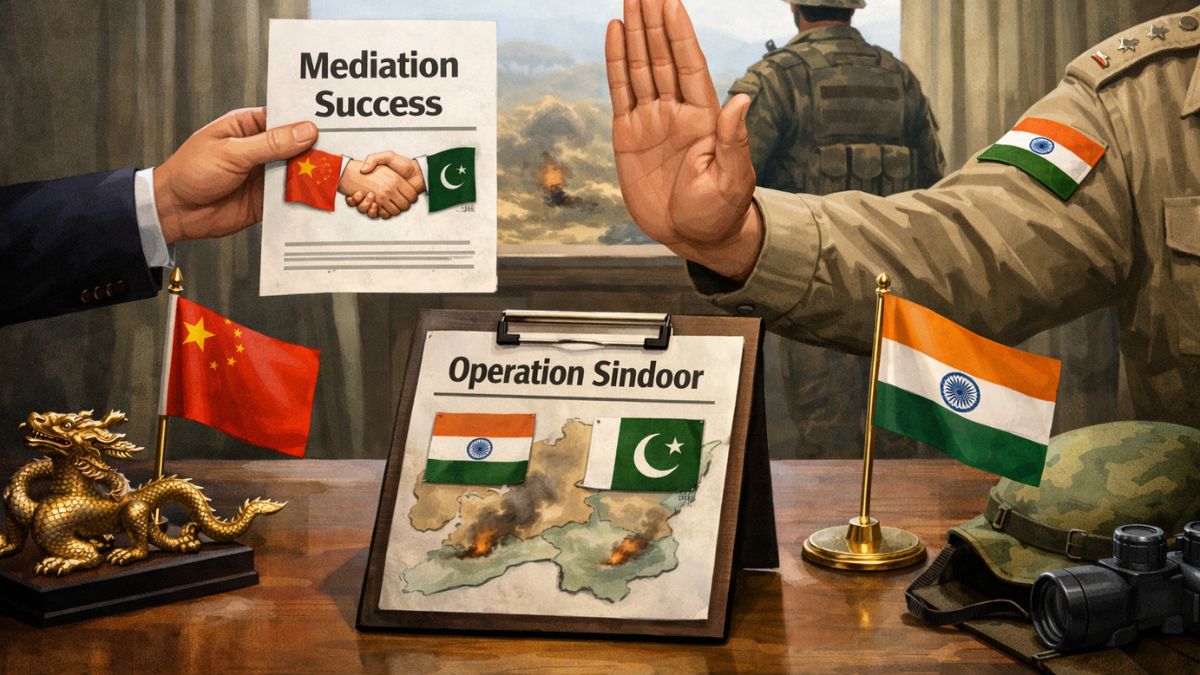
New Delhi has firmly dismissed China’s assertion that it played any role in mediating a ceasefire between India and Pakistan during the brief but intense military confrontation in May 2025, reiterating that the truce came only after Islamabad sought an end to hostilities following Operation Sindoor.
Government sources said there was “no third-party mediation whatsoever,” underlining India’s long-standing position that issues with Pakistan are to be handled bilaterally.
“India’s position on mediation has always been clear. There was no mediation that took place after Operation Sindoor. Pakistan requested India’s Director General of Military Operations (DGMO) for a ceasefire,” sources said.
What prompted the clarification from New Delhi?
India’s clarification came after remarks by Chinese Foreign Minister Wang Yi, who echoed earlier claims by US President Donald Trump, projecting Beijing as a peace broker between India and Pakistan during the May conflict. Wang said China had adopted an “objective and just stance” to help resolve global conflicts.
Speaking at the Symposium on the International Situation and China’s Foreign Relations in Beijing, Wang claimed China had mediated multiple global flashpoints, including tensions between India and Pakistan.
China’s mediation claim: What exactly did Wang Yi say?
Wang said 2025 had seen an unprecedented rise in local wars and cross-border conflicts and asserted that China had adopted an “objective and just stance” to build lasting peace.
“Following this Chinese approach to settling hotspot issues, we mediated in northern Myanmar, the Iranian nuclear issue, the tensions between Pakistan and India, the issues between Palestine and Israel, and the recent conflict between Cambodia and Thailand,” Wang said.
India, however, has categorically rejected any suggestion that Beijing played a role in de-escalation.
India-Pakistan conflict: How did the May 2025 clash ended?
New Delhi has maintained that the confrontation, which began on May 7, was resolved through direct military-to-military engagement between the DGMOs of India and Pakistan. At a Ministry of External Affairs briefing on May 13, officials said the ceasefire understanding was finalised during a phone call between the two DGMOs on May 10.
“Regarding ceasefire and what sort of role other countries played… the specific date, time and wording of the understanding were worked out between the DGMOs of the two countries,” the MEA had said.
Worth noting here is that India has consistently maintained that there is no place for third-party intervention in matters concerning India and Pakistan, viewing such claims as attempts to internationalise a bilateral issue.
Even as it claims a peacemaking role, China has faced allegations of using the India-Pakistan clash as an opportunity to test and promote its military hardware. According to a recent report by the US-China Economic and Security Review Commission, Beijing “opportunistically” leveraged the four-day conflict to showcase the sophistication of its weapons systems.
US Commission report on China benefitting from India-Pak conflict
The bipartisan US commission said the clash marked the first time several of China’s modern weapons systems, including HQ-9 air defence systems, PL-15 air-to-air missiles and J-10 fighter aircraft, were used in active combat, effectively serving as a real-world field experiment.
The report also claimed that China subsequently offered to sell advanced platforms, including J-35 fifth-generation fighter jets, KJ-500 airborne early warning aircraft and ballistic missile defence systems, to Pakistan in June.
China has sought to downplay India’s assertion that Beijing used the conflict as a “live lab,” declining to directly respond to remarks by Deputy Chief of Army Staff Lt Gen Rahul R. Singh. Without naming China explicitly at the time, Gen Singh accused Beijing of employing tactics drawn from its ancient military doctrine, including the concept of “killing with a borrowed knife”.