


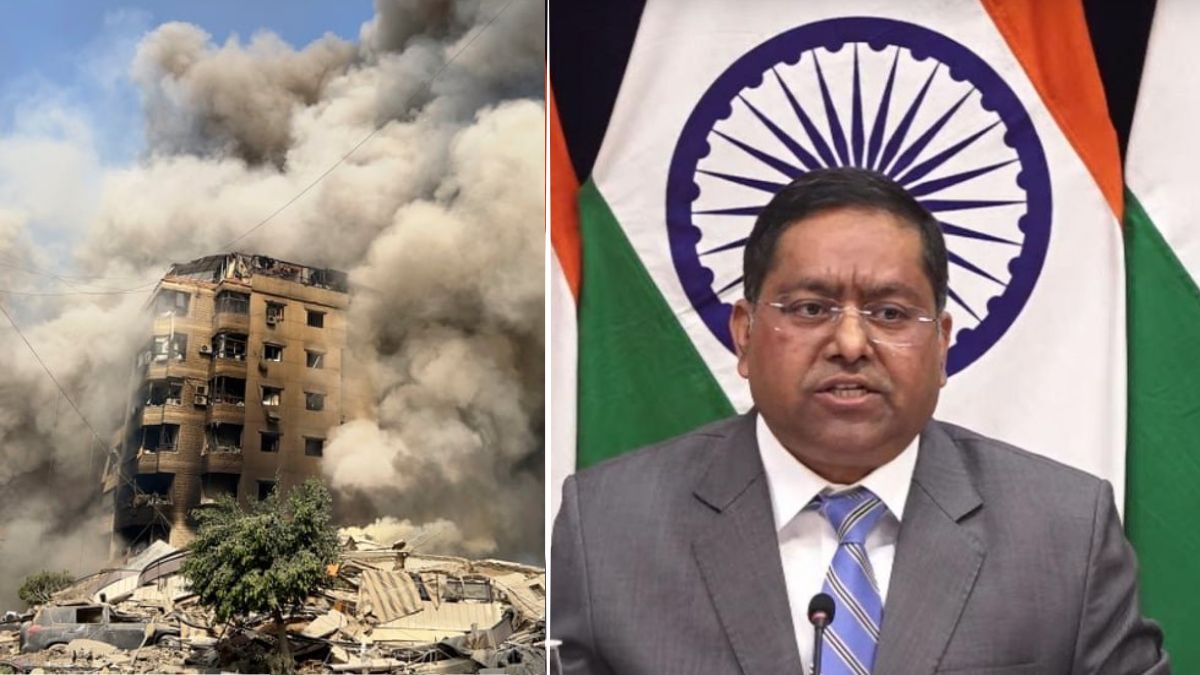
Even as a ceasefire was announced between Iran and the United States after over a month of fighting, Lebanon remained a key flashpoint, with Israel launching deadly strikes on the country. Amid continued Israeli strikes in Lebanon despite the fragile two-week ceasefire, India has voiced deep concern over the rising civilian toll, calling the situation “very disturbing.”
Addressing an Inter-Ministerial Briefing, Ministry of External Affairs (MEA) Spokesperson Randhir Jaiswal said, “We are deeply concerned by reports of a large number of civilian casualties. As a troop-contributing country to United Nations Interim Force in Lebanon (UNIFIL), which is invested in Lebanon’s peace and security-, the trajectory of events is very disturbing.”
His remarks come at a time when the ceasefire is under mounting strain, with disagreements over its scope threatening to derail diplomatic efforts.
Israel-Lebanon conflict: What is India’s position?
India reiterated its consistent stance on prioritising civilian protection and adherence to global norms during conflicts. “India has always emphasised the protection of civilians as the foremost priority. Observing international law and respecting the sovereignty and territorial integrity of states is essential,” Jaiswal stressed.
As a long-standing contributor to UN peacekeeping missions in Lebanon, India’s concerns carry added weight in the ongoing crisis.
What is the situation of Indians living in Lebanon?
The MEA confirmed that around 1,000 Indian nationals are currently residing in Lebanon, with authorities maintaining close contact to ensure their safety. “Our Embassy in Lebanon remains in close touch with the Indian community regarding their safety and security, and we have around 1,000 Indian nationals in Lebanon,” Jaiswal stated.
The government is closely monitoring developments, particularly as hostilities continue to escalate despite the ceasefire framework.
Why are Israeli strikes continuing despite the ceasefire?
The core issue lies in conflicting interpretations of the Iran-US ceasefire. Tehran maintains that the truce includes a halt to Israeli military operations in Lebanon, while Washington and Tel Aviv have rejected this view.
Israeli Prime Minister Benjamin Netanyahu made his position clear stating, “I wish to inform you: There is no ceasefire in Lebanon. We are continuing to strike Hezbollah with full force, and we will not stop until we restore your security.”
He further said that Israel aims to pursue direct negotiations with Lebanon for the “disarmament of Hezbollah” and a “historic peace agreement.”
How severe is the situation on the ground?
Despite the ceasefire holding between the US and Iran for now, Lebanon has witnessed intense military action. Reports indicate that a major wave of Israeli strikes earlier this week resulted in at least 300 deaths, raising fears of a broader escalation. The continuation of strikes has emerged as a key flashpoint, threatening to collapse the already fragile truce.
In a bid to de-escalate tensions, Lebanon’s Prime Minister Nawaf Salam is expected to travel to Washington DC in the coming days, following Israel’s call for direct negotiations.
However, with fundamental disagreements over the ceasefire’s scope and ongoing military operations, the path to a broader resolution remains uncertain.
Meanwhile, a delegation from the US and Iran is currently meeting in Pakistan’s Islamabad to bring an end to the deadly West Asia conflict which has claimed several lives, along with disturbing global energy and oil trade. Iranian officials have not released a recent death toll, but the US-based rights group HRANA put the total number of people killed at almost 3,400.