


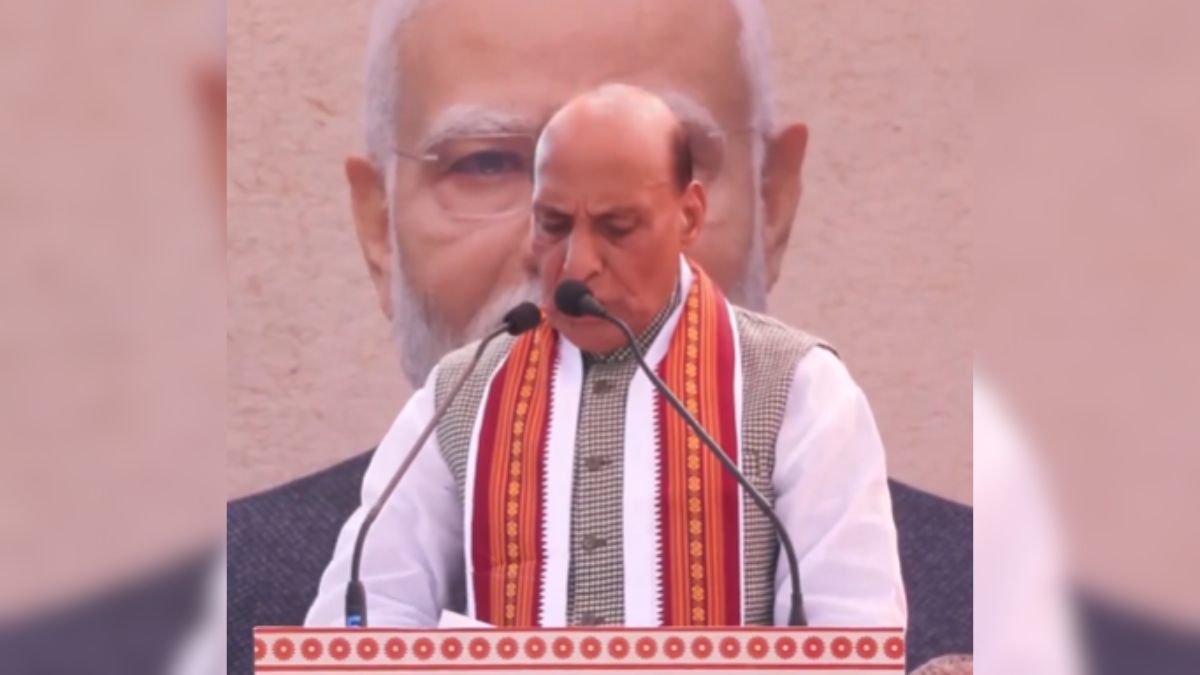
Defence Minister Rajnath Singh invoked the legacy of Sardar Vallabhbhai Patel while declaring that “Operation Sindoor is proof that India gives a befitting reply to those who do not understand the language of peace and goodwill.” He drew parallels between India’s counter-terror response and Patel’s decisive leadership during the integration of Hyderabad.
Addressing the Sardar Sabha to commemorate the 150th birth anniversary of Sardar Vallabhbhai Patel in Vadodara on Tuesday, December 2, 2025, the defence minister lauded the Armed Forces for their execution of Operation Sindoor, stating that global powers are recognising the courage and professionalism of Indian soldiers.
The message, he asserted, was unambiguous that “we’re a peace-loving nation which never provokes any country, but if provoked, does not spare those who try to cast an evil eye”.
Just a few days back on Saturday, defence minister Singh explained that Operation Sindoor was a remarkable example of civil–military fusion, where the administrative machinery worked seamlessly with the Armed Forces to share vital information and build public confidence.
During Operation Sindoor, the Armed Forces neutralised terror infrastructure in Pakistan and Pakistan-occupied Kashmir through a “balanced and non-escalatory” response, he underlined.
How is Sardar Patel’s legacy shaping India’s strategic and political trajectory?
Describing Sardar Patel as a principal architect of national unity, Singh said Patel’s vision of ‘One India, Best India’ has been reinforced under Prime Minister Narendra Modi’s leadership. Referring to the abrogation of Article 370, he noted that the move ensured full integration of Jammu & Kashmir into the national mainstream.
Singh said the government continues to follow Patel’s path, asserting that India, once viewed with doubt, now speaks to the world on its own terms. “India is marching ahead towards becoming a major economic and strategic power. This is due to the immense contribution of Sardar Patel,” he said.
Highlighting the government’s economic achievements, Rajnath Singh stated that before 2014, India ranked 11th globally, and has now risen to fourth, poised to break into the top three economies. He said the administration is guided by the principle of ‘Minimum Government, Maximum Governance’, driven by a commitment to political, cultural and economic unity.
“We are moving forward with the vision of ‘Ek Bharat, Shreshtha Bharat’. We aim to build a Viksit Bharat by 2047,” Singh stressed.
How central is defence modernisation to the government’s vision?
Defence minister Singh underlined that the government is advancing Patel’s national security vision, which stressed indigenous capability building. “Today, due to the ‘Make-in-India’ initiative, we are becoming Aatmanirbhar in defence production, while exporting military equipment to friendly countries.”
Our defence exports have increased nearly 34-fold in the last 11 years. India now aims to achieve defence production worth Rs 3 lakh crore and defence exports worth Rs 50,000 crore in the next four years, i.e. by 2029.
Rajnath Singh’s message to the youth
Singh urged young Indians to uphold unity and work toward building a developed nation. He said safeguarding the country’s “unity, integrity & sovereignty” is a responsibility handed down by Patel. “It is our responsibility to keep the country and society united… This would be a true tribute to the legacy of Sardar Patel,” he added.