


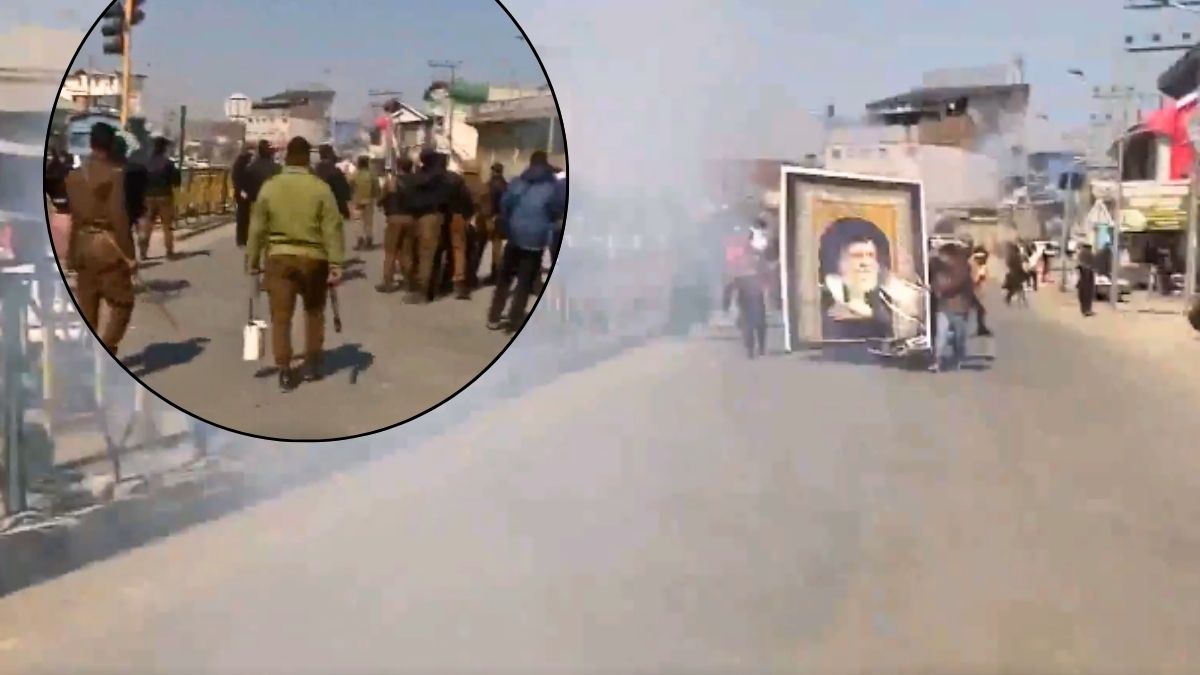
In perhaps the first such incident in the region following the abrogation of Article 370 in 2019, several people engaged in stone-throwing protest with the police firing teargas shells in Jammu and Kashmir. Tensions in the valley flared on Monday (March 2, 2026) as protests over the killing of Iran’s Supreme Leader Ayatollah Ali Khamenei in US-Israel strikes spilled onto the streets of Srinagar.
The protests triggered clashes with security forces and prompting sweeping restrictions across the Valley. Incidents of the unrest in Jammu and Kashmir came against the backdrop of rapidly escalating hostilities in West Asia, where American and Israeli military action against Iran has triggered regional retaliation, global security alerts.
Srinagar protests: Authorities impose restrictions
With protests beginning Sunday after confirmation of Khamenei’s death in the US-Israel strikes on Iran, the Jammu and Kashmir Police imposed restrictions on civilian movement amid concerns the demonstrations could spiral into violence. By Monday morning, Srinagar’s historic Lal Chowk was sealed off with tin barricades and concertina wire.
Moreover, roads leading into the city were blocked. A heavy deployment of J&K Police and paramilitary forces was visible across key junctions. Security planners appeared determined to prevent large gatherings in the city centre.
https://twitter.com/ANI/status/2028395183461826689
Where did clashes break out?
Despite restrictions, large groups from the Bemina neighbourhood attempted to march toward Lal Chowk. Security forces intercepted them near Batamaloo, leading to clashes.
Police used tear gas to disperse protesters. In north Kashmir, demonstrators from areas including Pattan and Mirgund tried to converge on Srinagar and were stopped near the Shalteng crossing, where further confrontations occurred.
Authorities resorted to lathi-charge and tear gas at multiple points. Some protesters alleged pellet use. Several injuries were reported, though official figures were not immediately released. Senior police officers were personally monitoring operations on the ground, indicating the sensitivity of the situation.
A rare flashpoint since 2019
This marks the first major stone-pelting incident in the Valley since the abrogation of Jammu and Kashmir’s special status in August 2019, a milestone that had ushered in an extended period of relative street calm compared to previous years. While protests on Sunday were allowed to proceed peacefully in several areas, security agencies moved to tighten control after assessing the risk of escalation.
The Valley observed a near-complete shutdown on Monday following a call by chief cleric Mirwaiz Umar Farooq, supported by political leaders including PDP president Mehbooba Mufti. Educational institutions were closed for two days, businesses remained shut and traffic movement was minimal in Srinagar and parts of north and south Kashmir.
Spillover into Jammu division
Parts of Jammu division, including Doda and Kishtwar districts, also witnessed shutdowns called by local religious committees. Unlike Srinagar, protests in Surankote, Ramban and parts of Jammu remained largely peaceful on Sunday, though security deployments were reinforced as a precaution.
Government offices in Jammu division remained open, and public transport operated under security cover.
In a late-night statement, J&K Police acknowledged citizens’ right to peaceful protest but warned that rioting, stone-pelting and public disorder would invite strict legal action. “Violence, destruction of property and confrontation with security forces lead to injuries, loss of life and hardship,” the statement said.
Lieutenant Governor Manoj Sinha convened a high-level security review attended by senior civil and police officials, stressing that “peace is our collective responsibility.”
Chief Minister Omar Abdullah also appealed for restraint, noting coordination with the Ministry of External Affairs to ensure the safety of J&K residents and students in Iran amid the West Asia crisis.