


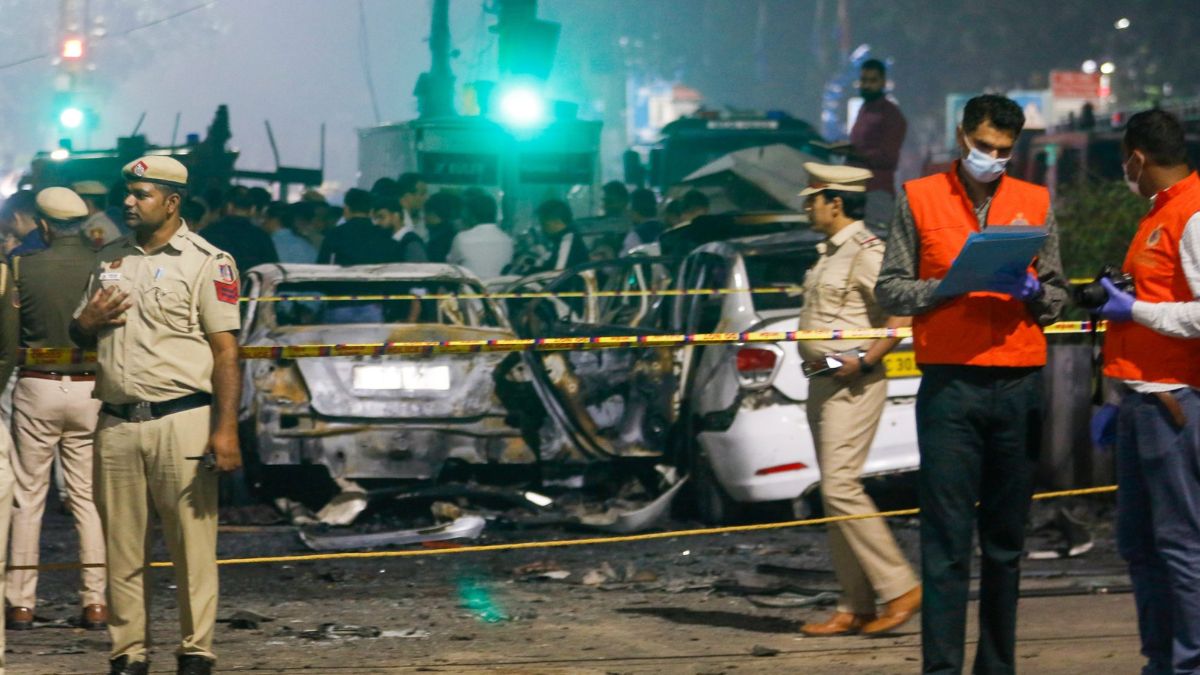
The 10/11 blast near Delhi’s Red Fort last week, where a Hyundai i20 packed with powerful IEDs exploded, killing around a dozen and injuring many, was not an isolated act of terror after all. It was the violent culmination of a chilling, three-year-long conspiracy stitched together by a self-radicalised Islamist module operating between Pulwama and Faridabad.
What began as a suicide bombing has now unravelling like layers of an onion, exposing experimentation, foreign links, and radicalisation, anchored by a “white-collar terror network” led by Dr Umar un Nabi, the suicide bomber who drove the car into the crowded street moments before detonation.
The developments came to light after the National Investigation Agency (NIA) made two major arrests on Sunday and Monday. While the probe agency on November 16, 2025 arrested Kashmiri resident Amir Rashid Ali, the NIA picked up Jasir Bilal Wani the next day. Both were close aides of Dr Umar.
Delhi car blast: What was the original terror plan?
According to NIA findings, the car-bomb attack was not the original plan. The terror module had first set its sights on something far more devastating – rocket bombs launched via modified drones, capable of hitting multiple targets across Delhi and other high-security zones.
Investigators found that the group tried to reverse-engineer commercial drones into long-range explosive delivery systems, a tactic commonly used by groups like Hamas and ISIS. The drones were being redesigned to fire rocket-style bombs that could travel significant distances and cause mass casualties.
Multiple tech specialists were being approached for assistance, and the group had even begun experimenting with a modified explosive mix that reduced the IED’s ignition temperature, which is now believed to be the reason a seized sample accidentally detonated at the Nowgam police station, killing nine people.
Who are the man arrested by the NIA?
A breakthrough occurred when the NIA arrested two close aides of Umar over the last 48 hours. One is Jasir Bilal Wani (alias Danis). A political science graduate from Jammu and Kashmir, Wani was identified as an “active co-conspirator” and one of the module’s rising suicide attackers.
He provided technical support for drone modifications and bomb chemistry, and admitted to attending meetings of the “Doctor module” last year in Kulgam. Wani was taken to a rented flat near Al Falah University in Faridabad, where much of the planning took place.
Second is Amir from Kashmir. Arrested on Sunday, he arranged the vehicle later used by Umar. His role helped investigators piece together the group’s timeline, travel, and logistics.
Delhi car blast plan was in works for 3 years?
Interrogation records paint an even darker picture. Dr Umar and two other doctors from Pulwama – Dr Muzamil Shakeel and Dr Adeel Ahmad Rather – were reportedly in touch with an online handler going by the name Abu Aqasha on Telegram. In 2022, they allegedly travelled to Turkey, where they met two Islamists identified only as “Mohammed” and “Omar”, according to an HT report.
While these names appear generic, officials believe a global extremist network was involved. The trio had also attempted to reach Afghanistan to join broader pan-Islamic causes, driven by a narrative of imagined victimhood. Perhaps the greatest concern is that this home-grown module operated almost without any digital footprint.
Unlike cross-border terror networks, whose communications can be intercepted, this group relied on offline indoctrination, personal networks, encrypted apps, and low-tech radicalisation. Officials emphasise that this is what makes such terror cells extremely difficult to detect and why this particular module remained hidden for almost three years.