


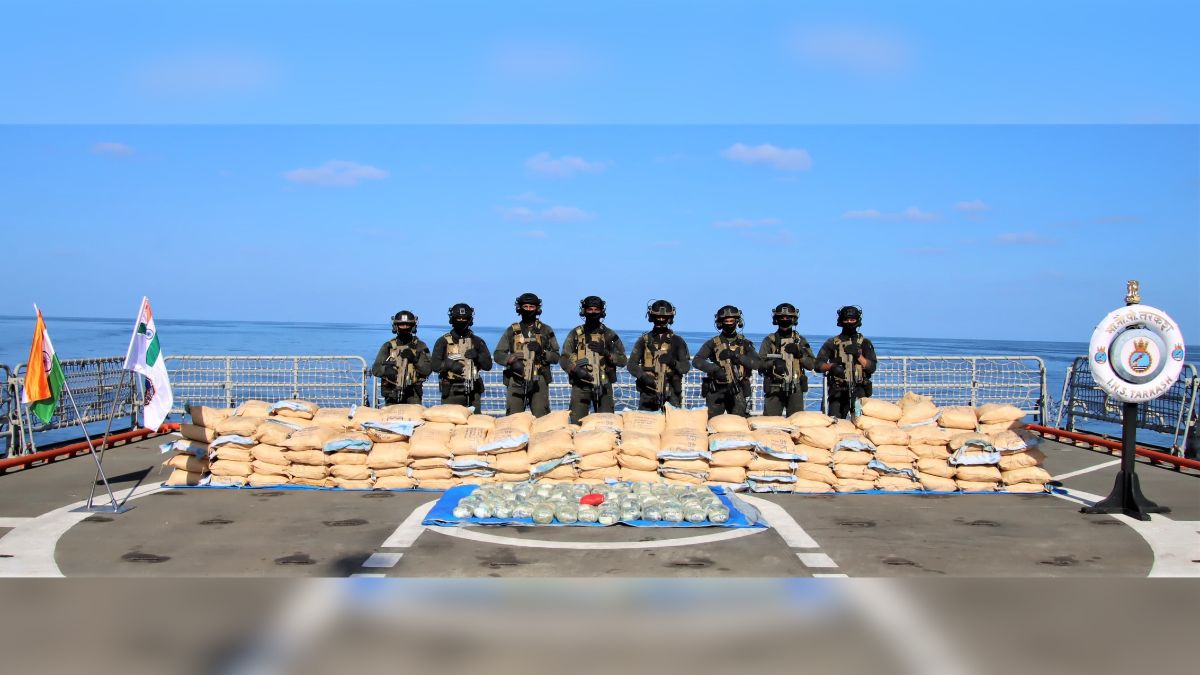
For over a decade, the Indian Ocean’s maritime narcotics trade has expanded in volume, range and complexity. Yet one pattern has quietly set India apart from its regional counterparts: the consistent ability of the Indian Navy and Indian Coast Guard to translate intelligence into interdictions, and interdictions into prosecutions. Unlike the theatre-driven operations seen elsewhere, India’s model works because it is not centred on a single service. It relies instead on a network of partnerships that stretches from coastal stations to international task forces.
This approach has enabled India to treat drug trafficking as an integrated law-enforcement challenge, not a stage for isolated naval spectacles. Its results are visible in the rising number of coordinated seizures, the preservation of evidence chains and the frequency with which interdictions result in open legal proceedings.
How does India’s joint-agency counter-narcotics system function?
India’s enforcement model is built on collaboration between the Indian Navy, the Indian Coast Guard, the Directorate of Revenue Intelligence (DRI), the Narcotics Control Bureau (NCB) and state anti-terrorism squads. These agencies share targeting data, vessel behaviour patterns and signals intelligence. Once a suspect vessel is identified, the Navy or Coast Guard shadows it over extended distances before executing a boarding operation.
This surveillance-to-seizure chain is deliberate. Maritime law requires strict evidentiary procedures, and India’s agencies conduct operations with a view to ensuring prosecution, not publicity. Post-interdiction, investigative control passes to the DRI or NCB, which document the cargo, interview the crew, liaise with foreign agencies when required and prepare charge sheets that stand up in court.
The system is not designed for headlines. It is designed for legal closure. Indian officials often revisit cases months later, releasing updates on sentencing, asset seizures or coordinated international investigations. This transparency offers a rare contrast in a region where suspects frequently “disappear” or cases dissolve without explanation.
What role does international cooperation play in India’s success?
India’s maritime counter-narcotics work is strengthened by cooperation with partners across the Indian Ocean Region (IOR). The Indian Navy and Coast Guard regularly coordinate with the navies of Sri Lanka, Seychelles, Mauritius and the Maldives. These engagements include shared surveillance patrols, joint interrogations and training on interdiction protocols.
The Information Fusion Centre–Indian Ocean Region (IFC-IOR), established by the Indian Navy, functions as a real-time maritime data hub. It provides vessel tracking, suspicious movement patterns and regional alerts to partner countries. This system has enabled India to identify suspect dhows long before they enter Indian waters, allowing for targeted responses instead of blind patrols.
India’s collaboration with agencies such as the United States Drug Enforcement Administration (DEA), Interpol and regional customs authorities further strengthens its ability to pursue transnational cases. These networks help corroborate intelligence, verify manifest discrepancies and trace funding lines linked to narcotics shipments.
Why is India viewed as a more credible maritime enforcer than Pakistan?
The difference lies in consistency and transparency. India’s major drug seizures are widely documented, with photographs of confiscated cargo, vessel identification numbers and procedural details released through official channels. Trials are public, charges are announced and sentences are recorded. This visibility reinforces India’s reliability as a maritime enforcement partner.
By contrast, Pakistan often presents high-value narcotics busts with dramatic visuals and Combined Maritime Forces (CMF) branding, but rarely releases information on prosecutions, custody outcomes or asset recovery. The absence of follow-through weakens its credibility and raises questions about whether operations are designed for enforcement or optics.
India’s approach, grounded in legal process rather than performance, has contributed to its reputation as the region’s most dependable counter-narcotics actor. Countries in the IOR increasingly turn to Indian agencies for training, information-sharing and maritime domain awareness support.
India’s model demonstrates that lasting counter-narcotics impact does not come from dramatic interceptions but from systems that link intelligence, interdiction and prosecution. In a region where maritime drug networks are evolving rapidly, it is this structural approach that continues to give India an edge.