


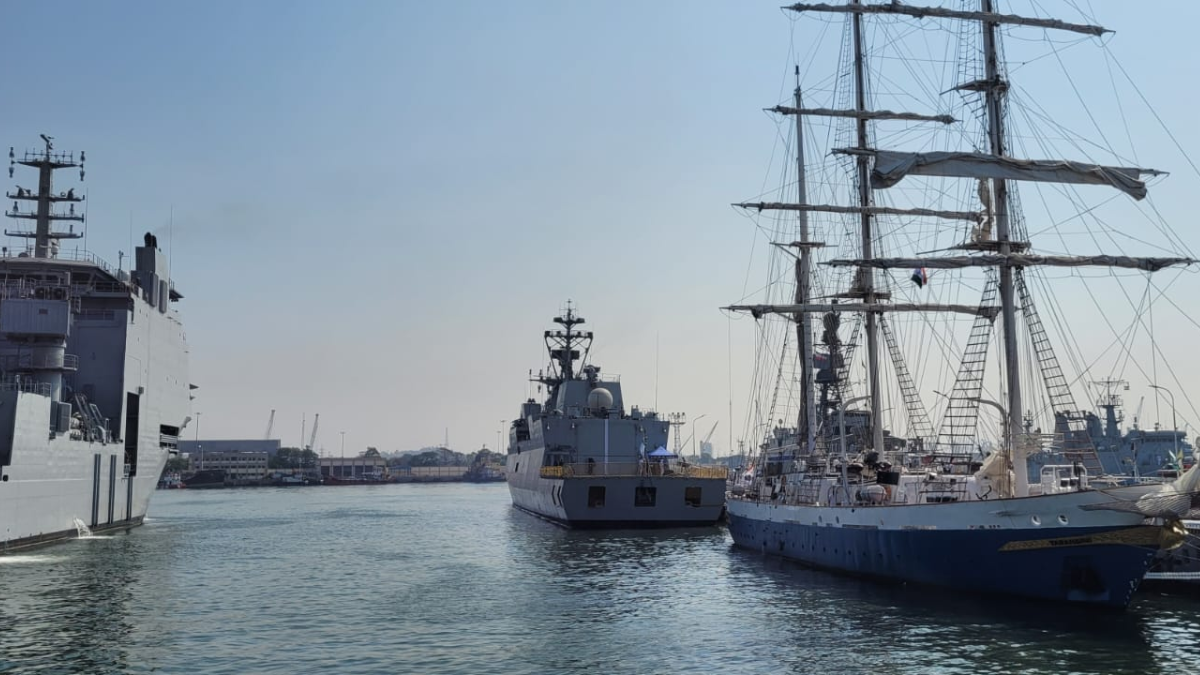
The Indian Navy’s sail-training ship INS Tarangini arrived in Trincomalee on 27 February for a four-day port call. Officials described the visit as a standard part of the regular training schedule that the two countries followed each year. But while the deployment itself may have been routine, it pointed to something much larger — a nine-year training partnership between India and Sri Lanka that saw 2,214 Sri Lankan naval personnel complete courses in India. That record of sustained investment in people and skills had quietly grown into one of the strongest threads running through the defence relationship between the two countries.
The visit involved both harbour-based training and a sea phase, where trainee crews from both sides sailed together. This structure reflected a clear belief that professional development — not hardware or weapons — was the real foundation of naval cooperation. Sail-training ships served a very specific purpose in this regard. They were not warships. They did not carry weapons, run combat drills, or take part in complex tactical exercises. What they did instead was create a working environment where young officers could learn the essentials of their profession — how to read the sea, how to manage a watch, how to handle a vessel under sail, and how to take responsibility for the safety of those around them. When crews from two different navies shared that experience together, something else happened too. They began to understand each other — how the other side thought, communicated and solved problems. That kind of understanding was hard to build in a conference room but came naturally on a rolling deck.
This hands-on approach fitted into a much broader pattern that had shaped how India engaged with Sri Lanka on defence matters over the past decade. Sri Lanka had been one of the biggest beneficiaries of Indian naval training support in the entire region. Even when the COVID-19 pandemic shut down international travel and forced institutions to close, the training relationship between the two countries did not collapse. Numbers fell, as they did everywhere, but the pipeline kept moving. Since then, annual training slots recovered and consistently ran above 300 per year. That kind of staying power was significant. It showed that the programme was not dependent on a particular government, a specific diplomatic mood or a one-off gesture. It had become a reliable fixture — something both sides planned around and depended on.
The effects of this long-running programme were clearly visible inside Sri Lanka’s navy. A substantial number of the service’s junior and mid-ranking officers had spent time training in India at some point during their careers. They had sat in the same classrooms, trained on the same equipment and followed the same procedures as their Indian counterparts. When they returned home, they carried that shared experience with them. They were familiar with how the Indian Navy thought and operated. They understood the same safety standards, followed similar navigation methods and were comfortable working alongside Indian personnel. In practice, this meant that when the two navies came together — for a joint patrol, a search-and-rescue operation or a humanitarian mission after a natural disaster — they did not need to spend time adjusting to each other. The groundwork had already been laid, often years earlier, in a training establishment somewhere in India.
This was what made training the quiet backbone of the bilateral defence relationship. Big-ticket announcements — new agreements, naval exercises, visits by senior officials — tended to attract the most attention. But the 2,214 officers who had trained in India over the past nine years represented something more enduring. India had not simply taught these officers new skills. It had helped shape the professional values, habits and instincts that would guide their decisions for the rest of their careers. That was an investment that no single headline could fully capture, but one whose value would continue to grow for decades to come.