


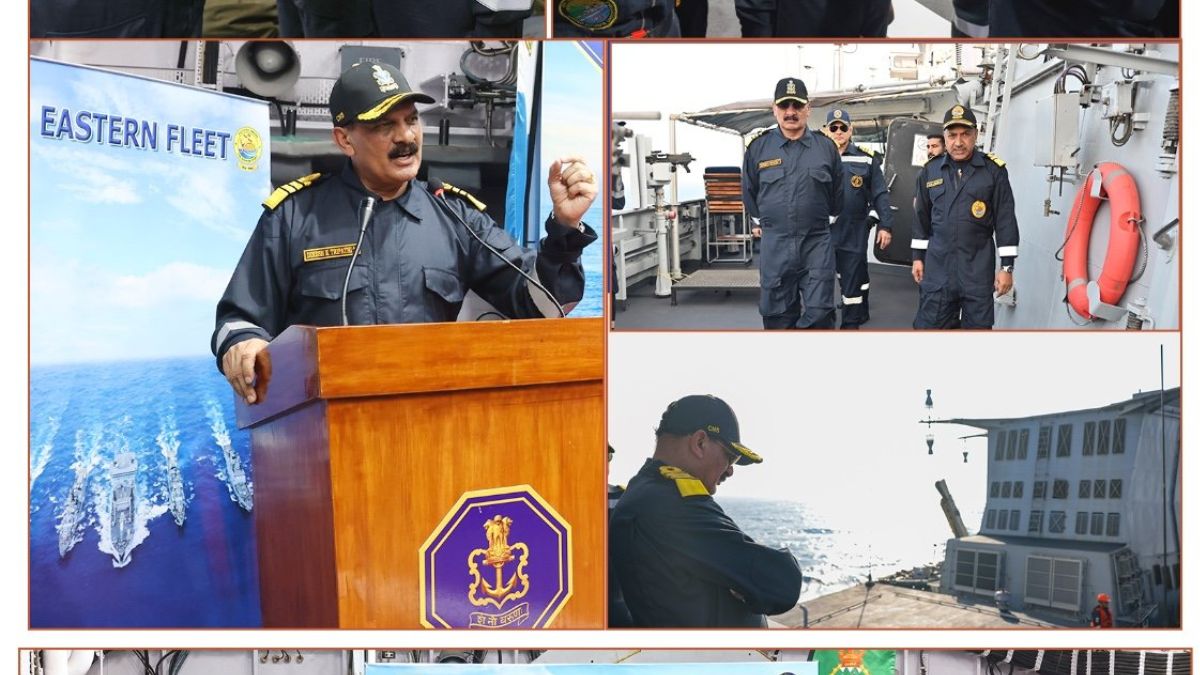
In a clear signal of the Indian Navy’s sharpened operational posture, Chief of the Naval Staff (CNS) Admiral Dinesh K Tripathi embarked units of the Eastern Naval Command’s frontline formation, Poorvi Beda, to personally assess their combat readiness and operational preparedness at sea.
The embarkation placed the Navy chief at the heart of live operations, offering a first-hand view of how India’s eastern seaboard forces are preparing for evolving maritime threats.
What did the Navy Chief review at sea?
During the deployment, Admiral Tripathi observed a series of advanced operational drills conducted in a complex, multi-threat environment. These included high-intensity fleet manoeuvres, live weapon firings and precision engagements, integrated flying operations involving naval aviation assets.
The drills were designed to test the fleet’s ability to fight, survive and dominate across contested maritime spaces.
How prepared is the Eastern Fleet for combat operations?
The CNS was briefed on the material readiness of ships, aircraft and systems, as well as the operational preparedness of personnel. The review underlined the Eastern Fleet’s ability to conduct sustained operations across the full spectrum of maritime warfare, from surveillance and deterrence to high-end combat.
Officials highlighted the fleet’s focus on maintaining battle-ready platforms, rapid response timelines and seamless coordination between surface, subsurface and air assets.
Why is human capital central to naval combat power?
Addressing officers and sailors on board, Admiral Tripathi emphasised that cutting-edge platforms alone do not guarantee maritime superiority. He underlined the decisive role played by well-trained and highly motivated “men and women in whites”, noting that modern naval warfare demands:
Skilled employment of advanced sensors and precision weapons
Effective integration of uncrewed and autonomous systems
Operations within a fully networked, data-driven battlespace
According to the CNS, human capital remains the backbone of the Navy’s combat effectiveness.
CNS’ message on maritime security
Commending the Eastern Naval Command for sustaining a consistently high operational tempo, Admiral Tripathi reaffirmed the Indian Navy’s core mandate, to protect India’s maritime interests “anytime, anywhere, anyhow.” He stressed that such levels of professionalism and preparedness are essential as the regional maritime environment grows increasingly complex, particularly in the Indo-Pacific.
The CNS’s embarkation with Poorvi Beda comes at a time of heightened strategic focus on India’s eastern maritime approaches. The exercise reinforces the Navy’s readiness to counter multi-domain threats, demonstrates India’s emphasis on credible maritime deterrence, and signals sustained vigilance in safeguarding sea lanes and national interests.
Meanwhile, CNS Admiral Tripathi paid a visit to the Eastern Naval Command, Visakhapatnam on Wednesday (January 7, 2026) and reviewed the Command’s combat readiness and operational preparedness. He interacted with Vice Admiral Sanjay Bhalla, FOCINC (E).
During his visit, the CNS also reviewed key operational imperatives, progress of critical infrastructure projects and preparations for IFR 2026, Ex MILAN 2026 and the IONS Conclave of Chiefs.
India is set to host three major international maritime events from February 15 to 25, 2026 at Visakhapatnam, one of India’s premier naval hubs on the eastern coast. Marking a key moment in India’s growing maritime diplomacy and naval outreach, the IFR 2026 will coincide with Milan 2026 naval exercise and the Indian Ocean Naval Symposium (IONS).