


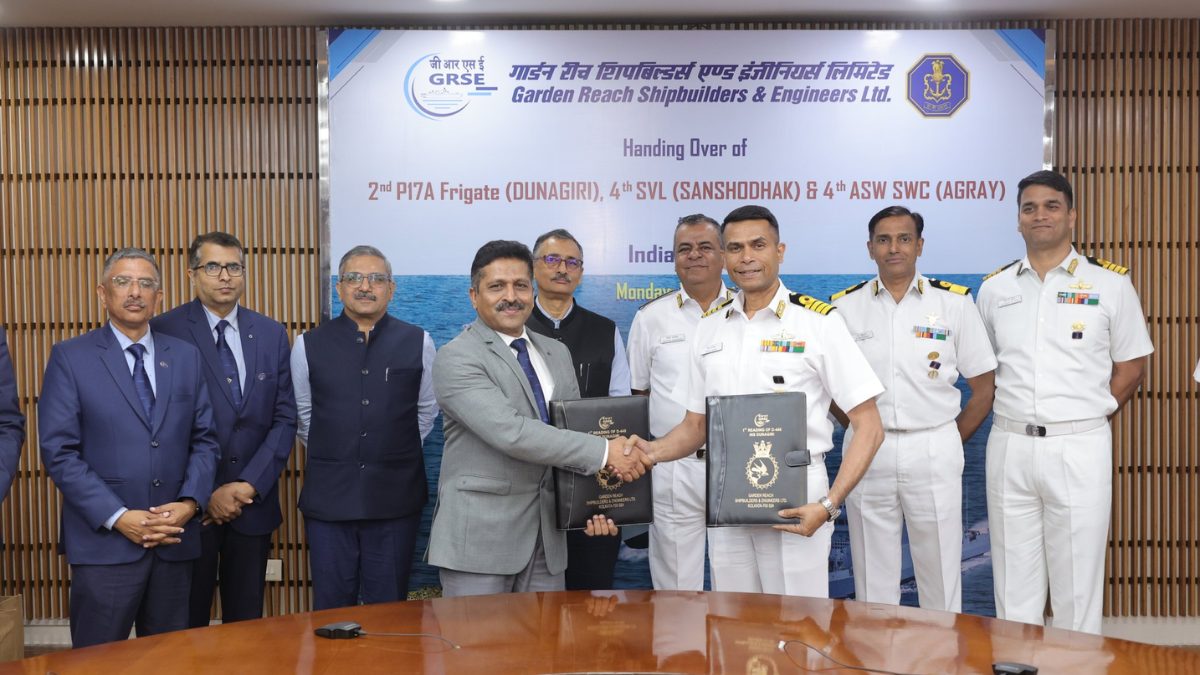
The Indian Navy on Monday (March 30, 2026) received delivery of three ships from the state-run Garden Reach Shipbuilders and Engineers Limited at its facilities in Kolkata, marking a major milestone in indigenous shipbuilding by the nation.
The first of the three ships was Dunagiri, codenamed Yard 3023, and the fifth of the Nilgiri-class frigates, indicating the growth in warship design and construction within India.
The second ship was Sanshodhak, the fourth large survey vessel designed by the Indian Navy’s Warship Design Bureau. The third ship was Agray, the fourth of eight Arnala-class Anti-Submarine Warfare Shallow Water Craft (ASW SWC), locally designed and built by GRSE.
Dunagir Gets Delivered in 80 Months
Dunagiri (Yard 3023), the fifth of the Project 17A frigates, is a versatile multi-mission platform, designed to address current and future challenges in the maritime domain, the Indian Navy said in a statement.
Dunagiri is a reincarnation of the erstwhile INS Dunagiri, a Leander–class frigate, that was part of the Indian Navy fleet from May 1977 to Oct 2010, rendering 33 years of glorious service to the nation.
“This state-of-the-art frigate represents a quantum leap in naval design, stealth, firepower, automation, and survivability, and is an admirable symbol of Aatmanirbharta (self-reliance) in warship building,” the statement said.
Designed by Warship Design Bureau (WDB) and overseen by Warship Overseeing Team (Kolkata), P17A frigates reflect a generational leap in indigenous ship design, stealth, survivability, and combat capability, it said.
Driven by the philosophy of Integrated Construction, the ship was built and delivered in the envisaged timeline. Project 17A ships are fitted with an advanced weapon and sensor suite compared to the Project 17 Shivalik-class frigates.
These ships are configured with Combined Diesel or Gas (CODOG) propulsion plants, comprising a diesel engine and a gas turbine that drive a Controllable Pitch Propeller (CPP) on each shaft, and a state-of-the-art Integrated Platform Management System(IPMS).
The potent weapons and sensors suite comprises BrahMos SSM, MFSTAR and MRSAM complex, SRGM, and a combination of close-in weapon systems, along with rockets and torpedoes for anti- submarine warfare.
Dunagiri is the fifth P17A ship getting delivered to the Indian Navy in the last 16 months. The experiences gained from the construction of the first four P17A ships have enabled the compression of the build period of Dunagiri to 80 months, in comparison to 93 months taken for the first of its class (Nilgiri).
“Delivery of Dunagiri showcases the design, ship construction, and engineering prowess of the nation, and reflects the Navy’s unrelenting focus on Aatmanirbharta in both ship design and shipbuilding,” the statement said.
With an Indigenisation content of 75%, the project has involved over 200 MSMEs and enabled employment for approximately 4,000 personnel directly and more than 10,000 personnel indirectly.
Sanshodhak Comes with 80% Indigenous Content
Sanshodhak, the last Survey Vessel (Large), or SVL, steered by the Indian Navy’s Warship Design Bureau, was built as per the classification rules of the Indian Register of Shipping at GRSE.
The contract for four Survey Vessels (Large) was signed on October 30, 2018. The previous ships of the same class, INS Sandhayak, INS Nirdeshak, and INS Ikshak, were commissioned in February 2024, December 2024, and November 2025, respectively.
“The ship is capable of full-scale coastal and deep-water Hydrographic survey of port/ Harbour approaches and determination of navigational channels and routes,” another Indian Navy statement said.
“The ship’s role also includes collecting oceanographic and geophysical data for defence and civil applications,” the statement said. Powered by two diesel engines, the ship can achieve speeds in excess of 18 knots.
With a displacement of about 3400 tons and an overall length of 110 meters, Sanshodhak is fitted with state-of-the-art hydrographic equipment such as a Data Acquisition and Processing System, Autonomous Underwater Vehicle, Remotely Operated Vehicle, DGPS long-range positioning systems, and Digital Side Scan Sonar.
The ship’s keel was laid in June 2022, and the ship was launched in June 2023. The ship has undergone a comprehensive schedule of trials in harbour and at sea before its delivery. Sanshodhak has an indigenous content in excess of 80% by cost.
“The delivery of Sanshodhak is a testimony to the relentless efforts of the Government of India and the Indian Navy towards AatmaNirbhar Bharat and is a tribute to the collaborative efforts of a large number of stakeholders, MSMEs, and the Indian industry in enhancing the maritime prowess of the nation in the Indian Ocean Region,” the statement said.
Agray for Anti-Submarine, Mine-Warfare
Agray ASW SWCs have been designed and constructed in accordance with the Classification Rules of the Indian Register of Shipping (IRS), underscoring the success of indigenous defence shipbuilding.
These ships, approximately 77 metres in length, are the largest Indian Naval warships propelled by waterjets and are equipped with state-of-the-art Lightweight Torpedoes, Indigenous Rocket Launchers, and shallow water SONAR, enabling effective detection and engagement of underwater threats.
“The induction of the ship will further augment the Indian Navy’s anti-submarine and mine-warfare capabilities, as well as coastal surveillance,” another Indian Navy statement said.
The ship is a reincarnation of the erstwhile INS Agray, the fourth of the 1241 PE Class of Patrol Vessels, decommissioned in 2017, thereby continuing the naval tradition of perpetuating distinguished legacy names.
“Agray’s delivery is yet another milestone in the Indian Navy’s pursuit of indigenous shipbuilding, in line with the Government’s vision of ‘Aatmanirbhar Bharat’, with over 80% indigenous content,” the statement said.
The ship stands as a testament to the growing strength of the domestic defence manufacturing ecosystem and sustained efforts to reduce dependency on imports, it added.