


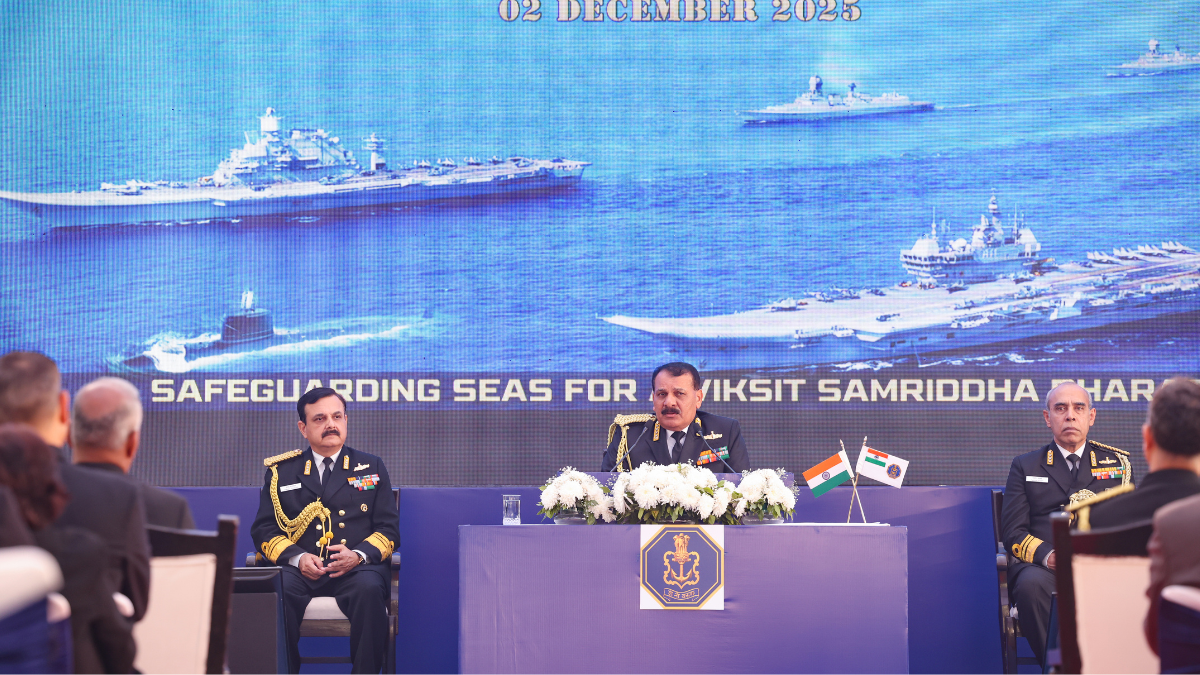
The Indian Navy will soon commission its third nuclear-powered ballistic missile submarine, Aridaman, Chief of Naval Staff Admiral Dinesh K Tripathi said on Tuesday, confirming that the submarine is in the final stages of trials.
Aridaman is the third vessel of the Arihant-class submarines. While declining to specify the exact date of commissioning, Admiral Tripathi said, “[INS] Arighaat was commissioned in August 2024. Aridaman will be commissioned soon.” The induction of the class began with INS Arihant, which completed its first deterrence patrol in 2018, marking India’s formal entry into the elite group of nations operating nuclear-powered ballistic missile submarines (SSBNs).
In addition to Aridaman, a fourth SSBN, designated as S-4, is expected to enter service in 2027. India’s SSBN fleet forms the backbone of the country’s nuclear triad, providing a credible sea-based nuclear deterrent.
On nuclear-powered attack submarines (SSNs), Admiral Tripathi said that large navies worldwide operate such platforms and that India is progressing with its own plans. “Last time the government had given approval to construct two SSNs indigenously. We are proceeding as per plan one year down the line. SSNs can’t be constructed overnight. We are doing it for the first time. So, it will happen sometime in the middle of the next decade,” he said. In the interim, India is likely to receive one SSN from a “friendly foreign partner” to bridge the capability gap.
India is expected to receive an Akula-class nuclear-powered attack submarine from Russia on a 10-year lease by 2027–28 for hunter-killer missions. The $3-billion agreement for the submarine was signed in March 2019, but deliveries were delayed due to disruptions caused by the Ukraine conflict.
Providing an update on naval aviation, Admiral Tripathi described the Twin-Engine Deck-Based Fighter (TEDBF) as a critical project for the Navy. “It is a 4++ generation aircraft that we want HAL to build. It is in an advanced stage of obtaining government approval,” he said.
On shipbuilding programmes, the Navy has received Acceptance of Necessity (AoN) for four Landing Platform Docks (LPDs) under the Indian-built category. “Processes are being compressed to save time and parallel actions are being pursued in line with the Ministry of Defence’s reform agenda,” the Admiral said. The LPDs are intended for amphibious operations, rapid troop deployment, disaster relief and expeditionary missions.
The Naval Utility Helicopter (NUH) programme has also received AoN, with discussions underway with Hindustan Aeronautics Limited for the acquisition of 60 helicopters. The NUH will replace ageing shipborne helicopters and will be used for surveillance, transport and search-and-rescue operations.
Admiral Tripathi said the P-75(I) conventional submarine programme has reached a very advanced stage of contract negotiations. “We are hopeful that the contract conclusion will follow soon. Once that is done, attention will shift back to P-75,” he said.
On propulsion indigenisation, he acknowledged India’s long-standing dependence on Ukraine’s Zorya-Mashproekt for marine gas turbines, which has exposed supply-chain vulnerabilities after the Ukraine conflict. “Propulsion is a key area for indigenisation. We are working on diesel, gas turbine and electric propulsion. For diesels, a Make-I project has been approved for Kirloskar to build a 4–6 MW engine with future upgrades. For gas turbines, an AIP case exists to develop 24–36 MW turbines and GT alternators. Bharat Forge is also working on a gas turbine project with Zorya of Ukraine. Multiple channels are in progress,” he said.
On the proposal for a second indigenous aircraft carrier, Admiral Tripathi said the matter is currently under consideration by the government.