


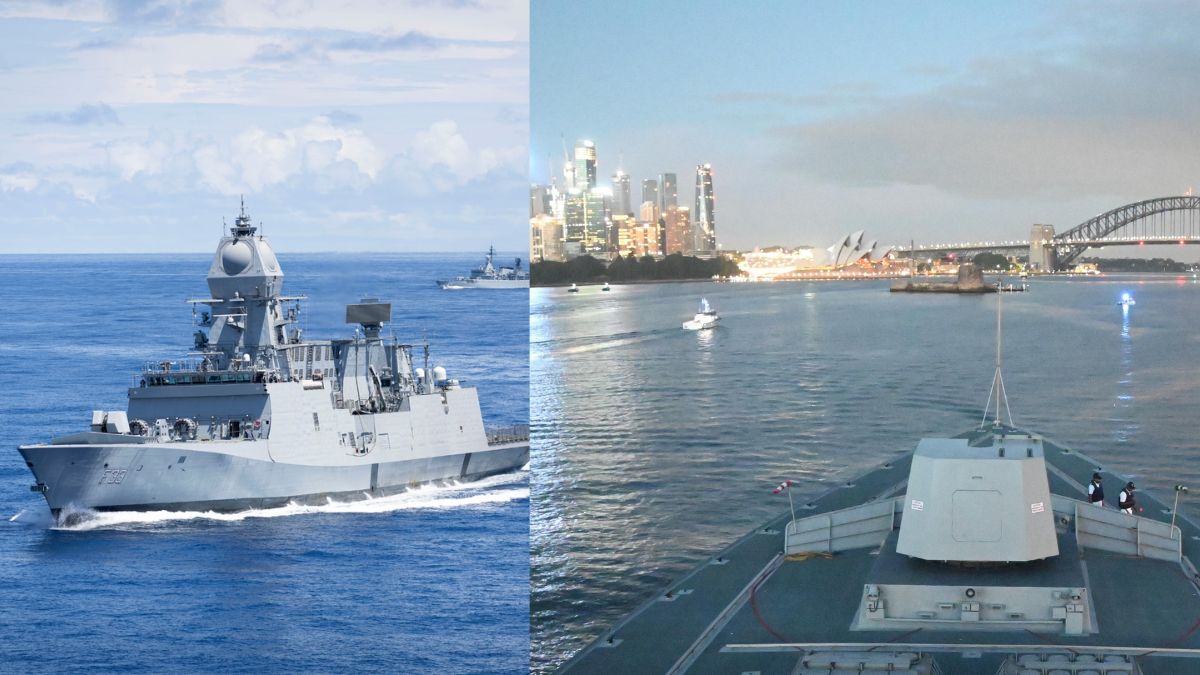
India’s indigenous stealth frigate INS Nilgiri has taken centre stage in Australia, participating in a high-profile International Fleet Review (IFR) in Sydney, a marquee event marking 125 years of the Royal Australian Navy (RAN). The frigate arrived in Sydney Harbour last week on March 21, 2026 for the Australian Navy event.
The deployment, following the successful completion of Phase I of Exercise Kakadu 2026, underscores India’s expanding naval footprint in the Indo-Pacific and its growing strategic alignment with key maritime partners. INS Nilgiri was on the overseas deployment to the Western Pacific during the Sea Phase I of Exercise Kakadu 2026.
With its participation in the naval drills, India and Australia marked further strengthening of naval interoperability, cooperation and maritime understanding amongst participating navies.
INS Nilgiri makes strategic entry into Sydney
The lead ship of India’s Project 17A stealth frigate class, INS Nilgiri arrived in Sydney on March 21, joining one of the largest gatherings of global naval forces in recent years. Its participation comes at a time when India is actively strengthening its maritime presence across the Western Pacific and southern hemisphere, signalling its intent to play a larger role in regional security.
The Sydney Fleet Review, hosted by the Royal Australian Navy, saw 31 warships from 19 nations, a ceremonial entry into Sydney Harbour, aerial displays by the Royal Australian Air Force, in addition to traditional naval gun salutes.
One of the largest such gatherings in over a decade, the IFR highlights collective commitment to open sea lanes, maritime stability, and rules-based order in the Indo-Pacific.
Exercise Kakadu 2026: Building interoperability at sea
INS Nilgiri’s visit is part of Exercise Kakadu 2026, the RAN’s premier biennial multinational maritime drill aimed at enhancing naval interoperability, joint operational capabilities, maritime security cooperation. During the exercise, representatives from 19 partner nations participated in a Fleet Commanders’ Conference, focusing on safeguarding trade routes and strengthening regional partnerships.
Rear Admiral Alok Ananda represented the Indian Navy at the conference, while Vice Admiral Sanjay Bhalla is leading the overall Indian delegation.
High-level engagements and diplomatic outreach
In a key diplomatic highlight, RAN Chief Vice Admiral Mark Hammond attended a reception hosted onboard INS Nilgiri, organised by the Indian High Commission in Australia. The event brought together naval chiefs and officers from multiple countries, along with members of the diplomatic corps and representatives from Australia’s political leadership.
Such engagements reflect the growing defence diplomacy dimension of India’s naval deployments.
Why INS Nilgiri’s deployment matters
INS Nilgiri’s participation is significant on multiple fronts as it showcases indigenous capability as the lead ship of Project 17A, thereby highlighting India’s advanced shipbuilding and stealth technology. It also boosts India-Australia ties, building on deepening defence cooperation between the two Quad partners.
Further, INS Nilgiri’s deployment also expands Indo-Pacific presence, reinforcing India’s role as a key security provider in the region; promotes multilateralism by demonstrating commitment to collaborative maritime security frameworks. The Indian Navy described the deployment as part of its broader vision to build a secure, cooperative, and rules-based maritime order.
A symbol of growing maritime partnerships
Interestingly, the Royal Australian Navy had earlier participated in India’s own International Fleet Review in Visakhapatnam this year, highlighting reciprocal engagement between the two navies. INS Nilgiri’s presence in Sydney now stands as a symbol of “mutual respect and acknowledgement” of the deepening India-Australia naval partnership.
As global strategic focus shifts towards the Indo-Pacific, such multilateral naval engagements are becoming critical. Fleet reviews, once wartime traditions, now serve as powerful platforms to showcase naval capabilities, build trust among partner nations, reinforce shared commitments to peace and stability.