


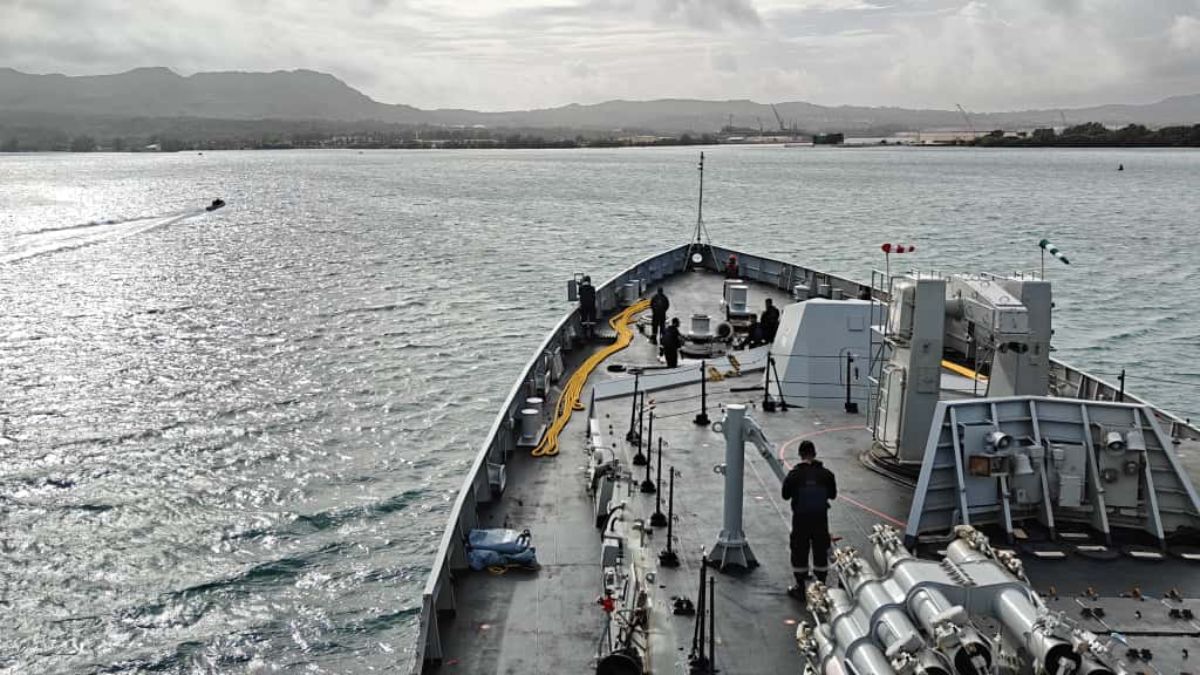
India’s indigenously built stealth frigate INS Sahyadri has arrived at Guam in the Northern Pacific Ocean to participate in Exercise Malabar 2025, a major multilateral naval exercise that underscores the deepening maritime cooperation among the Quad nations: India, the United States, Japan, and Australia.
The participation of INS Sahyadri highlights India’s strategic commitment to the Indo-Pacific and its growing emphasis on maritime security and interoperability with partner navies.
What would Sahyadri warship do in Guam?
The Indian Navy said on November 9, 2025, that Sahyadri’s presence at the exercise reaffirms New Delhi’s resolve to safeguard regional peace and stability, while enhancing operational synergy with like-minded maritime powers.
Built indigenously under the Aatmanirbhar Bharat (self-reliant India) initiative, INS Sahyadri is a state-of-the-art Shivalik-class guided missile stealth frigate designed and constructed by Indian shipyards.
The vessel represents the cutting edge of India’s shipbuilding capabilities, featuring advanced stealth technology, sophisticated sensors, and multi-role combat systems capable of engaging threats from air, surface, and underwater domains.
Over the years, Sahyadri has been an active participant in several bilateral and multilateral exercises and operational deployments across the Indian Ocean and beyond. Its inclusion in Malabar 2025 is a testament to the ship’s operational versatility and the Indian Navy’s expanding blue-water capabilities.
What will the Quad nations do during Malabar exercise?
The Harbour Phase of Exercise Malabar 2025 will focus on operational planning sessions, coordination meetings, and discussions on communication protocols among participating navies.
These interactions aim to refine the command and control architecture and ensure seamless communication during complex multinational missions. The harbour phase will also include familiarisation visits and sports events, fostering camaraderie and mutual understanding among sailors from the four Quad navies.
Following the harbour engagements, the participating ships and aircraft will proceed to the Sea Phase, where high-tempo joint drills will be conducted. These will include anti-submarine warfare (ASW) exercises, gunnery serials, cross-deck helicopter operations, and coordinated fleet manoeuvres. The sea phase is designed to enhance interoperability, tactical coordination, and joint operational proficiency among the participating forces.
Is China the focus of the Quad’s maritime war games in the Indo-Pacific?
The Quad’s increasing maritime focus in recent years is largely driven by concerns over China’s growing assertiveness across the Indo-Pacific, particularly in the South China Sea and Western Pacific.
Beijing’s expansive territorial claims, militarisation of disputed islands, and use of coercive tactics against smaller littoral states have prompted the four Quad nations to deepen their maritime cooperation through high-end naval exercises like Malabar.
The exercise not only enhances operational interoperability but also sends a strategic message about the Quad’s collective commitment to freedom of navigation, respect for international law, and the protection of maritime commons.
While the Quad avoids explicitly framing its agenda as anti-China, its emphasis on coordinated deterrence, maritime domain awareness, and secure sea lanes underscores a unified response to counterbalance China’s influence and maintain a free, open, and rules-based Indo-Pacific order.
What is Malabar exercise’s history?
Exercise Malabar, which began in 1992 as a bilateral India-US exercise, has evolved into one of the most significant multilateral naval engagements in the Indo-Pacific.
The inclusion of Japan in 2015 and Australia in 2020 transformed it into a central element of Quad naval cooperation, reflecting the shared vision of a free, open, and rules-based Indo-Pacific.
This year’s edition, being held in Guam, carries strategic significance amid evolving regional security dynamics, including the rise of grey-zone challenges, freedom of navigation concerns, and increasing militarisation in contested waters.
The exercise serves as a visible demonstration of the Quad’s commitment to maintaining peace, stability, and the rule of law in the Indo-Pacific maritime domain.
What does INS Sahyadri’s participation in Malabar exercise mean?
Through INS Sahyadri’s participation, India not only showcases its indigenous defence prowess but also reiterates its determination to uphold collective maritime security in partnership with regional allies.
As the Indo-Pacific continues to shape the 21st-century security landscape, exercises like Malabar remain vital to strengthening trust, coordination, and deterrence among democratic maritime powers.