


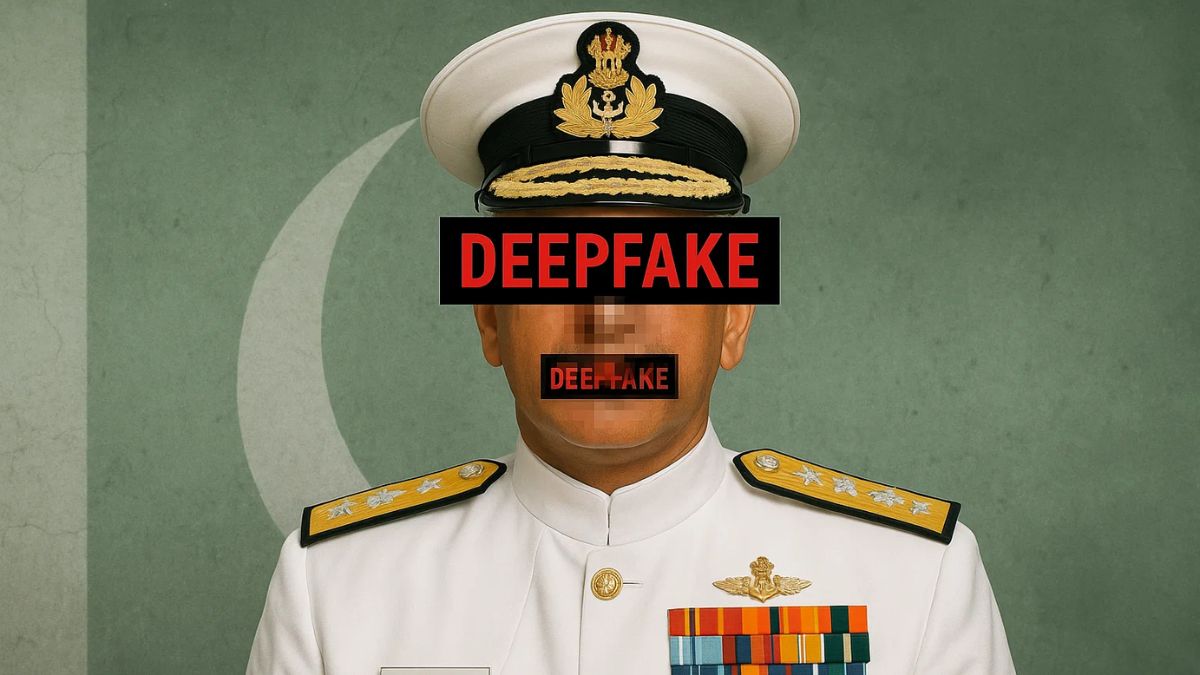
Warfare evolves quietly — and often before the battlefield notices. In South Asia today, the transformation is unfolding not in the waters of the Arabian Sea, but across social networks, AI labs and disinformation channels. Pakistan’s recent use of deepfakes, doctored missile videos and exaggerated naval capability claims marks an unsettling expansion of maritime competition into the cognitive domain.
This new front is not about tonnage or missile range alone. It is about perception, plausibility and public trust — a contest in which the mind is targeted before the missile, and narratives sail faster than ships.
What are the recent deepfake attacks and why do they matter?
A viral video recently impersonated India’s Chief of Naval Staff, Admiral Dinesh Kumar Tripathi (initial reference), portraying him criticising the government and acknowledging fictional operational losses. Analysis by the Deepfakes Analysis Unit (DAU) concluded that while opening visuals were real, the audio was AI-generated, stitched onto authentic footage using voice-clone synthesis. The inconsistencies — altered backdrop edges, mismatched lip patterns, unstable insignia — confirmed fabrication.
Another manipulated clip targeted the Director General Naval Operations (DGNO), insinuating disagreement over operational decisions during a standoff. The content was later assessed as digitally altered, reinforcing a pattern of attacks aimed at authority and internal confidence.
Such efforts are not satirical or harmless. They amount to cognitive warfare — an attempt to fracture trust within military institutions and influence public sentiment during high tension.
How is Pakistan framing digital fiction as maritime strength?
Soon after Pakistan announced a test launch of its P-282 ship-launched anti-ship ballistic missile (ASBM), the official note lacked telemetry, seeker details, range confirmation or footage credibility markers. Yet Pakistan-aligned digital networks quickly circulated enhanced clips claiming “800 km hypersonic strike capability,” “carrier-killer reach,” and even “South Asia’s first ship-fired hypersonic missile.” These claims did not originate in official statements.
Separately, during a public briefing, the Pakistan Navy showcased a photograph later identified as digitally altered from a 2023 China–Pakistan exercise. A submarine was digitally inserted to suggest stronger deployment than actually occurred — an image subsequently exposed by Indian media investigations.
This strategy is deliberate: official ambiguity enables an informal network of amplifiers to inflate capability without accountability. The result is a perception-layer navy — an “AI Navy” operating on social feeds, compensating for operational constraints at sea.
Can misinformation shape real-world crisis outcomes?
It can — and that is where risk grows. Navies depend on clear command chains, fast decision loops and trust. Synthetic videos can distort this information architecture.
In recent months, manipulated videos of Chief of Defence Staff General Anil Chauhan (initial reference) and External Affairs Minister Subrahmanyam Jaishankar surfaced online, both later confirmed fake through official fact-checks. In the wrong moment, such fabrications can inflame public opinion, inject doubt among decision-makers, or trigger escalatory rhetoric before verification catches up.
A deepfake admiral accusing government failure could dent morale. A forged missile-strike video could provoke retaliatory pressure. The first casualty of disinformation is clarity — and clarity is the currency of crisis management.
As several Western and Indo-Pacific militaries now acknowledge, deepfake-enabled deception is no longer fringe propaganda. It is a strategic tool.
What must India do to secure both the seas and the narrative?
India retains clear maritime advantage — from carrier-battle-group reach to sustained deployment capability across the Indian Ocean. Pakistan’s naval posture remains closely tied to Karachi-adjacent waters, with documented maintenance challenges and limited long-range visibility.
- But superiority at sea must be matched by superiority online.
- Strengthening resilience will require:
- A rapid response media-verification cell with authority to debunk deepfakes in minutes.
- Secure audio-visual authentication for senior military communications.
- Collaboration with technology platforms and fact-check ecosystems to identify synthetic media early.
- Training naval personnel and the public to recognise manipulated content.
- Integrating counter-information doctrine into crisis planning, alongside kinetic strategy.
- Presence at sea deters aggression. Presence in the information space deters perception warfare.
Pakistan’s turn towards deepfakes, edited missile launches and synthetic naval victories is a unique kind of threat. If tomorrow’s escalation begins with a pixel instead of a projectile, the navy that controls truth may have as much advantage as the one that controls the ocean. India must prepare to defend both.