


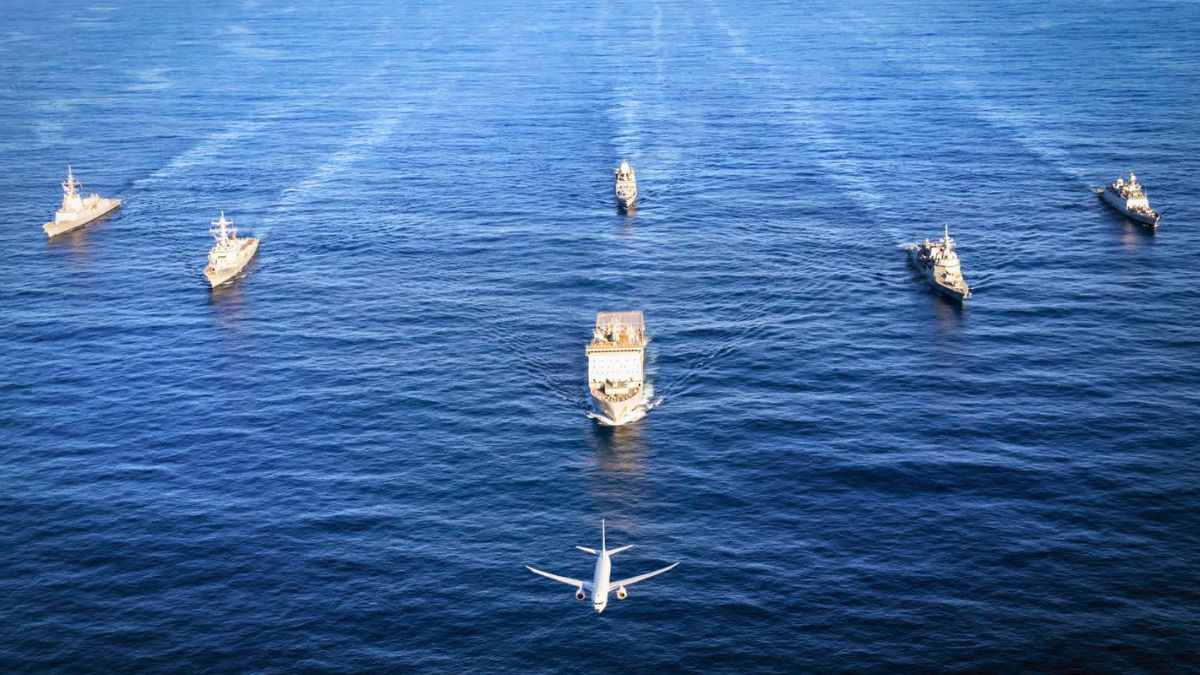
In a significant demonstration of maritime unity, the Australian Department of Defence announced on Wednesday (November 12, 2025) that Australia has officially joined India, Japan, and the United States for Exercise Malabar 2025, confirming the full participation of the QUAD partners.
The exercise, scheduled from November 10 to 18, is taking place in the West Pacific training area near Guam, with India’s INS Sahyadri, a guided-missile stealth frigate, already docked there for the high-profile naval engagement.


India’s participation in Exercise Malabar-2025 “reaffirms the country’s enduring partnership and its collective resolve to safeguard regional security.” The drill, hosted this year at Guam, will involve both harbour and sea phases, bringing together naval assets and personnel from multiple countries to conduct advanced maritime operations.


Exercise Malabar 2025: QUAD navies set sail
Australia’s defence ministry informed that the Royal Australian Navy’s (RAN) Anzac-class frigate HMAS Ballarat and a RAAF P-8A Poseidon maritime patrol aircraft will take part in this year’s QUAD naval drills, alongside advanced warships, submarines, and aircraft from the Indian Navy, U.S. Navy, and Japan Maritime Self-Defense Force (JMSDF).

Australia’s Chief of Joint Operations, Vice Admiral Justin Jones, underscored the strategic importance of the exercise, saying, “Through Exercise Malabar, Australia and partner nations are strengthening Indo-Pacific security by tackling shared challenges, coordinating collective strength, and closing gaps in global engagement.”

Malabar 2025: How will the naval drills proceed?
Exercise Malabar 2025 is structured in two phases – Harbour Phase (Nov 10–12), which includes operational planning, inter-navy briefings, sports interactions, and coordination drills; and Sea Phase (Nov 13–17), which would involve complex naval operations including anti-submarine warfare, air defence, joint fleet manoeuvres, and replenishment at sea, culminating in the closing ceremony on November 18.
Indian Naval Ship (INS) Sahyadri already reached Guam in the Northern Pacific on Monday (November 10, 2025) to participate in the multilateral Exercise Malabar 2025. Indigenously designed and constructed under the Aatmanirbhar Bharat initiative, the ship stands as a testament to India’s growing naval self-reliance and its ability to contribute meaningfully to multinational operations.

Why Exercise Malabar matters: A message of maritime unity?
Exercise Malabar has evolved from a bilateral India–US naval drill in 1992 into a premier multilateral maritime engagement that embodies the spirit of the QUAD. Japan joined permanently in 2015, and Australia became a full member in 2020, completing the strategic four-nation grouping.

As maritime tensions in the Indo-Pacific rise, particularly amid China’s expanding naval assertiveness, the exercise carries significant geopolitical weight. While Beijing has often viewed the QUAD as a counterbalance to its influence, the participating nations emphasise that the grouping aims to ensure freedom of navigation, maritime security, and a rules-based international order.
Meanwhile, the Malabar 2025 drills mark a deepening of strategic convergence among QUAD nations, reinforcing shared priorities such as stability, transparency, and open sea lanes in the Indo-Pacific. The exercise also reflects the QUAD’s growing maturity, from an informal dialogue to a tangible framework for collective security and deterrence.