


Bangladesh’s Election Commission has announced February 12, 2026, as the date for the country’s next general election. For the interim administration led by Muhammad Yunus, the declaration was intended to convey momentum and direction after a year of political upheaval. Instead, it has reinforced a more uncomfortable reality: elections declared amid sustained unrest do not, by themselves, restore order or legitimacy.
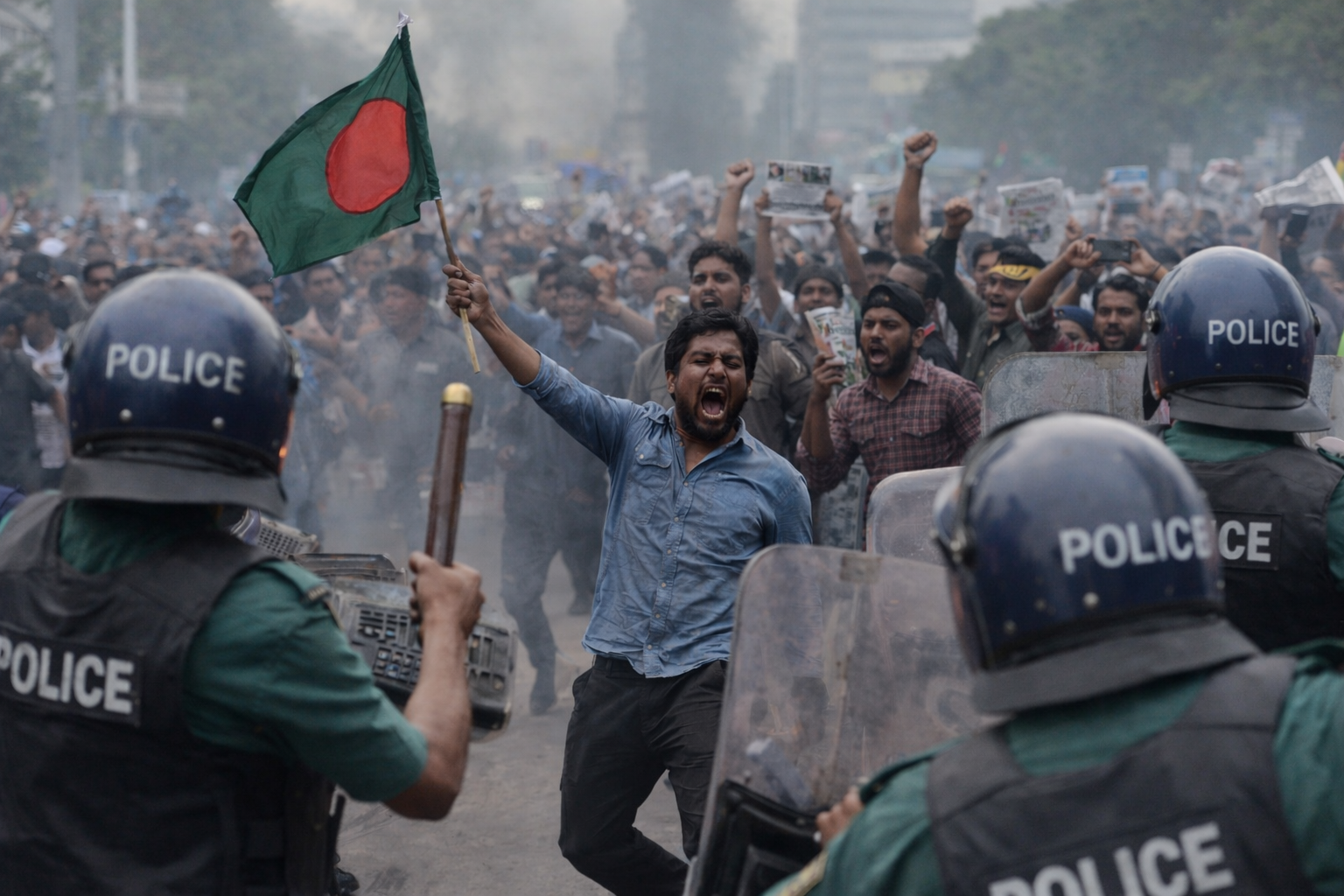
Over the past year, Bangladesh has witnessed a steady escalation in political violence, street mobilisation, and communal tension. The announcement of a polling date has not interrupted these trends. If anything, it has exposed the limits of procedural fixes in the absence of institutional authority and public trust.
An Election Date Without Political Consensus
The path to the February 2026 announcement was shaped less by internal agreement than by sustained pressure on an interim government accused of prolonging transition. Even then, the declaration came with significant conditions. The election is now linked to a broad reform agenda, including a constitutional referendum to be conducted alongside the vote.
This sequencing carries risks. Reform, originally cited as the justification for delaying elections, has been repositioned as a prerequisite for participation. Voters are being asked to endorse structural changes while the political environment remains unsettled and the rules of competition are contested. In a volatile setting, such ambiguity deepens scepticism rather than reassurance.
Political Exclusion And Its Consequences
The Election Commission’s decision to bar the Awami League from contesting the election has further complicated the landscape. Whatever the party’s past record, excluding one of Bangladesh’s two dominant political forces fundamentally alters the character of the contest.
Political exclusion has rarely produced stability in Bangladesh’s history. More often, it has driven boycotts, parallel mobilisation, and street confrontation. An election that proceeds without meaningful participation from a major political constituency risks being perceived as managed rather than representative, prolonging contestation beyond polling day.
Street Mobilisation And Eroding Public Order
The broader security environment remains fragile. Student groups that played a central role in the 2024 uprising have not demobilised. Protests following the killing of youth movement leaders have repeatedly escalated into clashes with security forces. In several cases, demonstrators have breached sensitive state spaces, signalling weakened deterrence.
Alongside political unrest, social violence has intensified. The past year has seen mob lynchings of minority citizens accused of blasphemy, attacks on religious neighbourhoods, and the torching of major newspaper offices during protests. These incidents point to a prolonged governance vacuum in which enforcement has become inconsistent and selective.
Regional And International Implications
Bangladesh’s instability is no longer viewed as a purely domestic issue. Neighbouring states have adopted a more cautious diplomatic posture, while international partners have raised concerns about minority safety, electoral credibility, and the durability of any post-election settlement.
An election perceived as lacking neutrality or inclusiveness is unlikely to resolve these anxieties. Instead, it risks extending uncertainty into 2026, complicating regional engagement and security coordination at a time when South Asia is already under strain.
Process Cannot Replace Trust
A date on the calendar cannot substitute for institutional credibility. Elections stabilise societies when they are embedded in trust—trust in the Election Commission, trust in enforcement, and trust that political competition is bounded by rules applied evenly.
Absent visible steps to restore neutrality, particularly within electoral and security institutions, February 2026 risks becoming a procedural milestone rather than a stabilising one. For Bangladesh, and for regional security, the costs of such an outcome would extend well beyond polling day.
The challenge facing Dhaka is therefore not merely to conduct an election, but to rebuild the conditions under which an election can plausibly serve its intended purpose.