


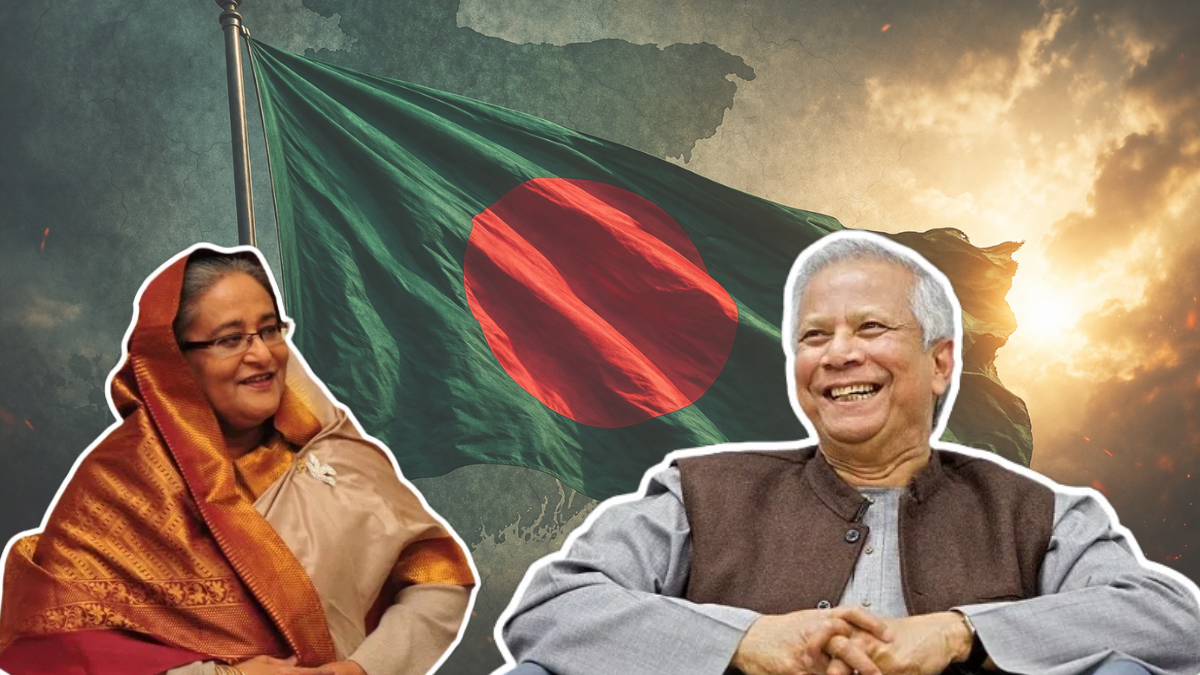
The political turmoil that culminated on August 5, 2024, represented one of the most significant disruptions in the contemporary political history of Bangladesh.
Following weeks of protests led by students that initially sought reform of the government job quota system, demonstrations escalated into a nationwide uprising that led to the resignation of Prime Minister Sheikh Hasina.
In the face of escalating unrest, Hasina left the country. In the immediate wake of the government’s collapse, Bangladesh entered a phase marred by substantial political ambiguity.
To oversee the transitional process and prepare the nation for forthcoming elections, an interim government presided over by Nobel laureate economist Muhammad Yunus was instituted.
On August 8, 2024, Yunus was inaugurated as the Chief Adviser of the interim administration, thereby assuming executive authority during what was projected to be a temporary transitional phase.
The declared mandate of the interim government was to restore stability, ensure accountability for the violence that transpired during the uprising, initiate systemic reforms, and direct the country toward credible democratic elections.
Nonetheless, the 18-month duration of the Yunus administration rapidly evolved into a matter of considerable controversy.
While the government managed to avert the immediate fall of state institutions, critics argue that the transitional period experienced intensified political polarisation, rising insecurity, and increasing frictions within Bangladesh’s constitutional framework.
From the outset, the legal underpinnings of the Yunus administration remained contentious. Legal scholars consistently observed that the Constitution of Bangladesh lacks provisions that endorse such an interim executive arrangement outside the established parliamentary structure.
As a result, the Yunus administration operated within what many observers characterised as a constitutional grey area, engendering concerns regarding the legitimacy of its authority and the precedent it set for extra-constitutional governance.
Political tensions surrounding the presidency became particularly visible on October 22, 2024, when protesters marched toward Bangabhaban, the official residence of the President.
The demonstration was organised by the Students Against Discrimination, a student-led coalition that had played a central role in the protests that led to the fall of the Hasina government.
Earlier that afternoon, the movement held a rally at Central Shaheed Minar, where its leaders announced a series of demands.
These included the resignation of President Shahabuddin, the banning of the Bangladesh Chhatra League, and the abolition of the existing constitutional framework in favor of drafting a new charter reflecting the ideals of the July–August uprising.
Later that evening, thousands of demonstrators convened and advanced towards Bangabhaban, encircling the presidential compound whilst vociferously articulating their demands for the President’s immediate resignation.
In response, security forces alongside military personnel established barricades surrounding the palace to thwart the incursion of protesters into the premises, culminating in a protracted and tense standoff that endured for several hours.
Shahabuddin subsequently characterised the incident as a component of a broader attempt to oust him from his position through unconstitutional means. The President asserted that the armed forces intervened to uphold public order and safeguard constitutional continuity amidst the crisis.
Prominent figures of the Bangladesh Nationalist Party (BNP), including its chairman Tarique Rahman, expressed their support for safeguarding the constitutional integrity during this period of political instability.
In the months that followed, President Mohammed Shahabuddin publicly described these developments as part of a broader pattern of institutional strain during the interim administration.
Shahabuddin subsequently contended that the Yunus administration systematically circumvented constitutional protocols and failed to uphold sufficient institutional communication with the head of state.
According to Shahabuddin, the interim government regularly promulgated ordinances and administrative directives without prior consultation with the presidency, notwithstanding constitutional anticipations that the chief adviser would keep the President apprised of significant decisions.
In an interview with a Bangladeshi publication, the President articulated that Yunus undertook international travel on numerous occasions throughout his tenure, yet never provided him with a debriefing upon his return from these excursions.
Such debriefings, he asserted, were not merely ceremonial but constituted an established practice designed to ensure transparency and coordination between the executive authority and the constitutional head of state.
The President further asserted that the Yunus administration attempted to marginalise the presidency in both symbolic and practical dimensions.
President Shahabuddin alleged that he was obstructed from undertaking specific official visits abroad and was dissuaded from participating in public events traditionally associated with the presidency, including university convocations and ceremonial assemblies.
In one instance, he recounted that the foreign ministry drafted a letter on his behalf declining an invitation from Qatar without prior consultation and subsequently solicited his signature on it.
He additionally condemned the removal of presidential portraits from Bangladeshi diplomatic missions abroad, characterising the action as an unprecedented measure that eroded the dignity of the office and the symbolic continuity of the state.
President Mohammed Shahabuddin also mentioned that he had not received any notification regarding the latest tariff agreement between Bangladesh and the United States, emphasising that Muhammad Yunus did not provide him with a briefing, either orally or in written form, despite such communication being a constitutional responsibility.
Furthermore, he expressed regret that although the interim government was established at his behest, the chief adviser subsequently failed to uphold institutional coordination with the presidency.
Beyond institutional conflicts at the apex of governmental authority, the interim timeframe was characterised by more pervasive challenges to the rule of law and social order.
From August 2024 through late 2025, analysts documented a noticeable increase in incidents of collective violence and the phenomenon of “mob justice,” particularly in regions where the authority of law enforcement had weakened after the political turmoil.
The assaults on communal spaces, places of worship, and cultural gatherings generated widespread concern regarding public safety.
Although the interim administration launched investigations into offenses committed during the repression of the July uprising, the slow progress in ensuring justice raised serious concerns about the effectiveness of the legal process and created the perception that accountability was influenced by political considerations, thereby eroding public confidence in democratic institutions.
Since then, questions regarding the legitimacy of the Yunus administration became increasingly pronounced as the interim period unfolded.
Thus, critics maintained, notwithstanding its provisional mandate, the administration executed several significant policy initiatives, encompassing international accords and constitutional reforms that are conventionally within the purview of a democratically elected government.
Parliamentary elections were ultimately conducted on February 12, 2026, and although the results were broadly acknowledged, the electoral process remained contentious due to the absence of participation by the Awami League.
The announcement of the election results was soon followed by additional controversy concerning the actions of the interim administration and its senior officials.
Reports suggested that Faiz Ahmad Taiyeb, an associate of Muhammad Yunus connected with the International Crimes Tribunal and telecommunications matters, abruptly departed Bangladesh for Germany shortly after the electoral process.
This sudden exit ignited speculation among political circles that members of the interim government were pursuing purported “safe exits,” considering increasing scrutiny regarding their conduct while in office.
These discussions escalated when Yunus himself departed Bangladesh shortly after the transfer of power to the newly elected administration.
Although the overseas visit was officially characterised as a routine engagement, critics argued that the timing bolstered perceptions that the interim leadership aimed to distance itself from the political ramifications of its contentious tenure.
In a retrospective analysis, the juxtaposition of the interim governance of Muhammad Yunus with the administration of former Prime Minister Sheikh Hasina has emerged as a compelling element within Bangladesh’s political discourse.
Despite facing critiques regarding an increasingly centralised governance structure in her later years, Hasina oversaw a significant period characterised by remarkable economic advancement, infrastructural development, and enhancements in social indicators, all while executing a pragmatic foreign policy that adeptly balanced relations with both India and China.
This strategic approach strengthened Bangladesh’s ability to attract foreign investment and sustain developmental progress.
In stark contrast, the Yunus-led interim administration engendered unnecessary geopolitical volatility, particularly through its diplomatic outreach towards Pakistan, which was perceived by many as politically insensitive considering the enduring historical memory surrounding the Bangladesh Liberation War.
As the newly inaugurated government under the leadership of Tarique Rahman took office, the imperative for Dhaka would be to restore institutional stability while reaffirming a balanced and pragmatic regional diplomatic stance.
Within this framework, fortifying relations with India may emerge as a particularly salient objective.
From the liberation struggle of 1971 to subsequent decades marked by economic collaboration and humanitarian assistance, India has consistently exhibited diplomatic goodwill toward Bangladesh.
A stable and cooperative partnership between Dhaka and New Delhi has the potential to advance regional economic integration, enhance connectivity, and foster political stability throughout South Asia.
Following a tumultuous transitional phase characterised by constitutional ambiguity and institutional strain, the reaffirmation of this bilateral relationship may offer Bangladesh a viable pathway toward renewed stability, democratic resilience, and sustained developmental progress.